

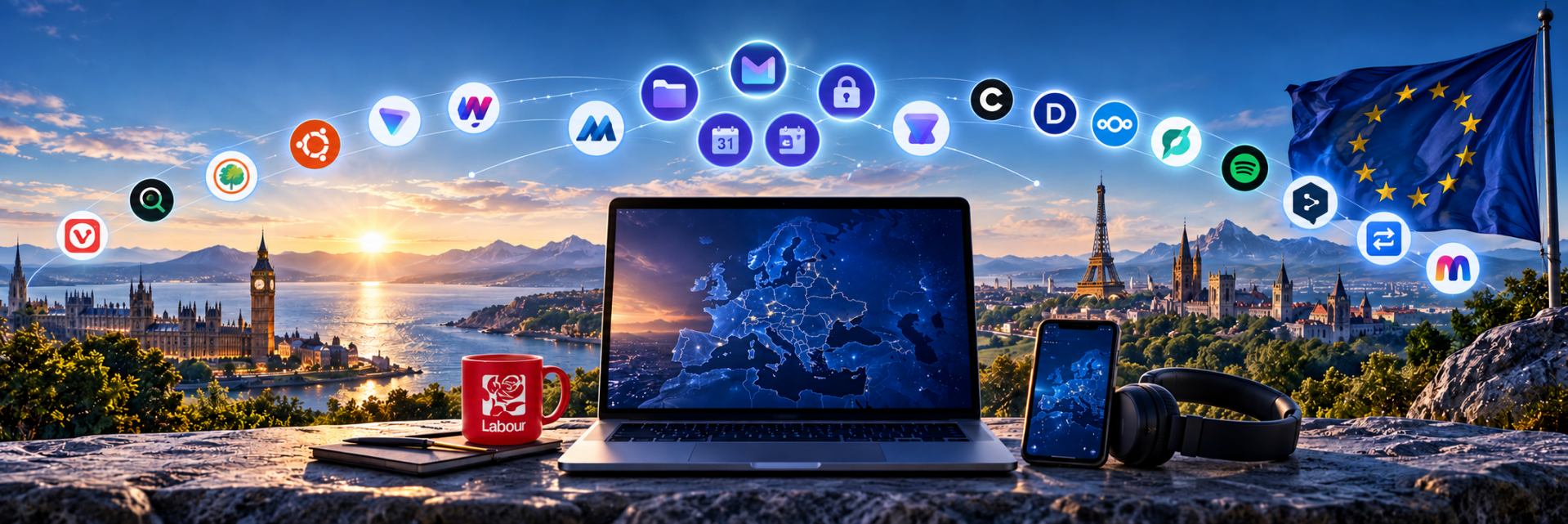
My European Technology Stack: Everyday Alternatives to American Technology
Why I Chose European Technology
American technology companies dominate much of our digital lives, from email, search engines and smartphones to artificial intelligence, social media and cloud storage. However, the United Kingdom and Europe have developed an impressive range of alternatives that deserve greater recognition.
My decision to move towards European technology is also driven by concerns about privacy, government surveillance and the legal powers available to American authorities. The US CLOUD Act of 2018 allows American authorities, through lawful legal processes, to require companies subject to US jurisdiction to disclose data under their control, even when that information is stored outside the United States.
These concerns are reinforced by the 2013 disclosures of former US intelligence contractor Edward Snowden, which exposed extensive surveillance activities conducted by the US National Security Agency (NSA). The leaked documents revealed programmes including PRISM, through which American intelligence agencies obtained communications data from major technology providers, raising serious questions about privacy, oversight and the extent of government access to personal information.
For me, these documented controversies highlight the importance of reducing dependence on American technology companies and strengthening European digital sovereignty. Although European services are not automatically immune from surveillance or foreign legal obligations, choosing providers with European ownership, infrastructure and strong privacy protections can offer greater control over personal information.
I have spent time exploring these technologies and selecting those I believe offer the best practical alternatives for everyday use. My aim is not to suggest that every American product can be replaced without compromise, but to demonstrate how much of our digital lives can already be supported by UK and European technology.
These are my personal selections, chosen for their usability, privacy, security and reliability. Some are well established, while others are still developing. I believe supporting these alternatives is an important step towards greater technological independence, consumer choice and a more competitive European digital economy.
Privacy, Email and Personal Security
Proton — Switzerland 🇨🇭
Alternatives to Gmail, Outlook, Google Drive, OneDrive and other American services.
Proton forms the foundation of my European technology stack. My six preferred services are Proton Mail, Proton VPN, Proton Drive, Proton Authenticator, Proton Pass and Proton Calendar.
Together, they provide encrypted email, internet privacy, cloud storage for photographs and documents, password management, two-factor authentication and calendar functionality.
I particularly value having these essential services within one privacy-focused European ecosystem.
Link: https://proton.me/
Artificial Intelligence
Mistral AI — France 🇫🇷
Alternative to ChatGPT, Google Gemini and Microsoft Copilot.
Mistral is my preferred European artificial intelligence provider. Its AI assistant offers conversational assistance, writing, research, information analysis and everyday productivity features.
It demonstrates that Europe can develop competitive artificial intelligence technology rather than relying entirely on American companies.
Link: https://chat.mistral.ai/
Search Engines
Mojeek — United Kingdom 🇬🇧
Alternative to Google and Bing.
Mojeek is a British search engine with its own independent web index. This is particularly important because many alternative search engines still depend on results supplied by larger American companies.
Its independent approach makes it a valuable part of Europe's digital technology ecosystem.
Link: https://www.mojeek.com/
Ecosia — Germany 🇩🇪
Alternative to Google and Bing.
Ecosia is a German search engine that uses its revenue to support environmental projects, including tree planting and ecosystem restoration.
It provides a familiar search experience while supporting Ecological restoration, although some search results still depend on external technology partners.
Link: https://www.ecosia.org/
Web Browsers
Vivaldi — Norway 🇳🇴
Alternative to Google Chrome and Microsoft Edge.
Vivaldi is a Norwegian browser known for its customization features, built-in productivity tools and emphasis on user control.
It is particularly suitable for people who want a feature-rich browser without depending on Google's own browser.
Link: https://vivaldi.com/
Private Messaging and Video Meetings
Olvid — France 🇫🇷
Alternative to WhatsApp and Facebook Messenger.
Olvid is my preferred European private messaging application. It provides end-to-end encrypted communication without requiring a telephone number or email address to create an identity.
Its QR code method allows secure face-to-face contact addition while still supporting remote link sharing—making it ideal for everyday private communication.
Link: https://olvid.io/
Proton Meet — Switzerland 🇨🇭
Alternative to Zoom, Google Meet and Microsoft Teams.
Proton Meet provides privacy-focused video meetings within the Proton ecosystem. It offers an alternative for people who want secure video conversations without relying on American conferencing platforms.
Link: https://proton.me/meet
Office Productivity
Collabora Office — United Kingdom 🇬🇧
Alternative to Microsoft Office and Google Docs.
Collabora Office provides document editing, spreadsheets and presentations using open-source technology.
It supports familiar office file formats and offers an alternative for people who want to create and edit documents without depending on Microsoft or Google.
Link: https://www.collaboraoffice.com/
Computers and Operating Systems
Ubuntu — United Kingdom 🇬🇧
Alternative to Microsoft Windows.
Ubuntu is a widely established Linux operating system developed by Canonical, a British company.
It provides a complete desktop environment for browsing, productivity, communication and everyday computing, with access to a large selection of free and open-source applications.
Link: https://ubuntu.com/desktop
Smartphones
Fairphone — Netherlands 🇳🇱
Alternative to Apple iPhone and Google Pixel.
Fairphone is a Dutch smartphone manufacturer that emphasises repairability, longer product lifespans and more responsible electronics manufacturing.
Its approach challenges the disposable nature of much of the smartphone industry and provides a distinctive European hardware alternative.
Link: https://www.fairphone.com/
Jolla — Finland 🇫🇮
Alternative to Apple and Google smartphone ecosystems.
Jolla is a Finnish technology company developing smartphones and mobile software around Sailfish OS.
Its products represent an important effort to maintain a European mobile technology ecosystem independent of the dominant American platforms.
Link: https://jolla.com/
Mobile Operating Systems
/e/OS — France 🇫🇷
Alternative to Google's version of Android.
/e/OS is a privacy-focused mobile operating system developed by the French /e/ Foundation.
It is designed to reduce dependence on Google services while retaining compatibility with many Android applications. It can be used on supported smartphones, including selected Fairphone models.
Link: https://e.foundation/
Sailfish OS — Finland 🇫🇮
Alternative to Android and iOS.
Sailfish OS is a Finnish mobile operating system developed by Jolla.
It offers a distinctive smartphone experience and greater independence from Google and Apple, although application compatibility and supported devices remain important considerations.
Link: https://sailfishos.org/
Maps and Navigation
HERE WeGo — Netherlands 🇳🇱
Alternative to Google Maps and Apple Maps.
HERE WeGo provides maps, route planning, driving directions and navigation.
Its European origins and established mapping technology make it a practical alternative for everyday journeys, particularly for people looking to reduce their dependence on Google Maps.
Link: https://wego.here.com/
Music Streaming
Spotify — Sweden 🇸🇪
Alternative to Apple Music and YouTube Music.
Spotify is one of Europe's most successful consumer technology services, offering music streaming, podcasts and personalised recommendations.
Its international popularity demonstrates that European digital services can compete successfully with major American technology companies.
Link: https://www.spotify.com/
Translation
DeepL — Germany 🇩🇪
Alternative to Google Translate.
DeepL is a German artificial intelligence translation service offering translations across numerous languages.
It is particularly useful for translating documents, articles and everyday communications, and has become a well-established European alternative to Google's translation services.
Link: https://www.deepl.com/
Large-File Sharing
SwissTransfer — Switzerland 🇨🇭
Alternative to American cloud file-sharing services.
SwissTransfer, provided by Swiss hosting company Infomaniak, allows users to send large files through a straightforward web interface.
It is particularly useful when sharing files that are too large for conventional email attachments.
Link: https://www.swisstransfer.com/
Website Building and Hosting
Webador — Netherlands 🇳🇱
Alternative to Wix and Squarespace.
Webador is my preferred European website-building and hosting platform. I use it to create, publish and maintain my own research website.
Its straightforward editor makes it possible to build and update a website without programming knowledge or complicated technical arrangements.
For individuals, researchers, bloggers and small organisations, I consider Webador an excellent European alternative to American website-building services.
Link: https://www.webador.com/
Social Media
WSocial — Sweden 🇸🇪
Alternative to X and Bluesky.
WSocial is a developing European social networking platform designed to provide an alternative to established social media networks.
Its European identity and ambitions for a more independent social media ecosystem make it the perfect option, although expanding its user community will be essential to its long-term success.
WSocial is my personal preference over X.
Link: https://wsocial.eu/
Monnett — Luxembourg 🇱🇺
Alternative to Instagram.
Monnett is a European social networking platform supporting photo sharing, videos and social interaction.
Although considerably less established than Instagram, it offers an alternative for people interested in supporting European social media services.
Its biggest challenge is attracting a sufficiently large and active community.
Link: https://monnett.social/
Video Sharing and Entertainment
Dailymotion — France 🇫🇷
Alternative to YouTube and TikTok.
Dailymotion is a French video-sharing platform offering news, entertainment, short-form videos and content from publishers and creators.
It provides a practical European alternative, although its international recognition, creator community and content selection remain smaller than those of YouTube and TikTok.
Link: https://www.dailymotion.com/
What Is Still Missing from European Technology?
Despite the impressive range of alternatives already available, Europe still faces several important challenges.
1. Social Media Audiences
Services such as WSocial and Monnett need much larger international audiences to compete effectively with established American platforms.
Even when an alternative offers comparable features, persuading people to move away from networks where their friends, family and favourite creators already participate remains difficult.
2. Video Platforms and Content Availability
Dailymotion demonstrates that Europe can provide a credible video-sharing platform. However, it needs greater recognition, broader content availability and stronger creator participation to become a more comprehensive alternative to YouTube and TikTok.
3. Smartphones and Application Compatibility
Fairphone, Jolla, /e/OS and Sailfish OS represent important European alternatives, but smartphone independence remains challenging.
Many essential applications, including banking, transport, government and entertainment services, are developed primarily for Android and iOS.
4. Dependence on American Infrastructure
European ownership does not automatically mean technological independence.
Some European services still depend on American cloud providers, software components, browser engines, artificial intelligence infrastructure or mobile application ecosystems.
Reducing these dependencies will require continued investment in European infrastructure and technology development.
5. Awareness and Accessibility
Perhaps the greatest challenge is public awareness.
Many people are unfamiliar with the European alternatives already available, even when those services offer comparable features and straightforward everyday use.
Clearer information, better compatibility and easier switching between platforms would make European technology more accessible.
Conclusion
Exploring these services has strengthened my view that UK and European technology already provides credible alternatives to much of the American technology used in everyday life.
My selections are not intended to suggest that every European product is superior in every respect. Some are mature, internationally successful services, while others are still developing their capabilities and communities.
Nevertheless, I believe they demonstrate that choosing European technology is increasingly practical.
The challenge now is to improve the remaining gaps, increase public awareness and ensure that European alternatives can compete internationally.
Technological independence begins with having a genuine choice — and Europe already offers far more choices than many people realise.
For additional products and services, visit my main European Technology Alternatives directory.