

The Microwave Auditory Effect (Frey Effect)
Understanding the Frey Effect
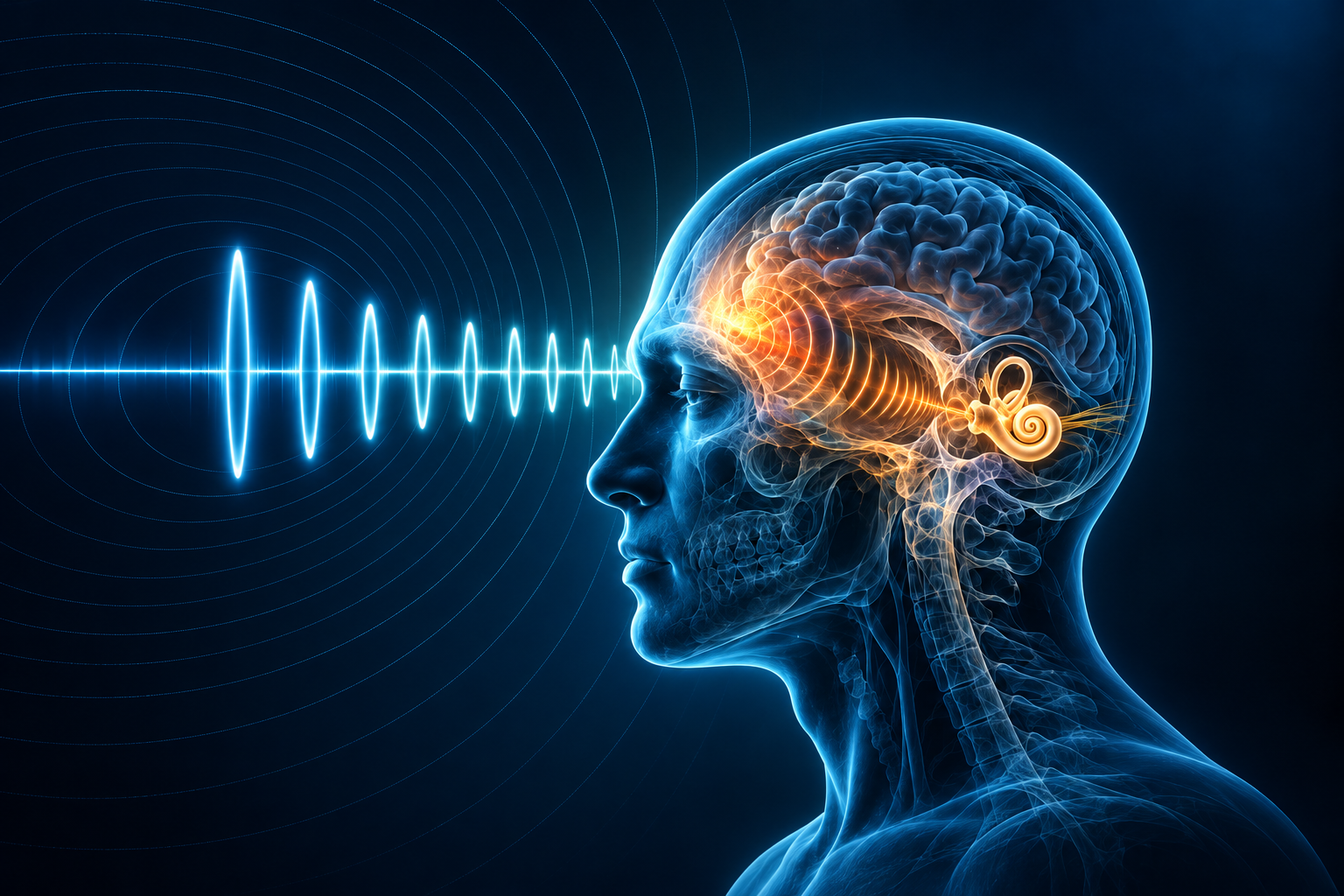
The microwave auditory effect, also known as the Frey effect, is a scientifically established phenomenon in which pulsed radiofrequency (RF) radiation produces auditory sensations without conventional sound travelling through the surrounding air. First systematically documented by American biophysicist Allan H. Frey in the early 1960s, the effect allows individuals exposed to appropriately pulsed microwave energy to perceive sounds such as clicks, buzzing, hissing or knocking, often appearing to originate from within or near the head.
Unlike ordinary hearing, where airborne sound waves enter the external ear, the microwave auditory effect begins with the absorption of electromagnetic energy within cranial tissue. Extremely brief temperature changes cause rapid thermoelastic expansion, generating microscopic acoustic pressure waves that propagate through the head by bone conduction and stimulate the cochlea. The auditory system subsequently converts these mechanical signals into neural activity, which the brain interprets as sound.
The Discovery of Microwave-Induced Hearing
During the early 1960s, Allan H. Frey investigated reports that individuals working near radar equipment could perceive unusual auditory sensations despite the absence of a conventional acoustic source.
His controlled experiments demonstrated that pulsed microwave radiation could induce recognisable auditory sensations in human subjects. The sounds varied according to the characteristics of the transmitted pulses, including their frequency, duration and repetition rate.
In his 1962 paper, Human Auditory System Response to Modulated Electromagnetic Energy, published in the Journal of Applied Physiology, Frey reported that auditory sensations could be produced at distances of several hundred feet from a transmitting antenna under the experimental conditions described.
His findings established microwave-induced hearing as a reproducible physical phenomenon and encouraged further investigation into how electromagnetic energy could interact with the human auditory system.
How Pulsed Radiofrequency Energy Produces Sound
The microwave auditory effect depends on the interaction between pulsed electromagnetic energy and biological tissue.
When a sufficiently brief microwave pulse reaches the head, a small proportion of its energy is absorbed by tissue. This produces an extremely rapid, minute increase in temperature, generally far too small to be consciously experienced as warmth.
Although the temperature change is extremely small, the speed at which it occurs is important.
The rapid deposition of energy causes tissue to expand almost instantaneously. This expansion generates a mechanical pressure disturbance that propagates through surrounding tissue and cranial structures.
This process is known as thermoelastic expansion.
The resulting pressure waves travel towards the inner ear, where they stimulate the cochlea through a mechanism related to bone-conducted hearing.
The brain interprets the resulting neural activity as an auditory sensation, even though no conventional external sound wave has travelled through the air to reach the ear.
The electromagnetic carrier itself is not heard directly. Instead, it provides the energy that generates the mechanical pressure waves responsible for the sensation.
The Role of Pulse Duration and Repetition
The characteristics of microwave-induced auditory sensations depend strongly on how electromagnetic energy is delivered.
A single sufficiently intense and brief pulse may produce a click, pop or knocking sensation.
When pulses are repeated, their timing can produce different perceptual effects, including buzzing, chirping or tonal qualities.
Pulse duration, repetition frequency, peak power and the distribution of absorbed energy all influence the resulting acoustic pressure waves.
This explains why the microwave auditory effect is primarily associated with pulsed rather than ordinary continuous-wave microwave exposure.
The radiofrequency carrier operates at frequencies far above the human audible range. However, the mechanically generated pressure waves can contain frequencies that the cochlea is capable of detecting.
Consequently, the perceived sound is determined by the interaction between the pulse characteristics, the mechanical response of cranial tissue and the auditory system.
Bone Conduction and the Cochlea
The cochlea is a spiral-shaped structure within the inner ear responsible for converting mechanical vibrations into electrical signals that the nervous system can interpret.
During ordinary hearing, airborne sound waves vibrate the eardrum and are transmitted through the middle-ear bones to the cochlea.
In microwave-induced hearing, the initial acoustic pressure waves originate within tissue rather than travelling through the external ear canal.
These internally generated waves propagate through cranial structures and reach the cochlea, stimulating the sensory hair cells responsible for auditory transduction.
The hair cells convert mechanical movement into electrical activity within the auditory nerve.
Signals then travel through the brainstem and other auditory processing structures before reaching the auditory cortex, where they contribute to conscious sound perception.
The mechanism therefore relies on the established biological hearing pathway rather than direct electromagnetic stimulation of the brain's language or auditory-processing centres.
James C. Lin and the Thermoelastic Explanation
Following Frey's original experiments, American scientist James C. Lin made important contributions to understanding the physical mechanisms responsible for microwave-induced hearing.
Lin investigated how absorbed electromagnetic energy could produce mechanical pressure waves within the head and how these waves could stimulate the auditory system.
His work included mathematical and computational modelling of the interaction between pulsed microwave radiation and cranial tissue.
These models considered factors such as the geometry of the head, electromagnetic energy absorption, tissue properties, pressure-wave propagation and auditory perception thresholds.
In his 1976 paper, Microwave Auditory Effect—A Comparison of Some Possible Transduction Mechanisms, Lin examined several proposed physical explanations and identified thermal expansion as a particularly significant mechanism.
His later calculations further explored the acoustic frequencies, pressure amplitudes and energy thresholds associated with microwave-induced hearing.
This research helped establish the thermoelastic explanation as the widely accepted scientific mechanism underlying the Frey effect.
Mathematical and Computational Modelling
Understanding microwave-induced hearing requires consideration of both electromagnetic energy absorption and the mechanical response of biological tissue.
Mathematical models allow researchers to estimate how radiofrequency energy is distributed within the head and how rapid heating produces acoustic pressure waves.
Computer simulations can represent simplified cranial geometry and tissue characteristics to calculate the resulting pressure distribution and propagation.
James C. Lin's research was particularly important in connecting these physical calculations with experimentally observed auditory thresholds.
Such models provide a way to investigate the interaction between electromagnetic radiation, cranial tissue and the inner ear without relying exclusively on subjective descriptions of perceived sound.
Modern computational methods can extend this approach through increasingly detailed anatomical representations, electromagnetic simulations and acoustic modelling.
These techniques are relevant to the wider development of computational human models and digital-twin technologies, although Lin's historical models should not be confused with a complete modern digital twin of an individual.
From Auditory Sensations to Encoded Information
The discovery of microwave-induced hearing also raised the possibility of communicating deliberately encoded information through pulsed electromagnetic energy.
Rather than producing only isolated clicks or buzzing sensations, researchers investigated whether the timing and modulation of microwave pulses could carry recognisable patterns.
Experiments described by Don R. Justesen in his 1975 paper Microwaves and Behavior included Morse-code communication and the reported recognition of prerecorded spoken digits encoded into microwave pulse sequences.
These demonstrations showed that the microwave auditory effect could support the perception of deliberately encoded information under experimental conditions.
The distinction is important: the information originated from external electronic equipment and was perceived through the auditory system. The experiments did not demonstrate natural thought transmission or mind reading.
The experiments, researchers and methods are examined in greater detail in the separate Encoded Communication: Morse Code & Speech section.
Scientific Understanding
The microwave auditory effect is an established physical and biological phenomenon supported by experimental observations, theoretical analysis and subsequent scientific research.
The accepted thermoelastic mechanism explains how appropriately pulsed microwave energy can generate acoustic pressure waves within the head and produce auditory sensations through the cochlea.
The microwave auditory effect therefore represents a documented interaction between electromagnetic physics, biological tissue and human perception, providing an important example of how electromagnetic energy can produce a sensory experience through a measurable physical mechanism.
Scientific References
Allan H. Frey (1962)
Human Auditory System Response to Modulated Electromagnetic Energy.
Journal of Applied Physiology, 17(4), 689–692.
https://doi.org/10.1152/jappl.1962.17.4.689
James C. Lin (1976)
Microwave Auditory Effect—A Comparison of Some Possible Transduction Mechanisms.
Journal of Microwave Power, 11(1), 77–81.
https://doi.org/10.1080/00222739.1976.11688989
James C. Lin (1977)
Theoretical Calculation of Frequencies and Thresholds of Microwave-Induced Auditory Signals.
Radio Science, 12(6S), 237–242.
https://doi.org/10.1029/RS012i06Sp00237
James C. Lin and Zhangwei Wang (2007)
Hearing of Microwave Pulses by Humans and Animals: Effects, Mechanism, and Thresholds.
Health Physics, 92(6), 621–628.
https://doi.org/10.1097/01.HP.0000250644.84530.e2
James C. Lin (2022)
The Microwave Auditory Effect.
IEEE Journal of Electromagnetics, RF and Microwaves in Medicine and Biology, 6(1), 16–28.