

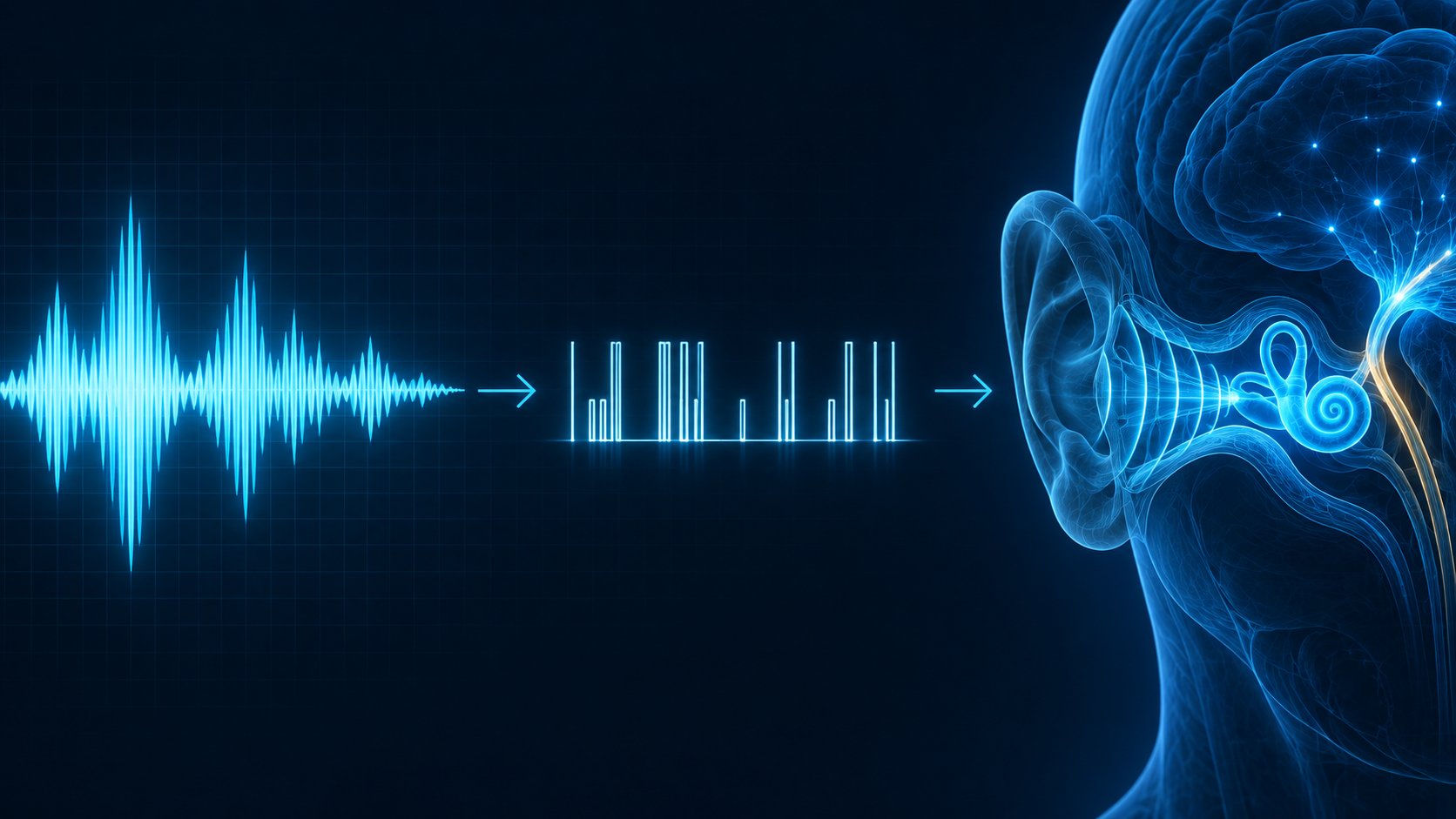
Encoded communication: Morse code & speech
Electromagnetic Receivers We Are
“ElectroMagnetic receivers we are” — Don R. Justesen, Microwaves and Behavior (1975).
In the closing verse of his 1975 scientific paper, American experimental psychologist Don R. Justesen reflected on the human body's relationship with electromagnetic energy. His words distinguished our ability to receive electromagnetic information from our extremely weak natural electromagnetic emissions. Although humans can perceive externally generated electromagnetic signals when those signals interact with an appropriate sensory mechanism, the body's own emissions are far too weak to support the natural transmission of thoughts between individuals. The distinction is particularly relevant to the microwave auditory effect, where information can be deliberately encoded into radiofrequency pulses and perceived as sound without a conventional external acoustic source.
From Microwave Hearing to Encoded Communication
The microwave auditory effect, systematically investigated by American biophysicist Allan H. Frey in the early 1960s, demonstrated that appropriately pulsed microwave radiation could produce audible sensations such as clicks, buzzing and knocking.
Unlike conventional hearing, these sounds do not initially travel through the surrounding air. Instead, brief pulses of absorbed electromagnetic energy produce extremely small, rapid thermoelastic expansions within tissue. These generate mechanical pressure waves that propagate through the head and reach the cochlea, where they are converted into neural signals and interpreted by the brain.
This discovery raised an important scientific question: if microwave pulses could produce recognisable auditory sensations, could their timing and modulation also carry deliberately encoded information?
Experiments subsequently reported in the scientific literature demonstrated that they could.
Morse Code: Arthur W. Guy's Experiments
One of the earliest documented demonstrations of encoded communication through microwave-induced hearing involved American engineer Arthur W. Guy.
As described by Don R. Justesen in his 1975 paper Microwaves and Behavior, Guy's father, a retired railway telegrapher, operated a Morse-code key connected to a microwave pulse-generating system.
The opening and closing of the telegraph key controlled the transmission of microwave pulses. When the radiation was directed towards Guy's head, he perceived the resulting auditory signals and was able to recognise complex messages transmitted in Continental Morse code.
The experiment demonstrated that the microwave auditory effect was not limited to producing isolated clicks or buzzing sensations. Deliberately controlled pulse sequences could carry symbolic information that a listener familiar with the code could interpret.
The information originated from an external transmitter, while the listener's auditory system provided the biological mechanism through which the signals were perceived.
Joseph C. Sharp and H. Mark Grove: Encoded Speech Experiments
A further development involved experiments conducted by researchers Joseph C. Sharp and H. Mark Grove, described by Justesen in 1975.
Rather than transmitting simple Morse-code patterns, the researchers investigated whether recorded human speech could be converted into microwave pulse sequences and subsequently recognised by a listener.
They recorded nine single-syllable spoken digits, representing the numbers one through nine.
The electrical waveform of each recorded word was processed so that a brief microwave pulse was triggered whenever the waveform crossed its zero reference in the negative direction.
This process converted information from the original speech recording into a sequence of microwave pulses whose timing was determined by the speech waveform.
When exposed to these encoded pulse sequences, Sharp and Grove reportedly heard, identified and distinguished the nine spoken digits.
Justesen compared the perceived speech quality to that produced by an artificial larynx.
The significance of the experiment was that recognisable spoken information had been encoded into electromagnetic pulses and perceived through the microwave auditory mechanism, without requiring a conventional loudspeaker or electronic receiver attached to the listener.
These were experimental demonstrations of encoded speech communication, not merely proposals for future technology.
However, the reported demonstration was limited to nine familiar, prerecorded digits. More complex words and sentences were not tested because the necessary average microwave energy was expected to approach contemporary exposure limits.
The underlying experimental account was published through Justesen's description and cited personal communication.
Don R. Justesen's 1975 Publication
In March 1975, Don R. Justesen published Microwaves and Behavior in the scientific journal American Psychologist.
The paper examined the biological and behavioural effects of microwave radiation and included important descriptions of experiments involving encoded auditory communication.
On page 395, Justesen discussed both the Morse-code demonstration associated with Arthur W. Guy and the encoded-speech experiments conducted by Sharp and Grove.
His account established that the reported experimental work had progressed beyond simply producing microwave-induced auditory sensations.
Information could be deliberately encoded into pulsed electromagnetic energy and subsequently recognised by a human listener.
Justesen characterised the speech demonstration as direct, wireless, receiverless communication.
In this context, receiverless meant that no conventional electronic receiving apparatus was required at the listener's ear. The human head and auditory system provided the biological receiving pathway.
How the Brain Interprets Encoded Information
The electromagnetic pulses themselves are not interpreted directly by the brain as language.
Instead, the absorbed microwave energy generates rapid thermoelastic pressure waves that stimulate the cochlea. Sensory hair cells convert the resulting mechanical activity into electrical nerve signals, which travel along the auditory pathway towards the brain.
The brain then processes the timing, frequency characteristics and patterns of the incoming auditory information.
For Morse code, recognition depends on distinguishing the timing and spacing of perceived signals and associating those patterns with learned symbols.
For encoded speech, the auditory system must recover enough of the temporal and acoustic structure represented by the pulse sequence for familiar spoken information to be recognised.
Neural activity within the auditory system operates across multiple timescales. Auditory cortical oscillations, including theta- and gamma-band activity, have been associated with aspects of speech processing, such as tracking slower syllabic patterns and analysing more rapid acoustic features.
These neural processes help explain how the brain organises and interprets auditory information. They should not, however, be confused with the microwave carrier frequency or treated as evidence that the experiments directly controlled brainwaves.
The essential distinction is that electromagnetic energy provides the initial physical stimulus, while the cochlea and auditory pathways transform and interpret the resulting mechanical information.
Receiving Information Is Not Transmitting Thoughts
The experiments described by Justesen demonstrated the reception of deliberately encoded information through pulsed microwave energy.
They did not demonstrate telepathy, natural thought transmission or the extraction of private thoughts from the brain.
In the encoded-speech experiments, the information originated from an existing recording and was converted into a microwave pulse sequence using electronic equipment.
The listener received and interpreted that externally generated information through the auditory system.
This distinction reflects the meaning of Justesen's closing verse: humans can act as receivers of electromagnetic information through established physical and biological mechanisms, but their natural electromagnetic emissions do not provide an equivalent means of transmitting thoughts to another person.
Scientific Significance
The Morse-code and encoded-speech experiments remain historically significant because they demonstrated, or reported, more than the simple perception of microwave-induced sounds.
They showed that the timing and modulation of electromagnetic pulses could be used to communicate recognisable information through the microwave auditory effect.
The scientific achievement was the reported successful transmission and recognition of deliberately encoded auditory information under controlled experimental conditions.
Historical Reference
Don R. Justesen (1975)
Microwaves and Behavior
American Psychologist, 30(3), 391–401.
https://doi.org/10.1037/h0076867
https://zoryglaser.com/wp-content/uploads/2020/05/MICROWAVES-AND-BEHAVIOR.pdf
The discussion of Morse-code and encoded-speech experiments appears on page 395. Justesen's closing verse appears on page 399.