


Brain–Computer Interfaces
Connecting Neural Activity with Computers, Communication and Assistive Technology
Brain–computer interfaces (BCIs) are technologies that establish a communication pathway between the nervous system and an external electronic device. By recording and interpreting patterns of brain activity, these systems can translate neural signals into commands that operate computers, communication devices, robotic equipment and other assistive technologies.
The human brain contains billions of neurons that communicate through electrical and chemical signalling. Brain–computer interfaces use specialised sensors or electrodes to detect aspects of this activity, while computer algorithms process the recorded signals to identify patterns associated with intended movements, attempted speech or other measurable neural processes.
Recent developments in neuroscience, artificial intelligence and implantable electronics have demonstrated increasingly sophisticated applications. Research participants with paralysis have used brain–computer interfaces to move computer cursors, select letters, operate digital devices and communicate through text or synthesised speech. These achievements demonstrate how neural activity can provide an alternative communication pathway when injury or disease prevents normal muscular movement or speech.
Companies such as Neuralink are developing implanted interfaces that allow users to control computer systems through decoded movement intentions. Meanwhile, academic research teams and other neurotechnology companies are investigating methods for reconstructing attempted speech, improving communication speed and developing more capable assistive systems.
Brain–computer interfaces can be invasive, involving electrodes implanted within or on the surface of the brain, or non-invasive, using sensors positioned outside the skull. Each approach offers different advantages and limitations involving signal quality, surgical requirements, portability and long-term reliability.
Although these technologies are sometimes described as enabling control through thought alone, current systems generally decode specific, measurable patterns of neural activity rather than unrestricted thoughts or memories. Their capabilities depend on the recording technology, individual training, computational processing and the tasks for which they have been developed.
This research section explores the established science behind brain–computer interfaces, their practical medical applications, the role of artificial intelligence in neural decoding and the continuing development of technologies intended to restore communication and independence for people with severe physical disabilities.
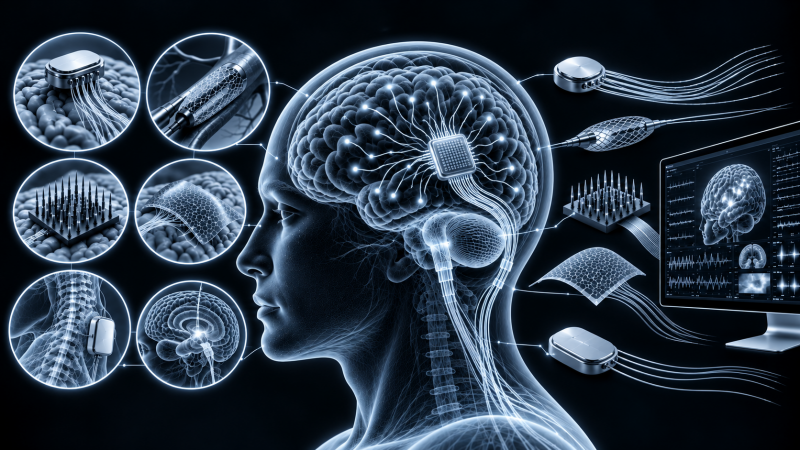
BCI Companies and Technologies
Explore the companies and technologies advancing brain–computer interfaces, from implantable neural devices and non-invasive systems to AI-assisted speech decoding, communication and assistive technologies.
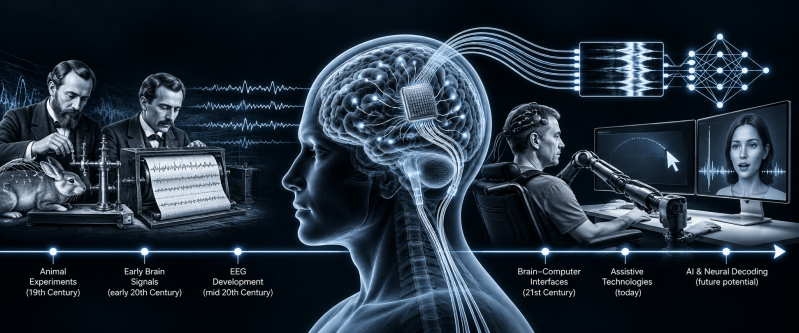
The History of Brain–Computer Interfaces
Explore the history of brain–computer interfaces, from early discoveries in brain electrical activity and pioneering experiments to the development of modern neural implants, assistive communication systems and AI-assisted neural decoding.
How Brain–Computer Interfaces Work
Brain–computer interfaces operate by detecting patterns of neural activity and converting them into information that can be interpreted by an electronic system. Rather than relying on conventional physical inputs such as keyboards, computer mice or touchscreens, BCIs use signals generated by the nervous system to provide an alternative method of communication and control.
Recording Neural Activity
Neurons communicate through electrical and chemical processes, producing patterns of activity associated with movement, sensation, speech and other neurological functions. Brain–computer interfaces record aspects of this activity using specialised electrodes or sensors.
Non-invasive systems commonly use electroencephalography (EEG), which measures electrical activity through electrodes positioned on the scalp. Invasive systems use electrodes implanted within or on the surface of the brain, allowing more localised neural signals to be recorded. These approaches differ in signal resolution, surgical requirements and practical applications.
Signal Processing and Neural Decoding
The recorded signals are processed electronically to reduce interference, identify relevant features and distinguish patterns associated with particular activities. Machine-learning algorithms can then be trained to recognise relationships between these neural patterns and intended actions.
For example, when a person attempts to move their hand, measurable activity may occur within brain regions associated with movement, even if paralysis prevents the intended physical action. A trained decoding system can interpret aspects of this activity and translate them into commands that move a computer cursor or operate another electronic device.
Artificial Intelligence and Adaptive Learning
Artificial intelligence plays an increasingly important role in modern BCI development. Machine-learning models can identify complex relationships within recorded neural data, adapt to changes in signal characteristics and improve the accuracy of decoded commands.
Some systems require users to practise specific mental or attempted physical actions while the software learns to associate recorded neural patterns with corresponding outputs. Calibration and continued adaptation can improve performance, although accuracy varies between individuals, recording methods and applications.
From Neural Activity to Computer Commands
Once neural information has been decoded, the resulting commands can control external technologies. These may include moving a cursor, selecting letters on a virtual keyboard, operating robotic equipment or generating synthesised speech.
In speech-related BCIs, researchers have developed systems that analyse neural activity associated with attempted speaking and translate it into text or audible output. These systems can provide alternative communication methods for people who have lost the ability to speak because of neurological injury or disease.
Communication Between the Implant and External Devices
Some implanted brain–computer interfaces use wireless communication to transfer recorded neural information to external processing equipment. The signals can be transmitted using established radiofrequency communication technologies before being processed by computers and decoding software.
This wireless transmission is distinct from the neural recording process itself. The electrodes detect electrical activity, while the communication system transfers the recorded information between electronic devices. The technology therefore combines neuroscience, electronics, signal processing, artificial intelligence and conventional wireless communication.
Together, these processes allow measurable patterns of brain activity to be translated into practical commands, creating new possibilities for communication, accessibility and assistive technology.
Restoring Communication and Independence
One of the most important applications of brain–computer interfaces is their potential to restore communication and independence for people living with paralysis or severe neurological disabilities. By translating recorded neural activity into computer commands, these technologies can provide alternative ways to interact with the digital world without requiring conventional muscular movement.
Neuralink and Computer Control
Neuralink has demonstrated implanted brain–computer interfaces that allow people with paralysis to control a computer cursor through decoded movement intentions. Participants have used these systems to interact with computer applications, play games and perform digital tasks.
The implant records neural activity through electrodes positioned within the brain. This information is transmitted to an external system, where decoding software interprets patterns associated with intended movement and converts them into cursor commands.
These demonstrations illustrate how neural signals can be used to operate familiar computer interfaces, potentially improving accessibility for people who cannot use conventional input devices.
Converting Attempted Speech into Communication
Another significant area of research involves restoring communication for people who have lost the ability to speak.
Researchers have developed experimental brain–computer interfaces that analyse neural activity associated with attempted speech. Using computational models trained on recorded neural signals, these systems can translate aspects of intended speech into written text or synthesised audio.
Some experimental systems have also combined speech decoding with animated digital avatars that reproduce aspects of facial expression and speech-related movement. This demonstrates how neural interfaces, artificial intelligence and computer-generated representations can be integrated to support more natural communication.
These technologies remain specialised research and clinical systems, with performance depending on factors such as electrode placement, individual neural activity, training data and decoding accuracy.
Assistive Devices and Robotic Control
Brain–computer interfaces have also been investigated for controlling robotic arms, assistive equipment and other external devices. By interpreting neural activity associated with intended movements, experimental systems can generate commands that allow users to interact with objects or operate equipment.
Such research aims to provide greater independence for people whose physical movement is severely restricted. However, capabilities vary considerably between experimental systems, and many applications remain under clinical investigation.
Current Achievements and Future Development
The ability to control computer interfaces, generate text from attempted speech and operate certain assistive devices through decoded neural activity represents an established achievement of modern neuroscience and engineering.
Nevertheless, these demonstrations should be distinguished from unrestricted interpretation of thoughts, memories or internal experiences. Current brain–computer interfaces typically depend on specialised sensors, individual calibration, task-specific decoding models and carefully controlled experimental or clinical conditions.
Continued advances in electrode technology, wireless electronics, artificial intelligence and neuroscience may improve reliability, accessibility and communication speed, potentially extending the practical benefits of these systems to more people.
Invasive and Non-Invasive Brain–Computer Interfaces
Brain–computer interfaces use different methods to detect and record neural activity. The choice of recording technology influences the quality of the information collected, the types of signals that can be decoded and the practical applications of the system.
These technologies are generally divided into invasive and non-invasive approaches, although electrodes placed on the surface of the brain are sometimes described as partially invasive because they do not penetrate brain tissue.
Invasive Brain–Computer Interfaces
Invasive BCIs use electrodes surgically implanted within brain tissue to record electrical activity from relatively small populations of neurons or, in some configurations, individual neurons.
This close proximity can provide detailed neural information that is difficult to obtain using external sensors. Implanted interfaces have supported experimental demonstrations of cursor control, robotic movement and attempted-speech decoding.
However, implantation requires surgery and introduces considerations involving infection, tissue response, long-term electrode stability and device maintenance. These systems are therefore primarily investigated in specialised medical and research settings.
Electrodes Positioned on the Brain's Surface
Electrocorticography (ECoG) uses electrodes positioned on the surface of the brain, beneath the skull, to measure electrical activity across regions of the cerebral cortex.
Unlike electrodes inserted directly into brain tissue, conventional ECoG electrodes record signals from the cortical surface. This approach can provide more spatially localised information than scalp-based EEG while avoiding penetration of the underlying brain tissue by the recording electrodes.
ECoG has been used in neuroscience research and experimental communication systems, including investigations into speech decoding and the control of external devices.
Although the electrodes do not ordinarily penetrate brain tissue, conventional ECoG still requires a surgical procedure and carries associated medical risks.
Non-Invasive Brain–Computer Interfaces
Non-invasive BCIs record brain-related signals without surgically implanting electrodes.
One of the most widely investigated methods is electroencephalography (EEG), which measures electrical potential differences using electrodes positioned on the scalp.
EEG systems can identify patterns associated with attention, motor imagery, visual stimulation and other neurological processes. These patterns can be used in experimental communication interfaces, accessibility tools and computer-control applications.
Because EEG signals must pass through the brain's surrounding tissues and skull, they generally provide less spatially localised information than implanted recording systems. They are also vulnerable to interference from muscle activity, eye movements and external electrical sources.
Nevertheless, non-invasive approaches avoid the surgical risks associated with implantation and can be suitable for repeated research sessions, rehabilitation and certain assistive applications.
Comparing the Different Approaches
The main differences between these technologies concern signal accessibility, spatial resolution, medical requirements and practical usability.
Implanted electrodes can provide highly detailed recordings from selected neural regions but require surgery and long-term medical oversight. Surface electrodes offer an alternative method of recording cortical activity, while scalp-based systems provide a non-surgical approach with different limitations in signal quality and interpretation.
No single method is universally superior. The most appropriate technology depends on the intended application, the person's medical circumstances and the information required by the decoding system.
The Importance of Recording Location
An important scientific distinction is that the location of a neural recording sensor affects the information that can be obtained.
Brain–computer interfaces do not simply detect all activity occurring throughout the brain. Their capabilities depend on which neural populations or brain regions are accessible, the characteristics of the recorded signals and the computational methods used to interpret them.
This is particularly important when evaluating claims about thought decoding, speech reconstruction or remote neural monitoring. Demonstrations involving surgically implanted electrodes or scalp-mounted sensors cannot automatically be extended to systems operating without comparable recording equipment.
Understanding these distinctions is essential for separating established BCI capabilities from technologies that remain experimental or scientifically unverified.
Artificial Intelligence, Neural Decoding and Digital Avatars
Artificial intelligence has become an important component of modern brain–computer interface research. By analysing complex patterns of recorded neural activity, machine-learning systems can identify relationships between brain signals and intended movements, attempted speech or other measurable neurological processes.
These developments have expanded the capabilities of brain–computer interfaces beyond simple command selection, enabling experimental systems that produce text, synthesised speech and animated digital representations of human communication.
Digital Avatars and Facial Animation
Researchers have also integrated neural speech decoding with computer-generated avatars.
In a notable 2023 research demonstration at the University of California, San Francisco, a participant with severe paralysis used a brain–computer interface to generate synthesised speech while an animated digital avatar reproduced speech-related facial movements.
The system combined neural recordings, computational decoding, speech synthesis and facial animation to create a more expressive form of communication.
This research illustrates how digital representations can reproduce selected aspects of human behaviour using information derived from neural signals.
However, such avatars should not be confused with complete digital replicas of the brain or human consciousness. They are computational representations designed to reproduce particular outputs, expressions or behaviours.
Artificial Intelligence and Personalised Communication
BCI decoding systems often require individual calibration because neural recordings differ between participants and can change over time.
Machine-learning algorithms can be adapted to an individual's recorded activity, allowing the system to recognise specific patterns associated with their intended actions or communication.
Personalisation may also extend to synthesised voices, communication preferences and the behaviour of digital avatars. These developments could help users communicate in ways that more closely reflect their individual identities.
Connections with Digital Twins
Digital twins are computational models representing physical objects, systems or processes, often updated using measured data.
Although an AI-controlled avatar and a digital twin are not the same technology, both can involve computational representations that respond to information from real-world sources.
Brain–computer interface research demonstrates one specialised application in which measured biological signals are interpreted computationally and used to control an external digital representation.
These connections are relevant to the broader study of artificial intelligence, virtual modelling, sensor integration and human–computer interaction.
Scientific Capabilities and Limitations
The successful decoding of intended movements and attempted speech demonstrates that particular forms of neural information can be interpreted using specialised recording equipment and trained computational models.
However, the ability to reconstruct selected information from recorded neural activity does not establish that all thoughts, memories or sensory experiences can be decoded.
Nor does it demonstrate that equivalent information can be obtained remotely without the necessary recording technologies.
Continued research is improving neural decoding, communication speed and digital representation, but the capabilities of each system must be evaluated according to its experimental methods, recording requirements and demonstrated results.
Future Developments in Brain–Computer Interfaces
Brain–computer interfaces are developing rapidly as advances in neuroscience, artificial intelligence, microelectronics and biomedical engineering create new possibilities for communication and interaction with technology.
Although current systems have demonstrated the ability to translate selected neural signals into computer commands, researchers are investigating ways to make these interfaces faster, more accurate, more accessible and capable of supporting a wider range of activities.
Faster and More Natural Communication
One of the most promising areas of development is the restoration of natural communication for people who have lost the ability to speak.
Future systems may improve the speed and accuracy of attempted-speech decoding, allowing users to communicate with fewer delays and less reliance on conventional text-selection interfaces.
Researchers are also investigating ways to reproduce characteristics of natural speech, including vocal expression, intonation and personalised synthesised voices.
Combined with animated digital avatars, these technologies could provide increasingly expressive communication systems that reproduce selected aspects of an individual's speech and facial movements.
More Advanced Computer and Device Control
Future BCIs may enable more precise control of computers, smartphones, robotic equipment and assistive technologies.
Improvements in neural recording and decoding could support more complex commands, smoother cursor movement and more intuitive interaction with digital environments.
Researchers are also exploring applications involving robotic limbs, powered mobility equipment and other technologies intended to restore independence for people with severe physical disabilities.
Artificial Intelligence and Adaptive Neural Interfaces
Artificial intelligence is expected to remain central to the development of more capable brain–computer interfaces.
Future machine-learning systems may require less individual calibration, adapt more effectively to changes in recorded neural activity and recognise a wider range of intended actions.
Advances in computational modelling could also allow multiple types of neural information to be analysed together, improving the coordination of communication, movement and assistive-device control.
These developments may reduce the amount of training required to operate a BCI and make the technology more practical for everyday use.
Wireless and Miniaturised Neural Technologies
Continued improvements in microelectronics, wireless communication and low-power computing may lead to smaller and more practical brain–computer interface systems.
Researchers are investigating approaches that reduce the need for external cables, improve the efficiency of neural recording and support longer-term operation.
Future systems may also integrate more processing directly into implanted or wearable devices, reducing their dependence on separate computing equipment.
Such advances could improve portability and convenience, although their clinical usefulness will depend on demonstrated performance and reliability.
Bidirectional Brain–Computer Interfaces
Most familiar BCI applications focus on recording neural activity and converting it into commands for external devices.
Another area of development involves bidirectional interfaces, which combine neural recording with controlled electrical stimulation of the nervous system.
Experimental research has demonstrated that stimulation can produce certain artificial sensory experiences, including aspects of touch. Future developments may improve the sensory feedback available when controlling prosthetic limbs or other assistive equipment.
Combining movement decoding with sensory feedback could allow users to interact with external devices in a more coordinated and natural manner.
Integration with Robotics, Virtual Environments and Digital Avatars
As neural decoding improves, brain–computer interfaces may become more closely integrated with robotics, virtual reality and AI-assisted digital environments.
A user might operate a robotic device while receiving sensory feedback, interact with a virtual environment through decoded movement intentions or communicate through an increasingly expressive digital avatar.
These possibilities build upon existing experimental achievements, but more sophisticated integration will require further advances in recording technology, computational interpretation and system coordination.
Long-Term Research Prospects
The development of brain–computer interfaces illustrates how measurable neural activity can be translated into useful information through specialised electronics and computational processing.
Future advances may expand the range of movements, communication functions and sensory interactions that these systems can support.
However, more ambitious applications, including complex sensory reconstruction and broader interpretation of neural activity, remain subjects of ongoing scientific investigation. Their feasibility must be established through reproducible experiments rather than assumed from existing demonstrations.
The long-term significance of brain–computer interfaces lies in their potential to connect biological neural processes with increasingly capable digital systems, particularly where these technologies can restore communication, movement and independence.
Research Connections and Further Reading
Brain–computer interfaces bring together several scientific disciplines, including neuroscience, biomedical engineering, artificial intelligence, signal processing and electronic communication. Their development provides an important example of how biological activity can be measured, interpreted computationally and translated into information used by external technologies.
The following research areas provide additional context for understanding these developments.
Radio Frequency Communication and Encoding
Wireless brain–computer interfaces may use radiofrequency communication to transfer recorded neural information between implanted or wearable electronics and external computing systems.
This connection illustrates how conventional wireless transmission technologies can support neural recording systems. However, the transmission of recorded neural data between electronic devices is distinct from directly detecting or influencing brain activity using electromagnetic fields.
Related research: Radio Frequency Communication and Encoding.
The Microwave Auditory Effect and Neural Perception
The microwave auditory effect demonstrates that appropriately pulsed radiofrequency energy can produce an auditory sensation through a physical mechanism involving rapid thermoelastic expansion and the auditory system.
Brain–computer interfaces operate through a different approach, typically measuring neural activity with electrodes or other specialised sensors and translating recorded signals into electronic commands.
Both subjects contribute to the broader scientific study of how biological systems interact with physical signals and how information can be represented, transmitted or perceived.
Related research: The Microwave Auditory Effect and Encoded Communication: Morse Code & Speech.
Artificial Intelligence, Digital Twins and Avatars
Machine learning enables brain–computer interfaces to interpret recorded neural signals and produce outputs such as cursor movement, text, synthesised speech and animated facial expressions.
Digital avatars can represent selected aspects of human communication, while digital twins provide computational representations of physical systems or processes.
Although these technologies have different purposes, they demonstrate how biological measurements, computational models and digital representations can be combined in specialised applications.
Related research: Digital Twins and Avatars.
BCI Companies and Technologies
Commercial and academic organisations are developing different approaches to neural recording, implanted electronics, wireless communication and assistive technology.
A dedicated research page will examine organisations including Neuralink, Synchron, Blackrock Neurotech and INBRAIN Neuroelectronics, comparing their technologies, research objectives and demonstrated capabilities.
Further reading: BCI Companies and Technologies.
The History of Brain–Computer Interfaces
Modern neural interfaces build upon decades of research into brain electrical activity, electrophysiology, computer-assisted signal interpretation and communication through neural recordings.
A separate historical overview will examine the contributions of early researchers, the development of EEG-based interfaces, the emergence of implanted systems and the progression towards modern AI-assisted neural decoding.
Further reading: The History of Brain–Computer Interfaces.
Together, these research areas illustrate the growing relationship between neuroscience, computation and communication technologies, while emphasising the importance of distinguishing established experimental achievements from emerging possibilities.