

Radio Frequency Communication and Encoding
How Electromagnetic Waves Carry, Transmit and Relay Information
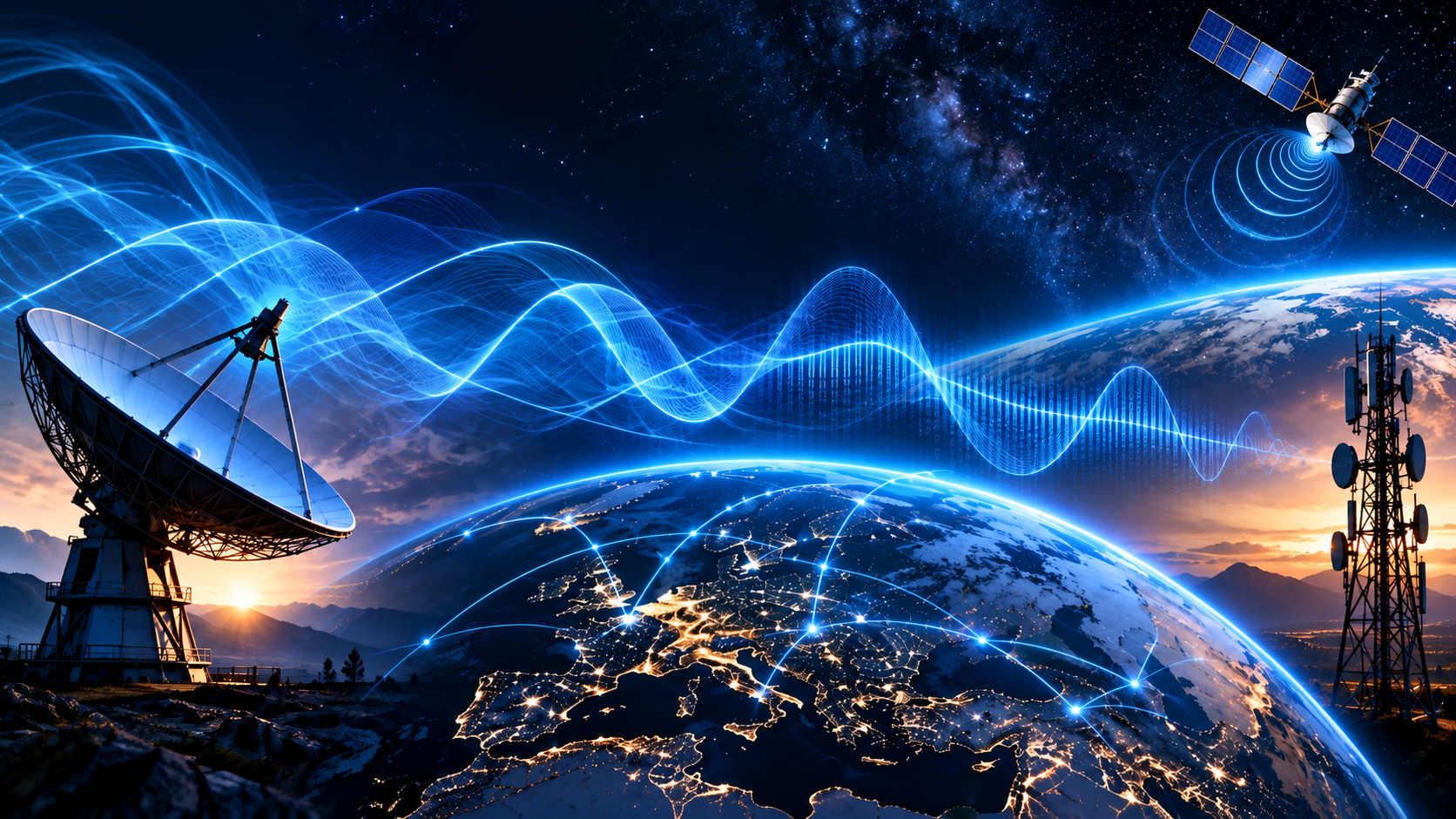
Radiofrequency (RF) communication is a fundamental part of modern technology, enabling information to be transmitted wirelessly across distances ranging from a few metres to thousands of kilometres. Radio waves are electromagnetic radiation that can carry encoded information, including speech, images, video, digital data and measurements collected by sensors.
Information is carried by modifying characteristics of an electromagnetic carrier wave, a process known as modulation. Different encoding strategies determine how information is represented, while the selected carrier frequency, transmitter power, antenna design and surrounding environment influence how effectively a signal travels and can be received.
Radiofrequency communication operates across a broad spectrum. Lower frequencies can support long-distance propagation through ground waves or reflections and refraction within the ionosphere, while higher frequencies are widely used for mobile networks, Wi-Fi, radar and high-capacity communication systems. Receivers, repeaters and interconnected relay networks can extend communication beyond the range of an individual transmitter.
This research section explores the established principles of RF transmission, frequency-dependent propagation, modulation and information encoding. It also examines how audio, visual, spatial and other forms of information can be represented electronically, distinguishing established communication technologies from experimental applications and theoretical possibilities.
🔍 Click image to enlarge
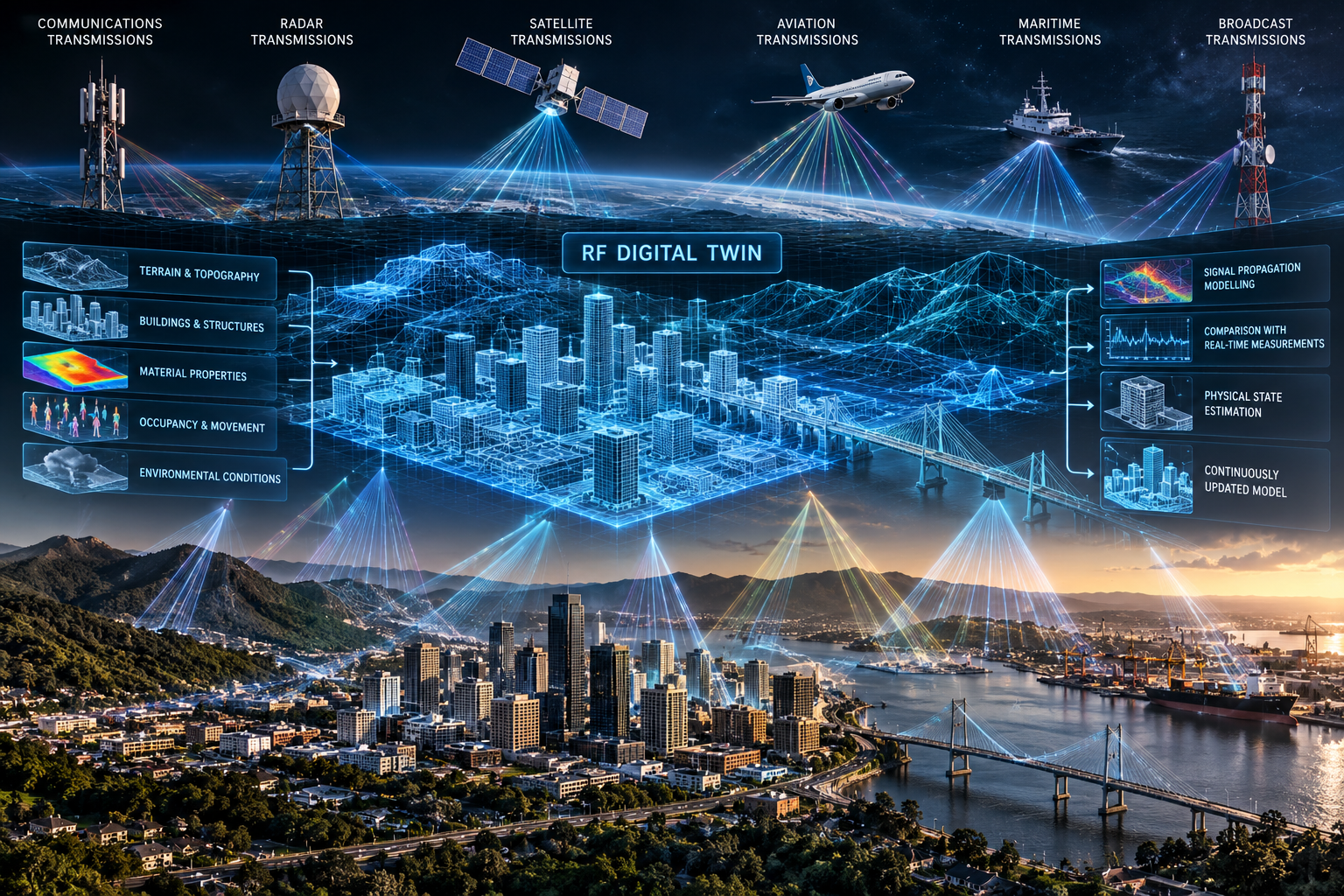
A Theoretical Method for Building a Radio Frequency Digital Twin of the Physical World
An original research hypothesis exploring how radiofrequency sensing, radar technologies, computational modelling and sensor fusion could be combined to construct a continuously updated digital representation of the physical environment.
How Radio Waves Carry Information
Radio waves are a form of electromagnetic radiation that travel through space at approximately the speed of light. Unlike sound waves, which require a physical medium such as air, water or solid material, electromagnetic waves can propagate through a vacuum.
Radiofrequency communication works by using an electromagnetic wave, known as a carrier, to transport information. The carrier operates at a particular frequency, while the information being transmitted is represented by controlled changes to its amplitude, frequency, phase or pulse characteristics. This process is called modulation.
For example, a 100 MHz radio carrier can transmit an audio signal containing frequencies of only a few thousand hertz. The lower-frequency information is encoded onto the higher-frequency carrier, allowing speech or music to be transmitted wirelessly and recovered by a suitable receiver.
Modern communication systems also use digital encoding, in which information is represented as numerical data. Speech, images, video and sensor measurements can all be converted into digital information before transmission. A receiver processes the incoming signal, recovers the encoded data and reconstructs the original information as accurately as possible.
It is important to distinguish the frequency of the carrier from the frequencies or data represented within it. A high-frequency carrier can transport lower-frequency information, but the carrier frequency itself does not determine what type of information can be transmitted. The available bandwidth, modulation method, signal quality and encoding strategy also influence communication capacity.
RF Frequencies and Signal Propagation
Radiofrequency signals occupy a broad section of the electromagnetic spectrum, with different frequencies exhibiting different propagation characteristics. Frequency is measured in hertz (Hz), with kilohertz (kHz), megahertz (MHz) and gigahertz (GHz) representing thousands, millions and billions of cycles per second respectively.
The frequency of a radio wave determines its wavelength, which influences how it interacts with the atmosphere, terrain, buildings and other obstacles. Lower-frequency signals generally have longer wavelengths and can offer advantages for long-distance communication, particularly through ground-wave propagation, diffraction and ionospheric propagation. Higher-frequency signals have shorter wavelengths and are widely used for broadband communications, radar, wireless networking and other applications requiring substantial information capacity.
At frequencies around 100 kHz to 1 MHz, ground-wave propagation can support communication over considerable distances, depending on transmitter power, antenna design and ground conductivity. Frequencies in the high-frequency (HF) band, approximately 3–30 MHz, can sometimes travel thousands of kilometres through ionospheric propagation, allowing communication beyond the normal radio horizon.
At 40 MHz, within the very-high-frequency (VHF) band, communication is generally more dependent on antenna height, terrain and line-of-sight conditions, although atmospheric phenomena can occasionally extend transmission distances considerably. Frequencies around 300 MHz and above are increasingly associated with terrestrial line-of-sight systems, mobile communications and specialised radio networks.
Between approximately 300 MHz and 6 GHz, radio frequencies are extensively used for mobile networks, Wi-Fi, radar, telemetry and wireless data transmission. Although these frequencies are often more affected by obstacles and propagation losses, suitable antennas, receiver sensitivity and communication infrastructure can support reliable transmission over substantial distances.
Transmission range is not determined by frequency alone. Transmitter power, antenna gain, receiver sensitivity, atmospheric conditions, interference and the surrounding environment all influence the distance over which information can be recovered. Repeaters, relay stations and interconnected communication networks can extend coverage far beyond the range of an individual radio link.
Receivers, Repeaters and the Relay of Information
Radiofrequency communication relies on transmitters and receivers working together to exchange information. A transmitter converts information into a modulated electromagnetic signal, which travels through the surrounding environment until it reaches a suitable receiving antenna. The receiver then processes the signal, demodulates it and, where necessary, decodes the information into its original form, such as speech, images or digital data.
The distance over which a signal can be received depends on several factors, including frequency, transmitter power, antenna height, terrain, atmospheric conditions and receiver sensitivity. For example, a 40 MHz VHF communication system might provide coverage over approximately 10–50 kilometres under suitable terrestrial conditions, while a high-frequency (HF) system operating around 10 MHz can sometimes communicate over thousands of kilometres using ionospheric propagation.
Repeaters extend communication by receiving a signal and retransmitting it, often from an elevated location with improved coverage. For example, a transmitter communicating with a repeater 30 kilometres away may reach another receiver a further 30 kilometres beyond the repeater, creating a communication path of approximately 60 kilometres. Additional repeaters can extend the network further, provided each radio link has sufficient signal quality.
Different relay systems use different methods. Some repeaters amplify and retransmit received signals, while others demodulate, decode or regenerate the information before transmitting it again. Relay stations may also operate on different frequencies, allowing information received on one radio channel to be transmitted through another.
Modern communication networks combine terrestrial radio links with fibre-optic connections, satellites, microwave backhaul and internet infrastructure. A signal originating from a short-range wireless device can therefore be converted, routed and retransmitted through multiple communication systems, allowing information to reach receivers thousands of kilometres away.
Importantly, the frequency used to transmit information does not have to remain the same throughout a communication network. A signal received at one frequency can be processed and retransmitted using another, while preserving the underlying information. This principle is fundamental to cellular networks, satellite communications, radio repeaters and modern digital communication infrastructure.
These technologies demonstrate how the range of information transmission can be extended through established engineering methods, without requiring a single electromagnetic signal to travel the entire distance between its original source and final destination.
Information Encoding: Audio, Visual, Spatial and Hybrid Strategies
Information encoding is the process of representing information in a form that can be stored, processed or transmitted by an electronic system. Modern communication technologies use a variety of encoding strategies to represent sound, images, movement, spatial relationships and other forms of data. Once encoded, this information can be transmitted using radiofrequency signals, optical communication systems or wired networks.
Audio Encoding
Audio encoding converts sound into a representation suitable for electronic processing or transmission. Analogue systems represent variations in sound pressure through continuously changing electrical signals, while digital systems sample and quantise audio waveforms into numerical data. More advanced methods can extract speech characteristics, including pitch, timing, spectral content and other features, allowing information to be represented or compressed more efficiently.
Visual and Feature-Based Encoding
Visual information can be encoded as individual pixels or through selected features such as edges, shapes, textures, movement and spatial relationships. Feature-based encoding is widely used in computer vision, image recognition and machine-learning systems, where extracting relevant characteristics can reduce processing requirements or support object identification and tracking.
Spatial and Temporal Encoding
Spatial encoding represents information about position, distance, direction and the relationships between objects. Temporal encoding represents information through changes over time, including event sequences, signal timing and movement patterns. These methods are used in radar processing, navigation, robotics, three-dimensional mapping and sensor-based monitoring systems.
Biomimetic Encoding
Biomimetic encoding draws inspiration from biological sensory systems, including the human auditory and visual pathways. For example, cochlear-inspired processing can separate sound into frequency components, while event-based cameras imitate aspects of biological vision by recording changes in brightness rather than continuously capturing complete images. Such approaches are used in neuromorphic computing, artificial sensory systems and specialised signal-processing technologies.
Hybrid and AI-Assisted Encoding
Hybrid encoding combines multiple representations or processing strategies within a single system. Audio, visual, spatial and temporal information can be processed together, allowing computers to identify relationships between different sources of data. Artificial intelligence and machine learning can also generate compact representations that preserve information relevant to particular tasks, including recognition, prediction and reconstruction.
Encoding, Transmission and Perception
An important distinction exists between encoding information, transmitting it and making it perceptible to a biological observer. Encoding determines how information is represented, while modulation and transmission determine how that representation is carried between electronic systems. Decoding reconstructs or interprets the information at the receiving end.
Historical experiments associated with Walter Reed demonstrated the reported recognition of speech information encoded into pulsed microwave signals, while separate advances in neuroscience have demonstrated the reconstruction of visual information from recorded brain activity using computational models. These represent distinct technological approaches, with different physical mechanisms and experimental requirements. Further scientific investigation would be necessary to establish whether such capabilities could be extended, integrated or implemented over greater distances, particularly without implanted or externally attached neural recording equipment.
Together, these encoding strategies demonstrate how modern electronic systems can represent and exchange increasingly complex information, forming the foundation of wireless communications, artificial intelligence, sensor fusion and advanced human–machine interfaces.
Research Connections and Further Reading
Radiofrequency communication and information encoding are closely connected to several established fields of scientific research, including radar, wireless sensing, neuroscience, artificial intelligence and computational modelling. Although these disciplines use different technologies and physical mechanisms, they share common principles involving signal generation, information processing, transmission, reception and interpretation.
Research into the Microwave Auditory Effect provides a historical example of how pulsed radiofrequency energy can produce auditory sensations under specific experimental conditions. Investigations by Allan H. Frey, Joseph C. Sharp, H. Mark Grove, Arthur W. Guy and other researchers contributed to understanding the interaction between electromagnetic energy, acoustic pressure waves and the human auditory system. Historical demonstrations involving Morse code and encoded speech are explored separately in the existing research section, Encoded Communication: Morse Code & Speech.
Modern radar and wireless sensing technologies demonstrate how reflected electromagnetic signals can be processed to estimate movement, distance and aspects of the surrounding environment. These measurements can contribute to three-dimensional modelling, object tracking and digital representations of physical systems.
Developments in artificial intelligence, sensor fusion and digital twins further demonstrate how information from multiple sources can be combined, analysed and represented computationally. Related advances in brain–computer interfaces show how recorded neural activity can be processed to support communication and control of external devices, particularly for people with severe physical disabilities.
The accompanying research pages examine RF frequency propagation, communication distances, receiver and repeater networks, and the encoding strategies used to represent audio, visual, spatial and other forms of information.
Together, these subjects provide a broader understanding of how information can be represented, transmitted, recovered and interpreted through established scientific and technological systems.