

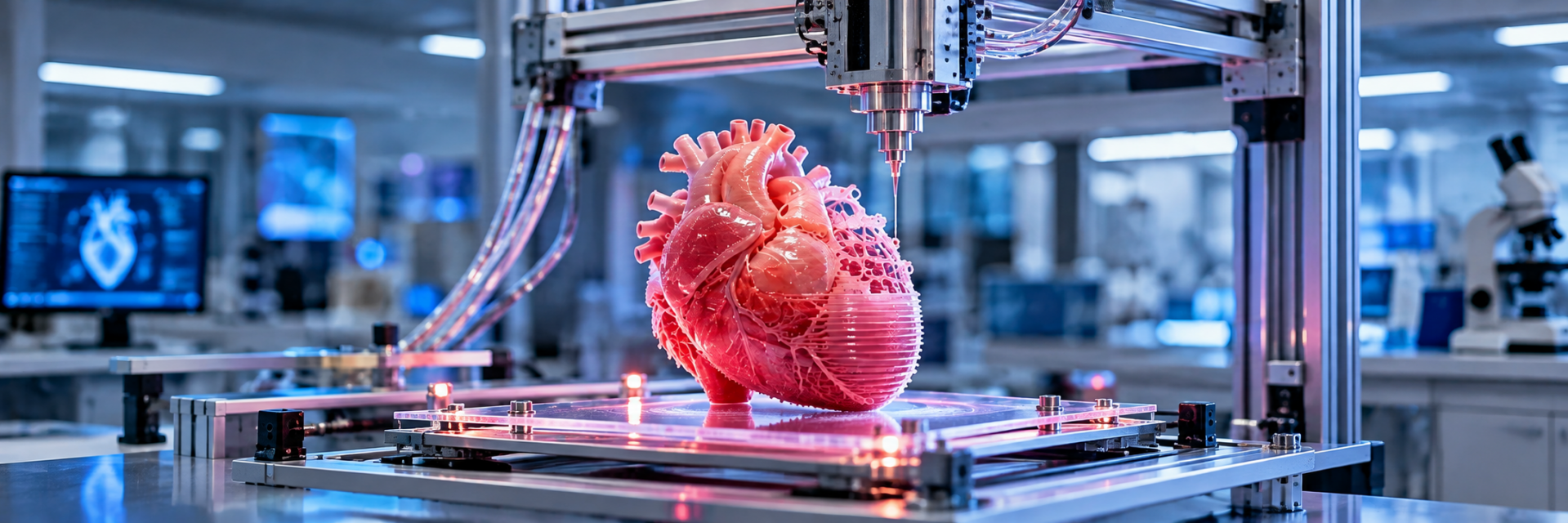
Organ Regeneration & 3D Bioprinting
Introduction
The ability to repair, regenerate or replace damaged human tissues and organs represents one of the most promising areas of modern biomedical research.
For decades, medicine has relied on treatments such as organ transplantation, artificial implants and conventional surgery to address severe tissue damage or organ failure. Although these approaches have transformed healthcare, they face important limitations, including donor-organ shortages, transplant rejection and the difficulty of restoring complex biological functions.
Regenerative medicine aims to address some of these challenges by using cells, biological materials and tissue-engineering techniques to repair or replace damaged structures.
One particularly innovative field is 3D bioprinting, which uses computer-controlled manufacturing methods to arrange living cells and specialised biomaterials into three-dimensional structures.
Unlike conventional 3D printing, which typically produces objects from plastics, metals or other non-living materials, bioprinting can incorporate living cells into carefully designed biological constructs.
Researchers are investigating how these techniques might eventually produce functional replacement tissues, improve the testing of medicines and reduce dependence on donated organs.
Europe, including the United Kingdom, is an important centre for this research. Universities, hospitals, biotechnology companies and scientific institutions are developing approaches involving stem cells, organoids, tissue scaffolds, advanced biomaterials and bioprinting technologies.
Some regenerative treatments, including certain stem-cell therapies and tissue-engineered products, already have established clinical applications. Other developments, such as laboratory-grown organoids and bioprinted tissue models, are primarily used in research or remain at experimental stages.
The production of complete, transplantable human organs through 3D bioprinting remains a major scientific challenge. Complex organs require functioning blood vessels, specialised cell populations, structural organisation and integration with the recipient's body.
This article examines the established science of organ regeneration and bioprinting, Europe's contributions to regenerative medicine, the latest advances in tissue engineering and the challenges that must be overcome before more complex laboratory-grown tissues and organs can become routine medical treatments.
How Organ Regeneration and 3D Bioprinting Work
Regenerative medicine combines biology, medicine and engineering to investigate how damaged tissues can be repaired, replaced or encouraged to regenerate.
Although the human body can naturally repair certain injuries, its regenerative abilities vary considerably between tissues. Skin and blood cells are continually renewed, while complex structures such as the heart and central nervous system have much more limited regenerative capacity.
Researchers are developing methods to overcome some of these biological limitations by combining living cells with specialised materials and controlled laboratory environments.
Stem Cells and Tissue Regeneration
Stem cells are cells capable of producing additional cells and, under appropriate conditions, developing into specialised cell types.
They play an important role in tissue maintenance, repair and regenerative medicine.
Different types of stem cells have different capabilities.
Adult stem cells occur in tissues such as bone marrow and help maintain or replenish particular cell populations. Blood-forming stem cells have been used clinically for decades to treat certain blood disorders and cancers.
Embryonic stem cells are pluripotent, meaning they can develop into many different cell types found in the human body.
Induced pluripotent stem cells (iPSCs) are produced by reprogramming specialised adult cells into a pluripotent state. This allows researchers to create cell populations with characteristics similar to embryonic stem cells without obtaining them from embryos.
European research institutions use stem cells to investigate tissue repair, disease mechanisms and potential replacement therapies.
However, producing specialised cells in a laboratory does not automatically mean they can be transplanted safely or restore normal organ function.
Researchers must also establish cell purity, stability, compatibility and long-term safety.
What Is 3D Bioprinting?
3D bioprinting is a form of additive manufacturing that arranges biological materials into three-dimensional structures using computer-controlled equipment.
A digital model guides the placement of materials, allowing researchers to build structures layer by layer or through other controlled deposition methods.
Many bioprinting systems use materials known as bioinks.
Bioinks may contain living cells, hydrogels, structural proteins and other substances designed to support cell survival and organisation.
Different printing techniques include extrusion-based bioprinting, droplet-based methods and light-assisted approaches.
Each technique has advantages and limitations involving printing resolution, material compatibility, cell viability and production speed.
The aim is not simply to produce an object resembling human tissue. Researchers must create an environment in which living cells can survive, interact and perform useful biological functions.
Tissue Scaffolds and Biomaterials
Tissue engineering often relies on three-dimensional structures called scaffolds.
A scaffold provides physical support for cells while helping guide their growth and organisation.
Scaffolds may be produced from natural biological materials, synthetic polymers or combinations of both.
Some are designed to degrade gradually as new tissue develops.
Others remain in place to provide continuing structural support.
Researchers can also investigate decellularised tissues, in which cells are removed from donated biological structures while much of the extracellular framework is retained.
New cells may then be introduced into the remaining structure.
These approaches aim to reproduce some of the physical and biochemical conditions that cells experience inside the human body.
However, a suitable scaffold alone is insufficient to produce a functioning organ. The cells must develop appropriate organisation, communication and physiological activity.
Organoids — Miniature Models of Human Organs
Organoids are three-dimensional cellular structures grown in laboratory conditions that reproduce selected characteristics of particular organs or tissues.
They are often developed from stem cells or other suitable cell populations.
Researchers have produced organoids representing aspects of the intestine, brain, kidney, liver and other biological systems.
Organoids are valuable for studying human development, investigating diseases and testing potential treatments.
They can sometimes provide information that is difficult to obtain from conventional two-dimensional cell cultures.
However, organoids are not equivalent to complete human organs.
They generally reproduce only selected features and may lack mature blood vessels, immune-system interactions, full-scale architecture or other essential components.
Their greatest established value is currently in biomedical research, disease modelling and drug development, although therapeutic applications are also being investigated.
Vascularisation — The Challenge of Supplying Living Tissue
One of the greatest obstacles to producing large, functional replacement tissues is vascularisation.
Living cells require oxygen and nutrients, while metabolic waste must be removed.
In the human body, blood vessels provide the transport network needed to support most tissues.
Small laboratory-grown structures may obtain sufficient oxygen and nutrients through diffusion from their surroundings.
As tissue becomes thicker or more complex, diffusion alone is generally insufficient to support cells throughout the structure.
Researchers are therefore investigating methods for producing vascular networks within engineered tissues.
These include printing channels, incorporating vascular cells, using specialised scaffolds and encouraging new blood vessels to form after implantation.
Creating vessels is only part of the challenge. They must also connect to a functional circulation and provide reliable blood flow.
Without an adequate blood supply, a large engineered tissue or organ cannot survive and function normally.
Tissue Maturation and Bioreactors
After cells have been arranged into a three-dimensional structure, they may require further development before the tissue becomes functional.
Researchers use controlled laboratory systems called bioreactors to provide suitable conditions for cell growth and maturation.
Depending on the tissue, these systems may regulate temperature, nutrient delivery, oxygen levels, fluid movement and mechanical stimulation.
For example, engineered cardiac tissue may benefit from controlled electrical or mechanical stimulation, while cartilage and bone research may involve different forms of physical loading.
These conditions can help cells develop more appropriate organisation and behaviour.
Nevertheless, laboratory maturation does not guarantee that engineered tissue will function safely after transplantation.
From Laboratory Research to Clinical Treatment
The development of a regenerative treatment involves several stages.
Researchers must first demonstrate that cells and engineered tissues behave as intended under laboratory conditions.
Preclinical investigations may then examine safety, biological compatibility and functional performance.
Clinical trials are required where applicable to determine whether a proposed treatment is safe and effective in patients.
European regulatory authorities assess advanced therapies according to their characteristics, manufacturing processes, intended uses and supporting evidence.
Some regenerative approaches, including established blood stem-cell transplantation and certain authorised tissue-engineered treatments, are already used in clinical medicine.
By contrast, fully bioprinted replacement hearts, kidneys and livers are not established clinical treatments.
The scientific challenge is to progress from producing living structures that resemble tissue towards creating safe, durable and functional biological replacements.
This distinction is central to understanding both the achievements and the limitations of modern regenerative medicine.
European and UK Regenerative Medicine Research
Europe, including the United Kingdom, has become an important centre for regenerative medicine, tissue engineering and three-dimensional bioprinting.
Research institutions, hospitals and biotechnology companies are investigating how living cells, biomaterials and advanced manufacturing techniques can be combined to repair damaged tissues and develop new medical treatments.
European research covers a wide range of applications, from established stem-cell transplantation and authorised tissue-engineered therapies to experimental approaches involving organoids, artificial tissue scaffolds and bioprinted structures.
United Kingdom — University of Edinburgh and Regenerative Medicine
The University of Edinburgh has a substantial research history in stem-cell biology, regenerative medicine and tissue repair.
Its Centre for Regenerative Medicine, associated with the Institute for Regeneration and Repair, has investigated how stem cells and developmental processes can be used to understand disease and develop potential treatments.
Research areas include tissue regeneration, cellular reprogramming and the biological mechanisms responsible for repairing damaged structures.
Such investigations provide an important scientific foundation for regenerative medicine.
However, understanding how cells regenerate tissues does not automatically establish a clinically effective treatment. Laboratory discoveries must undergo further development and appropriate clinical evaluation.
United Kingdom — University of Bristol and Tissue Engineering
The University of Bristol has contributed to research involving biomaterials, biofabrication and engineered biological structures.
Researchers have investigated materials and manufacturing approaches designed to support living cells and reproduce aspects of natural tissue environments.
These technologies are relevant to the development of tissue models, regenerative implants and future therapeutic applications.
A major challenge is ensuring that manufactured biological structures possess the mechanical properties, biological compatibility and cellular organisation required for their intended purpose.
United Kingdom — University College London and Regenerative Therapies
University College London (UCL), together with associated clinical and research institutions, has contributed to the development of regenerative medicine and tissue-engineering approaches.
Research has included stem-cell biology, tissue repair, biomaterials and experimental methods for reconstructing damaged anatomical structures.
UCL-associated researchers have also investigated tissue-engineered airway reconstruction, an area that illustrates both the potential and the considerable clinical challenges of developing complex biological replacements.
Early experimental procedures should not be interpreted as proof that complete laboratory-engineered airways are established, safe or routinely available treatments.
Long-term clinical outcomes and rigorous evaluation remain essential.
Netherlands — Utrecht University and 3D Bioprinting
Utrecht University and its associated research community have made important contributions to three-dimensional bioprinting and biofabrication.
Research has explored methods for organising living cells within engineered structures, including approaches involving hydrogels and advanced printing techniques.
These investigations are relevant to the development of cartilage, tissue models and other biological constructs.
Utrecht researchers have also contributed to the wider field of volumetric bioprinting, in which light-based techniques can form three-dimensional structures within suitable photosensitive materials.
Such approaches may offer advantages over conventional layer-by-layer manufacturing for particular applications.
Nevertheless, the ability to produce a complex biological shape does not establish that the resulting structure can function as a replacement human organ.
Sweden — CELLINK and BICO
Sweden has contributed to the commercial development of bioprinting through CELLINK, a company associated with the BICO group.
CELLINK has developed bioprinting equipment, bioinks and related technologies used by research laboratories.
These products help researchers investigate cell organisation, tissue models and engineered biological structures.
The availability of commercial bioprinters is an established technological achievement.
However, manufacturing equipment and laboratory tissue models should not be confused with approved clinical systems for producing complete transplantable organs.
Germany — Regenerative Medicine and Tissue Engineering
Germany has a substantial biomedical research infrastructure, including universities, hospitals, Fraunhofer institutes and other scientific organisations working on tissue engineering and advanced biomaterials.
German research includes the development of engineered tissue models, bioprinting techniques, stem-cell technologies and methods for studying organ function.
Fraunhofer research programmes have investigated approaches to producing biological structures for applications such as drug testing and regenerative medicine.
These technologies can help researchers examine biological responses under controlled laboratory conditions.
Clinical translation requires further evidence demonstrating safety, reproducibility and therapeutic effectiveness.
Italy — Holoclar and an Established Tissue-Engineered Treatment
An important European example of regenerative medicine reaching clinical practice is Holoclar.
Holoclar is an advanced therapy developed using a patient's own limbal stem cells to help restore the surface of the eye following certain severe burns.
The treatment received European Union marketing authorisation in 2015 for a defined group of patients with limbal stem-cell deficiency.
It demonstrates that specialised tissue-engineered treatments can progress beyond laboratory research into regulated clinical medicine.
However, Holoclar is not a bioprinted organ.
Its success illustrates the clinical potential of carefully developed cell-based therapies rather than proving that complex replacement organs can already be manufactured.
European Regulation and Clinical Development
The European Medicines Agency (EMA) plays an important role in evaluating advanced therapy medicinal products within the European Union.
These products can include gene therapies, somatic cell therapies and tissue-engineered medicines.
In the United Kingdom, the Medicines and Healthcare products Regulatory Agency (MHRA) regulates relevant medicinal products and clinical investigations.
Regulatory evaluation is essential because living-cell therapies present challenges involving manufacturing consistency, contamination, immune responses, abnormal cell growth and long-term safety.
Treatments must be assessed according to their specific characteristics and supporting clinical evidence.
Europe's Contribution to Future Organ Regeneration
European research demonstrates that regenerative medicine is not a single technology but a collection of related scientific and engineering approaches.
Stem-cell biology provides methods for producing and studying specialised cells.
Biomaterials and scaffolds help researchers create environments in which cells can organise and develop.
Bioprinting offers increasingly precise methods for arranging biological materials, while organoids provide experimental models of selected human organ functions.
Established clinical treatments demonstrate that some regenerative approaches already benefit patients.
However, the manufacture of complete, functional human organs suitable for routine transplantation remains an unresolved scientific and engineering challenge.
Continued progress will depend on advances in vascularisation, tissue maturation, immune compatibility, manufacturing reliability and clinical validation.
Clinical Applications and Experimental Organ Regeneration
Regenerative medicine has already produced treatments for certain types of tissue damage, while more complex applications remain subjects of laboratory research and clinical investigation.
The level of progress varies considerably between tissues and organs. Relatively simple structures, such as certain skin and ocular surface tissues, are generally easier to reconstruct than organs requiring extensive vascular networks, specialised architecture and coordinated physiological functions.
European researchers are investigating regenerative approaches across several important areas of medicine.
Skin Regeneration and Wound Repair
Skin is among the most established areas of tissue engineering.
Laboratory-grown skin cells and specialised skin substitutes have been used in the treatment of certain severe burns and difficult-to-heal wounds.
Some approaches involve growing a patient's own skin cells to produce sheets of tissue that can be transplanted onto damaged areas.
Others combine cells with biological or synthetic scaffolds designed to support wound healing.
European hospitals and research institutions have contributed to the development and clinical application of these technologies.
However, engineered skin does not always reproduce every feature of natural skin, including sweat glands, hair follicles, nerves and the complete organisation of its supporting structures.
Researchers are therefore investigating more sophisticated tissue constructs that better reproduce the complexity of human skin.
Three-dimensional bioprinting is also being studied as a method for positioning skin cells and biomaterials in controlled arrangements.
Although experimental bioprinted skin models are increasingly sophisticated, their use in routine clinical transplantation remains limited.
Corneal and Ocular Surface Regeneration
The eye provides an important example of regenerative medicine progressing into clinical practice.
Damage to the cornea or the specialised cells responsible for maintaining its surface can cause serious visual impairment.
One established European development is Holoclar, a treatment using a patient's own limbal stem cells to restore the corneal surface in eligible patients with limbal stem-cell deficiency following burns.
Holoclar received European Union marketing authorisation in 2015.
This demonstrates that specialised cell-based tissue regeneration can become an authorised medical treatment.
Researchers are also investigating engineered corneal materials, stem-cell-derived tissues and bioprinted structures that might eventually provide additional treatment options.
However, an engineered corneal model or experimental implant should not automatically be regarded as an approved replacement for conventional corneal transplantation.
Cartilage and Joint Repair
Cartilage is another important target for regenerative medicine.
Unlike many other tissues, cartilage has a limited natural capacity for repair because it lacks its own extensive blood-vessel network.
Researchers are investigating approaches involving cartilage cells, stem cells, scaffolds and bioprinting.
Some clinically used cartilage-repair procedures involve collecting cells from a patient, expanding them and implanting them into a damaged area.
European researchers have contributed to the development of these treatments and to newer methods for producing engineered cartilage.
Three-dimensional bioprinting may allow researchers to create cartilage constructs with carefully controlled shapes and cellular arrangements.
However, producing cartilage that maintains its mechanical strength and function over many years remains an important challenge.
Cardiac Tissue and Heart Regeneration
The human heart has a limited ability to replace large numbers of muscle cells lost following serious injury.
After a heart attack, damaged cardiac muscle is often replaced by scar tissue, which does not contract like healthy heart muscle.
European researchers are investigating stem-cell-derived cardiac cells, engineered heart tissue and biological patches that could potentially support cardiac repair.
Laboratory-grown cardiac tissue can sometimes demonstrate coordinated electrical activity and contraction.
These achievements are important because they show that researchers can reproduce selected functional characteristics of heart muscle.
However, producing a contracting tissue sample is not equivalent to manufacturing a complete replacement heart.
A transplantable heart requires multiple specialised cell populations, blood vessels, valves, electrical conduction pathways and precisely coordinated mechanical activity.
Engineered cardiac tissues remain an active area of research, and their clinical effectiveness must be established through appropriate trials.
Kidney Regeneration and Organoids
Kidneys are particularly challenging targets for regenerative medicine because they contain highly organised filtration structures and complex networks of blood vessels and tubules.
Researchers have developed kidney organoids from stem cells that reproduce selected features of developing kidney tissue.
These structures are valuable for studying kidney development, inherited diseases, drug toxicity and potential therapeutic approaches.
European universities and biomedical research institutions are contributing to this field.
Scientists are also investigating how engineered kidney tissues might become more mature, develop improved vascularisation and integrate with functioning biological systems.
However, kidney organoids do not currently perform the full range of functions required of a transplantable human kidney.
Producing a complete replacement kidney remains a long-term research objective rather than an established clinical capability.
Liver Regeneration and Engineered Liver Tissue
The liver has a greater natural regenerative capacity than many other human organs.
Under suitable conditions, remaining healthy liver tissue can grow and compensate for some loss of tissue mass.
Nevertheless, severe or chronic liver disease can overwhelm these regenerative abilities.
Researchers are investigating liver organoids, stem-cell-derived liver cells and engineered tissue constructs for disease modelling, drug testing and potential therapeutic applications.
Bioprinting techniques may help arrange liver cells within structures designed to reproduce aspects of the organ's organisation.
One important challenge is reproducing the liver's extensive metabolic functions and complex blood supply.
Although laboratory-grown liver models can perform selected biological activities, they are not equivalent to complete replacement livers suitable for routine transplantation.
Bone Regeneration and Tissue Scaffolds
Bone is another area where regenerative medicine and advanced manufacturing are being investigated.
Bone can naturally repair many fractures, but extensive defects caused by trauma, disease or surgery may require additional treatment.
Researchers use biomaterials, porous scaffolds and sometimes living cells to support bone regeneration.
Three-dimensional printing can produce patient-specific structures designed to fit complex anatomical defects.
However, an ordinary 3D-printed implant is not necessarily a bioprinted living tissue.
Bioprinting specifically involves biological materials and may incorporate living cells, whereas many established bone implants are manufactured from non-living materials.
European research is exploring how engineered scaffolds and biological approaches can improve integration with surrounding bone.
Why Complete Organ Replacement Remains Difficult
The development of a complete transplantable organ requires more than producing the correct external shape.
A functioning organ must contain appropriate cell populations organised into complex structures.
It must also receive an adequate blood supply, interact with surrounding tissues and maintain the specialised physiological functions required for survival.
For some organs, additional requirements include nerve connections, immune compatibility and coordinated electrical or mechanical activity.
Researchers must also demonstrate that engineered organs can function reliably over extended periods without unacceptable risks.
Manufacturing consistency, contamination control and regulatory approval present further challenges.
As a result, the development of complete bioprinted human hearts, kidneys and livers remains experimental.
Established Treatments Versus Future Possibilities
The distinction between clinical achievements and experimental research is essential.
Certain stem-cell therapies, tissue-engineered products and regenerative procedures are already established or authorised for specific medical indications.
Laboratory-grown organoids, engineered tissue models and bioprinted constructs are also established research technologies.
However, these achievements do not mean that complete, complex human organs can currently be manufactured and transplanted as routine medical treatments.
European research is advancing the field through improvements in cell biology, biomaterials, vascularisation and tissue engineering.
The next major challenge is translating these developments into treatments that are demonstrably safe, effective and reliable in patients.
Recent European Breakthroughs and Future Developments
Updated October 2026
European regenerative medicine is progressing through advances in bioprinting, stem-cell therapies, organoids and the engineering of living tissues.
Recent developments demonstrate improvements in how researchers manufacture biological structures, preserve cell viability and investigate treatments for damaged tissues.
However, the ability to grow or print living tissue does not mean that complete replacement organs are ready for clinical transplantation.
Netherlands — AI-Assisted 3D Bioprinting
In September 2025, the European Research Council highlighted research led by Riccardo Levato at Utrecht University and University Medical Center Utrecht.
The researchers developed an approach combining 3D bioprinting with computer vision and artificial intelligence.
Rather than relying entirely on predetermined printing instructions, the technology can observe aspects of the manufacturing process and adapt how biological structures are produced.
This approach aims to improve the survival and functionality of living cells within printed tissue.
It represents an important advance in biofabrication because producing biologically functional structures requires more than accurately positioning materials.
Nevertheless, the technology remains part of ongoing research into engineered tissues. It does not establish the availability of fully bioprinted replacement organs.
United Kingdom — Regenerative Therapy Enters Clinical Investigation
In July 2026, the European AMELIE research project announced progress in an ongoing clinical trial investigating a regenerative treatment for faecal incontinence.
The treatment uses a patient's own skeletal muscle-derived cells attached to implantable microcarriers.
These cells are intended to support tissue repair and potentially improve the function of damaged sphincter muscles.
The project reported that six patients had received treatment at participating British hospitals: four at the Royal London Hospital and two at the University Hospital of Wales in Cardiff.
This represents a significant transition from laboratory development to investigation in human patients.
However, treatment of the first participants does not establish clinical effectiveness.
The trial must continue evaluating safety, patient outcomes and whether the approach produces meaningful and lasting improvements.
United Kingdom — Progress in Cardiac Regeneration Research
British researchers continue to investigate whether damaged heart tissue can be repaired using stem cells and engineered biological structures.
Research supported by the British Heart Foundation has included the development of cardiac patches containing stem-cell-derived heart muscle cells.
Some experimental patches can demonstrate coordinated contractions in laboratory conditions.
Researchers are also investigating methods for encouraging blood-vessel growth and improving the survival of transplanted cardiac cells.
These approaches could eventually contribute to treatments for patients with heart damage.
However, engineered cardiac patches remain distinct from complete replacement hearts, and clinical benefits must be demonstrated through rigorous trials.
Europe — Established Regenerative Treatment Continues to Develop
An important example of regenerative medicine reaching patients is Holoclar, developed in Italy.
Holoclar uses a patient's own limbal stem cells, expanded in laboratory conditions, to repair damaged corneal surface tissue in eligible patients.
The treatment originally received conditional European Union marketing authorisation in 2015.
In February 2024, this was converted to standard marketing authorisation after additional evidence was provided.
The European Medicines Agency's updated 2026 information confirms Holoclar's established regulatory status.
This is important because it demonstrates that certain specialised tissue-engineered treatments have progressed into authorised clinical medicine.
However, Holoclar is not a bioprinted organ and should not be presented as evidence that complex replacement organs can already be manufactured.
Organoids and More Advanced Human Tissue Models
European researchers are continuing to develop organoids and engineered tissue models that reproduce selected biological characteristics of human organs.
These systems can help scientists investigate diseases, study cellular development and assess the effects of potential medicines.
Combining organoids with bioprinting offers opportunities to control their positioning and create more organised experimental structures.
Future developments may improve the accuracy of laboratory models and contribute to personalised medicine.
Nevertheless, organoids generally lack some of the specialised structures and physiological interactions required for complete organ function.
Their established value remains primarily in biomedical research, although therapeutic possibilities are being investigated.
The Challenge of Vascularisation
One of the most important areas of future research is the development of functioning blood-vessel networks within engineered tissues.
Without sufficient oxygen and nutrient delivery, large collections of living cells cannot survive.
Researchers are investigating printed channels, vascular cells, specialised scaffolds and methods for encouraging blood vessels to form and connect with surrounding tissue.
Progress in this area could make it possible to manufacture larger and more complex biological structures.
However, achieving laboratory vascularisation is only one step towards producing a transplantable organ.
Engineered tissues must also demonstrate appropriate physiological function, biological compatibility and long-term stability.
Artificial Intelligence and Personalised Regenerative Medicine
Artificial intelligence may contribute to future regenerative medicine by improving the design and analysis of biological structures.
Potential applications include optimising bioprinting parameters, analysing cell behaviour, identifying suitable biomaterials and monitoring tissue development.
Patient-derived stem cells and organoids may also support personalised research by allowing scientists to investigate biological responses using cells associated with an individual patient.
These approaches could improve disease modelling and help researchers identify promising treatments.
However, personalised laboratory models do not guarantee that a treatment will be effective in the patient from whom the cells originated.
Clinical validation remains necessary.
Manufacturing, Regulation and Clinical Safety
As regenerative technologies become more sophisticated, manufacturing and regulation will remain major challenges.
Living-cell products can vary between production batches and may require carefully controlled environments.
Researchers must demonstrate that engineered tissues contain appropriate cell populations and do not present unacceptable risks involving contamination, immune reactions, abnormal growth or loss of function.
European regulators, including the European Medicines Agency and the UK's Medicines and Healthcare products Regulatory Agency, have important roles in evaluating advanced therapies.
Developing reliable manufacturing processes will be essential if experimental tissue-engineering technologies are to progress towards wider clinical use.
Outlook
As of October 2026, Europe has demonstrated meaningful progress in regenerative medicine.
Dutch researchers are developing more adaptive bioprinting technologies, British hospitals are participating in clinical investigations of cell-based tissue repair, and established European treatments such as Holoclar demonstrate that some regenerative approaches have already reached patients.
Meanwhile, advances in organoids, stem-cell biology, vascularisation and biomaterials are expanding the possibilities for engineering living tissues.
The most immediate benefits may come from improved tissue repair, more realistic laboratory models and specialised regenerative treatments.
Manufacturing complete, functional human organs for routine transplantation remains a longer-term objective.
The future of European regenerative medicine will depend on turning promising laboratory discoveries into treatments supported by reliable manufacturing, robust clinical evidence and demonstrated long-term safety.
Sources & Further Reading
European Medicines Agency (EMA). Holoclar — Authorisation Details and Scientific Assessment.
European Research Council (ERC). (2025). AI Turns Printer into Partner in Tissue Engineering.
https://erc.europa.eu/news-events/news/ai-turns-printer-partner-tissue-engineering
AMELIE Project. (2026). AMELIE Project Update: Early Clinical Trial Milestones Achieved.
https://amelie-project.eu/amelie-project-update-early-clinical-trial-milestones-achieved/
British Heart Foundation (BHF). Regenerative Medicine Research.
https://www.bhf.org.uk/what-we-do/our-research/regenerative-medicine
European Medicines Agency (EMA). Advanced Therapy Medicinal Products: Overview.
https://www.ema.europa.eu/en/human-regulatory-overview/advanced-therapy-medicinal-products-overview
Utrecht University. Regenerative Medicine and 3D Bioprinting Research.
European Molecular Biology Laboratory (EMBL). Research at EMBL.