

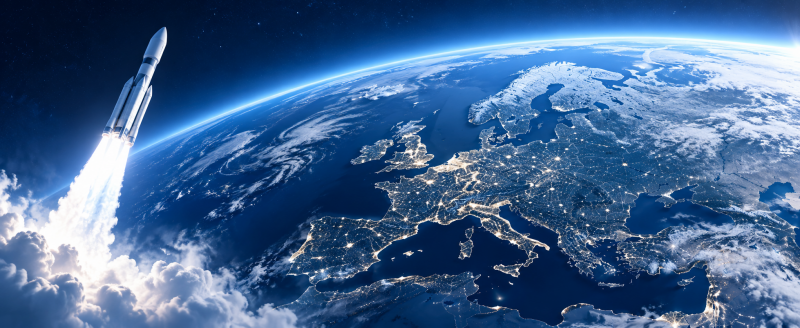
European Space
Tracking Europe's evolving space sector — from launch vehicles and spaceports to satellites, exploration missions and emerging technologies. Coverage focuses on verified developments, technical progress and what they mean for Europe's growing space capabilities.
European Launches & Spaceports
Europe is entering a new phase of independent spaceflight, with several commercial launch companies developing vehicles alongside a growing network of European spaceports. This section follows significant launch preparations, test programmes and confirmed missions, distinguishing scheduled flights from provisional targets and longer-term plans.
Coverage includes RFA One and SaxaVord Spaceport in Scotland, Isar Aerospace’s Spectrum, HyImpulse’s SL1, and other important developments across the European launch sector.
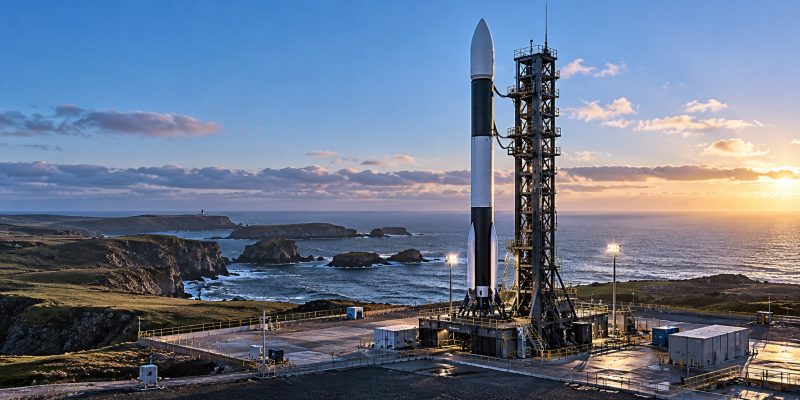
RFA One & SaxaVord
Rocket Factory Augsburg is preparing RFA One for its first test flight from SaxaVord Spaceport in Shetland. The previously targeted summer 2026 launch did not take place, but preparations continue, supported by further UK Space Agency and ESA funding for launch infrastructure and testing. The mission represents an important step towards regular commercial orbital launches from the UK.

Isar Aerospace — Spectrum
German launch company Isar Aerospace achieved a major milestone in September 2026 when its Spectrum rocket successfully reached orbit from Andøya Spaceport in Norway on only its second flight. The mission deployed multiple small satellites and demonstrated a new commercial European orbital-launch capability. Isar is now expanding production, with further Spectrum vehicles already being manufactured as it works towards more frequent launches.
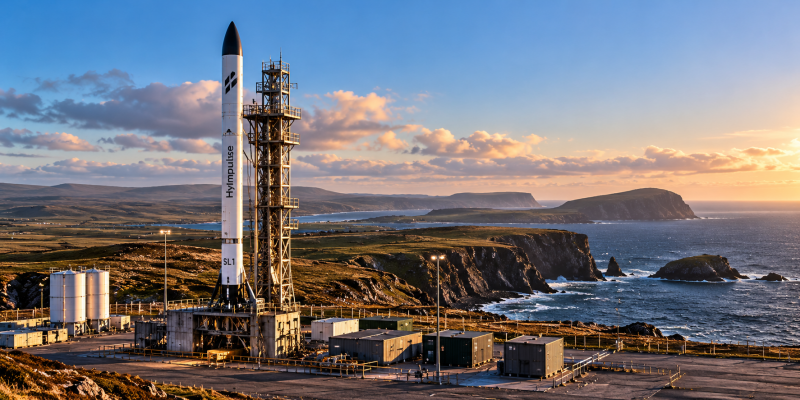
HyImpulse — SL1
German launch company HyImpulse is developing SL1, a three-stage hybrid rocket designed to carry up to 600 kg into low-Earth orbit. In October 2026, HyImpulse secured a UK Launch Operator Licence, clearing an important regulatory milestone for operations from SaxaVord. Its SR75 suborbital rocket is targeted to fly from Shetland in spring 2027, while development of the larger orbital SL1 continues.
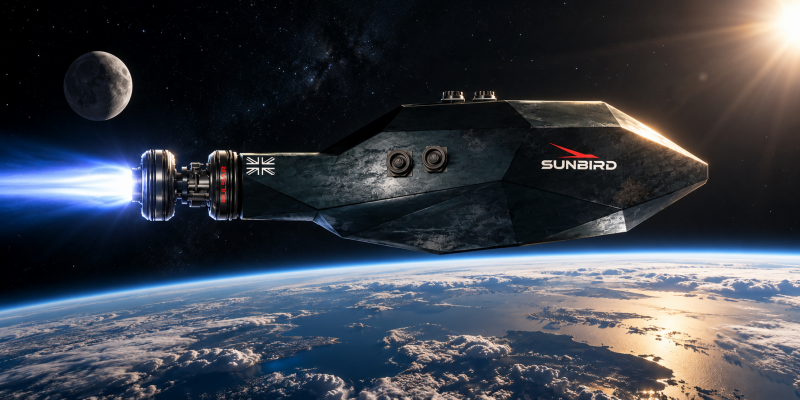
Pulsar Fusion — Sunbird
UK-based Pulsar Fusion is developing Sunbird, an advanced spacecraft concept intended to use direct fusion propulsion for high-speed travel beyond Earth orbit. In April 2026, the programme achieved first plasma in its experimental exhaust system, demonstrating plasma generation and confinement but not yet nuclear fusion. Further ground testing is planned as Pulsar develops its proposed Dual Direct Fusion Drive, with an in-orbit demonstration of core technology targeted for 2027.
ESA & European Missions
Europe operates one of the world’s most extensive space programmes through ESA, the European Union and national space agencies. This section follows major European missions including Ariane 6 launches, Copernicus Earth observation, scientific spacecraft and exploration programmes, focusing on significant milestones and new capabilities.
Ariane 6 — Europe’s Heavy-Lift Launcher
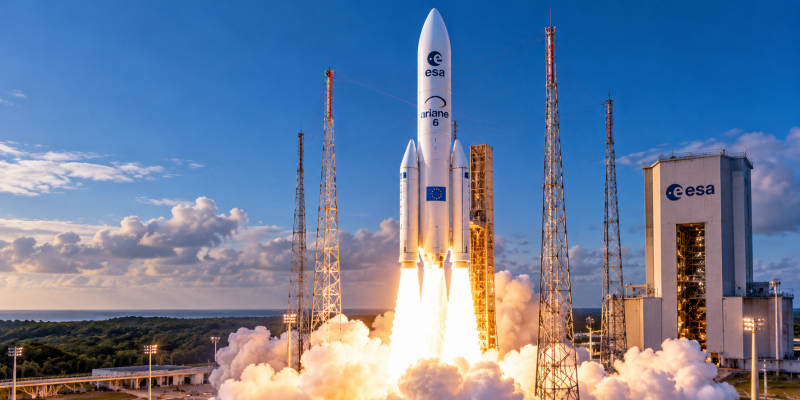
Ariane 6 is now in regular operational service, restoring Europe’s independent heavy-lift launch capability. In 2026 it has flown missions for Amazon Leo and Europe’s Meteosat weather programme. In June, the four-booster Ariane 64 flew with upgraded P160C boosters and placed 36 Amazon Leo satellites into orbit, setting a new payload-weight record for a European launcher. Its latest flight, on 27 August 2026, successfully launched the MTG-I2 weather satellite.
Commercial activity is also expanding: in September, Arianespace announced seven new agreements and MoUs covering approximately ten future Ariane 64 launches.
Copernicus & Earth Observation
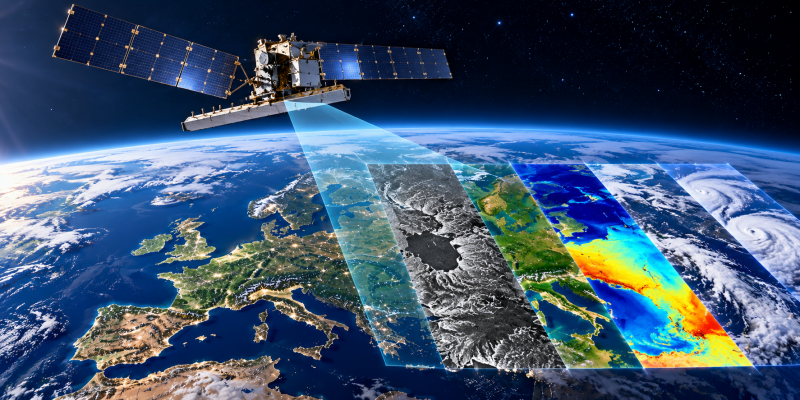
Europe’s Copernicus programme operates the Sentinel family of Earth-observation satellites, providing radar, optical, ocean, land and atmospheric measurements. In 2026 the constellation continued its renewal: Sentinel-1D became fully operational, joining Sentinel-1C to maintain Europe’s all-weather radar capability, while the original Sentinel-1A was retired after 12 years of service.
Sentinel-3C launched in September 2026, extending long-term measurements of ocean colour, sea and land temperatures and sea-surface height. Sentinel-4 is also bringing hourly monitoring of air pollution over Europe from geostationary orbit as part of the new Meteosat Third Generation system.
European Science & Exploration Missions
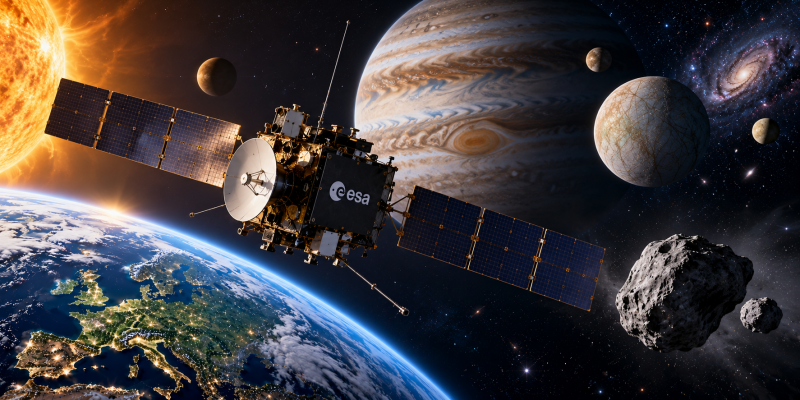
Europe’s scientific spacecraft are exploring targets from the Sun to Jupiter. ESA’s JUICE spacecraft completed another major Earth gravity assist on 28 September 2026, passing 8,640 km above Earth and gaining about 3.5 km/s as it continues its journey towards Jupiter and its ocean-bearing moons. Arrival at Jupiter is planned for July 2031.
Hera is approaching the Didymos–Dimorphos binary asteroid system, with rendezvous scheduled for November 2026. It will investigate the aftermath of NASA’s DART impact and help refine our understanding of asteroid-deflection techniques for planetary defence. Meanwhile, Euclid continues mapping the dark Universe and in 2026 reported exceptionally ancient quasars. Solar Orbiter continues its close study of the Sun, with a December 2026 Venus flyby expected to increase its orbital inclination to around 24°, providing increasingly direct views of the Sun’s polar regions.
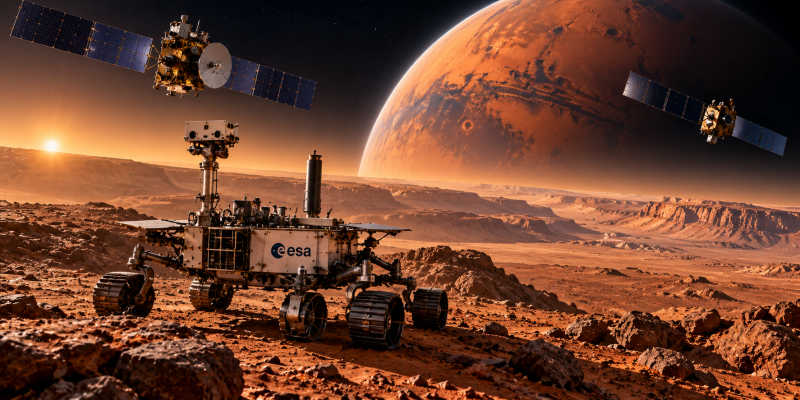
ESA Exploring Mars
Mars remains one of the central targets of European planetary exploration. ESA's Mars Express has been studying the Red Planet since 2003, producing detailed colour and three-dimensional views while investigating its surface, subsurface, atmosphere and history of water. New imagery released in 2026 continues to reveal remarkable Martian landscapes, including ancient terrain, vast dune fields and colourful formations near the south pole.
Europe is also preparing the ExoMars Rosalind Franklin rover for launch in 2028 and landing at Oxia Planum in 2030. Unlike previous Mars rovers, Rosalind Franklin will be able to drill as deep as two metres beneath the surface, where potential biological signatures are better protected from radiation and surface chemistry. Its onboard laboratory will analyse samples as scientists investigate whether ancient, water-rich Mars ever provided conditions suitable for life.
ESA's ExoMars Trace Gas Orbiter is already operating around Mars, studying the planet's atmosphere and trace gases while mapping water-rich material beneath the surface. Together, these missions combine orbital imaging, atmospheric science and future surface exploration in Europe's continuing search to understand Mars and its potential for past life.
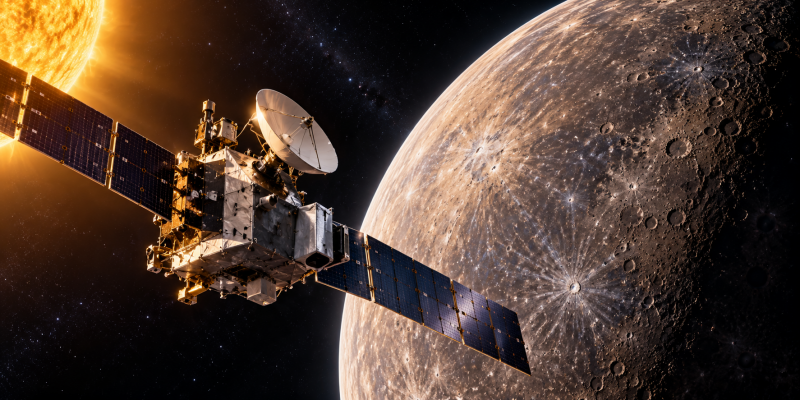
BepiColombo — Exploring Mercury
BepiColombo, a joint ESA–JAXA mission, is completing an eight-year journey to Mercury and entering one of the most technically demanding phases of European planetary exploration. After nine planetary flybys, its Mercury Transfer Module separated successfully in September 2026, leaving ESA's Mercury Planetary Orbiter and JAXA's Mio spacecraft to complete the final approach. The two spacecraft are scheduled to enter orbit around Mercury on 21 November 2026 before separating in December.
Beginning in April 2027, the two orbiters will investigate Mercury simultaneously from complementary orbits. Their instruments will examine the planet's surface and composition, enormous iron-rich interior, magnetic field, exosphere and interaction with the solar wind. The mission should provide an unprecedented view of the least-explored terrestrial planet and help scientists understand how Mercury — and the inner Solar System — formed and evolved.
What’s Next for European Space
Europe is entering an important new phase in spaceflight. New commercial launch systems are moving towards regular operations, established programmes such as Ariane 6 and Copernicus are expanding, and ambitious technologies including fusion propulsion are being developed alongside major ESA science missions. This page will be updated as RFA One, Isar Aerospace, HyImpulse, Sunbird and European institutional missions reach significant new milestones.
Last updated: October 2026