

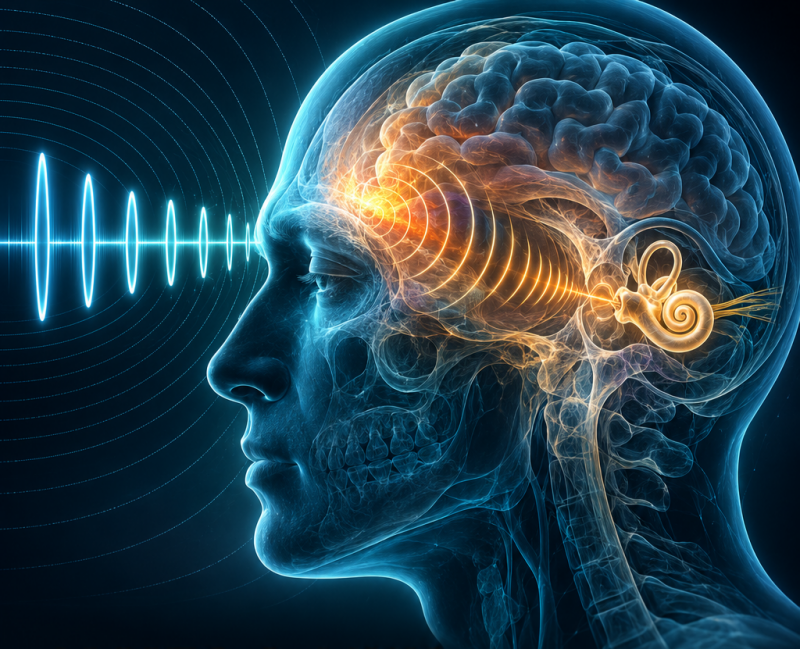
The Microwave Auditory Effect (Frey Effect)
The microwave auditory effect is an experimentally established phenomenon. Under particular conditions, pulsed radiofrequency energy can produce auditory sensations without a conventional external sound source. Reported perceptions include clicks, buzzing, hissing, knocking and tones.
1. What Is the Microwave Auditory Effect?
The Frey effect, also known as the microwave auditory effect, describes the perception of sounds produced by exposure to certain forms of pulsed radiofrequency energy. A person may perceive clicks, buzzing, knocking or other auditory sensations even though no corresponding acoustic sound is present in the surrounding environment.
American neuroscientist Allan H. Frey reported systematic observations of the phenomenon in the early 1960s. Subsequent experimental research demonstrated that appropriately pulsed microwave energy could produce auditory sensations in humans and experimental animals.
The leading physical explanation is the thermoelastic mechanism. A sufficiently brief RF pulse deposits a very small amount of energy in tissue, producing rapid transient heating and expansion. This generates a pressure wave that can propagate through the head and ultimately stimulate the auditory system.
This distinction is important: the established microwave auditory effect does not mean that microwaves are literally converted into ordinary airborne sound. Nor does the existence of the effect, by itself, demonstrate that radiofrequency energy caused Havana Syndrome. Those are separate questions requiring separate evidence.
2. How the Effect Works
When appropriately pulsed radiofrequency energy is absorbed by tissue in the head, it can produce an extremely small and rapid temperature increase. This transient heating causes thermoelastic expansion, generating pressure waves that propagate through tissue and can stimulate the auditory system.
The resulting sensation may be perceived as a click, buzz, knock or other sound even though no equivalent acoustic sound is travelling through the surrounding air.
This thermoelastic mechanism is supported by experimental research and provides the accepted physical explanation for the microwave auditory effect. Importantly, the temperature rise involved can be extremely small; the effect does not require the tissue to undergo substantial heating.
The microwave auditory effect itself is experimentally established. Whether this mechanism can explain particular reported incidents — including cases associated with Havana Syndrome — is a separate question that must be assessed against the evidence.
3. From Clicks to Communication: Speech and Morse Code
The microwave auditory effect was not limited experimentally to simple clicks or buzzing. Researchers also demonstrated that deliberately controlled microwave pulse patterns could convey information.
In work described by Don R. Justesen in 1975, engineer Arthur W. Guy received complex messages in Continental Morse code when operation of a telegraph key controlled the timing of microwave pulses directed towards his head. The perceived pulse patterns could therefore carry symbolic information that the listener could interpret as a message.
A further demonstration by Joseph C. Sharp and Mark Grove went beyond Morse code. Recordings of the spoken digits one to nine were electronically processed so that features of each recorded waveform triggered microwave pulses. Justesen reported that Sharp and Grove could hear, identify and distinguish the resulting encoded words.
This distinction is important: encoded Morse-code communication and limited prerecorded speech were experimentally demonstrated; they were not merely hypothetical proposals. However, the speech evidence was limited to nine expected single-syllable digits and was reported through Justesen's peer-reviewed account rather than a complete standalone experiment with modern controls and independent replication. It therefore does not establish arbitrary sentences, natural continuous conversation, or covert communication under uncontrolled real-world conditions.
4. James C Lin's Computational Head Model
James C Lin developed mathematical and computational models to examine how pulsed radiofrequency energy absorbed by tissue could produce extremely small, rapid temperature changes. Through thermoelastic expansion, these changes generate acoustic pressure waves within the head. The resulting waves can propagate towards the inner ear and stimulate the cochlea, producing an auditory sensation without an equivalent airborne sound entering the ear.
Early versions of Lin’s modelling used simplified representations of the head. Later computational work employed anatomical human-head models and numerical simulation to calculate the thermoelastic pressure waves produced by RF exposure. These models allowed researchers to examine quantities such as pressure amplitude, frequency and the conditions under which the resulting signal could reach the threshold of auditory perception.
An Early Step Towards Digital-Twin Modelling
In modern terms, this work can be viewed as an early conceptual precursor to digital-twin-style modelling: a computational representation of human anatomy was being used to predict how a physical stimulus would interact with biological tissue.
5. What Does This Have to Do With Havana Syndrome?
The microwave auditory effect is relevant to the scientific discussion surrounding Havana Syndrome—now more formally described by the US government as Directed Energy Bio-Effects (DEBE)—but relevance should not be confused with proof of causation.
The established science shows that appropriately pulsed radiofrequency energy can produce auditory sensations without conventional airborne sound. Historical experiments went further, demonstrating deliberate information encoding through microwave pulse timing, including Continental Morse code and limited recognisable prerecorded speech.
These findings establish physical capabilities that are important when evaluating proposed explanations for unusual auditory experiences. They do not, however, establish that microwave energy caused the incidents reported in Havana or elsewhere.
Demonstrating an effect in a controlled experiment and attributing a real-world incident to that mechanism are fundamentally different evidentiary questions. Attribution would require evidence connecting an exposure source, appropriate signal characteristics and exposure conditions to a particular incident.
The position taken throughout this research archive is therefore deliberately narrow: the Frey effect is established science; encoded Morse-code communication and limited prerecorded speech were experimentally demonstrated; their use in Havana Syndrome remains an unproven hypothesis.
6. What the Evidence Does — and Does Not — Establish
Research into the microwave auditory effect spans several different levels of evidence. Keeping those levels separate is essential when assessing what the scientific literature actually demonstrates.
Established or experimentally demonstrated
• The microwave auditory effect itself: appropriately pulsed radiofrequency energy can produce auditory sensations in humans.
• Control of perceived pulse timing and rhythm has been experimentally demonstrated.
• Morse-code communication using microwave pulse patterns was demonstrated and reported in the scientific literature.
• Limited encoded prerecorded speech was demonstrated in the Sharp-Grove experiment reported by Don R. Justesen. The demonstrated vocabulary consisted of the nine single-syllable digits one through nine.
Not established by those experiments
• Arbitrary, natural, continuous speech delivered through the microwave auditory effect.
• Reliable covert communication across uncontrolled real-world environments.
• That microwave auditory exposure produces the complete pattern of symptoms reported in Anomalous Health Incidents.
• That such a system was used against personnel in Havana or in any particular reported incident.
• Attribution of such incidents to a particular country, intelligence service or other actor.
The central evidentiary principle is simple: demonstrating a physical effect does not establish every proposed application of that effect. Each step—from perception, to communication, to injury, operational use and attribution—requires additional evidence.
7. Sources & Further Reading
This research summary draws upon the experimental and historical literature on the microwave auditory effect, together with subsequent scientific reviews and government assessments relevant to Anomalous Health Incidents.
Key Experimental & Scientific Literature
Allan H. Frey (1962) — Human Auditory System Response to Modulated Electromagnetic Energy
Journal of Applied Physiology, 17(4), 689–692.
One of the foundational experimental papers documenting auditory sensations produced by pulsed radiofrequency energy in human subjects.
https://journals.physiology.org/doi/abs/10.1152/jappl.1962.17.4.689
Don R. Justesen (1975) — Microwaves and Behavior
American Psychologist, 30(3), 391–401.
Important historical review describing microwave bioeffects research, including the experiments involving encoded Morse code and the Sharp/Grove speech demonstration discussed earlier on this page.
https://psycnet.apa.org/doiLanding?doi=10.1037%2F0003-066X.30.3.391
James C. Lin (1976) — Microwave Auditory Effect—A Comparison of Some Possible Transduction Mechanisms
Journal of Microwave Power, 11(1), 77–81.
Examines possible physical mechanisms underlying microwave-induced auditory perception and finds thermal expansion capable of producing stresses large enough to dominate the other mechanisms considered.
https://www.tandfonline.com/doi/abs/10.1080/00222739.1976.11688989
James C. Lin (1977) — Theoretical Calculation of Frequencies and Thresholds of Microwave-Induced Auditory Signals
Radio Science, 12(6S), 237–242.
Applies thermoelastic models to calculate the frequency and amplitude of microwave-induced acoustic signals, including predicted displacement and pressure. This is particularly relevant to our new Section 4.
https://agupubs.onlinelibrary.wiley.com/doi/10.1029/RS012i06Sp00237
James C. Lin, Jenn-Lung Su & Yujin Wang (1988) — Microwave-Induced Thermoelastic Pressure Wave Propagation in the Cat Brain
Bioelectromagnetics, 9(2).
Reports direct measurements of acoustic pressure-wave propagation in cat brains exposed experimentally to pulsed 2.45-GHz microwaves, providing experimental evidence relevant to the thermoelastic mechanism.
https://onlinelibrary.wiley.com/doi/10.1002/bem.2250090205
Modern Reference Work
James C. Lin (2021) — Auditory Effects of Microwave Radiation
This specialist book brings together the history, physics and experimental evidence surrounding microwave-induced hearing. Particularly relevant chapters cover the microwave auditory effect, microwave-to-acoustic energy conversion, thermoelastic pressure waves in head models and computer simulations using anatomical models.
https://link.springer.com/book/10.1007/978-3-030-64544-1
Anomalous Health Incidents / Havana Syndrome
National Academies of Sciences, Engineering, and Medicine (2020) — An Assessment of Illness in U.S. Government Employees and Their Families at Overseas Embassies
A major independent scientific assessment commissioned by the U.S. Department of State. The committee examined clinical evidence and possible mechanisms associated with reported Anomalous Health Incidents. It concluded that many of the distinctive acute signs, symptoms and observations were consistent with directed, pulsed RF energy, while noting that no mechanism had been proven and important uncertainties remained.