

The History Of The Microwave Auditory Effect
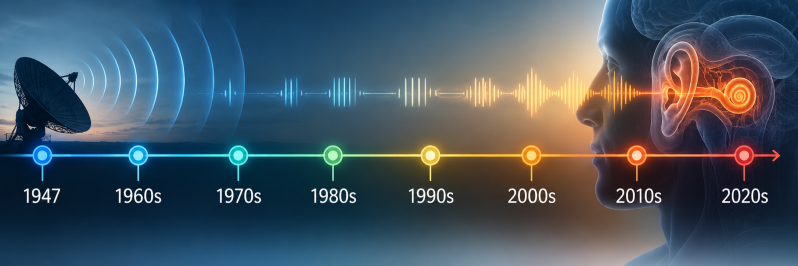
From radar observations in 1947 to modern bioelectromagnetic research
The history of the microwave auditory effect begins not in a neuroscience laboratory, but in the early world of high-power radar.
In 1947, personnel at the Airborne Instruments Laboratory in Mineola, New York reported unusual auditory sensations while working near a radar antenna. The observation later appeared publicly in a 1956 Airborne Instruments Laboratory advertisement in Proceedings of the IRE.
These reports are historically significant, but they need to be interpreted carefully. They did not establish that microwave energy itself was responsible. Radar installations contained conventional acoustic, electrical and mechanical sources that could also produce sound. What the 1947 episode provides is an early documented observation that preceded the controlled scientific investigation of microwave hearing.
During the following decade, military interest in the biological effects of microwave radiation expanded considerably. The initial concern was predominantly heating and occupational exposure, but researchers increasingly investigated whether radiofrequency energy could also produce more specific effects on the nervous system.
By 1956, the U.S. Department of Defense had assigned the Air Force responsibility for coordinating a Tri-Service programme examining the biological hazards of microwave radiation. The first annual Tri-Service conference was held at Griffiss Air Force Base in July 1957, bringing together work on dosimetry, tissue heating, neural effects and possible nonthermal responses.
This created the scientific environment from which systematic microwave-auditory research would emerge.
1961–1962 — Allan H. Frey Establishes Microwave Hearing Experimentally
The decisive transition came with Allan H. Frey.
Frey published an initial technical report in 1961 and, in 1962, Human Auditory System Response to Modulated Electromagnetic Energy. In controlled experiments, volunteers exposed to appropriately pulsed radiofrequency energy reported auditory sensations described as buzzing, clicking, knocking and hissing.
This is why Frey remains central to the history. The 1947 reports were observations associated with radar; Frey transformed the phenomenon into a reproducible experimental research problem.
1960s — From Discovery to a Scientific Research Field
Following Allan H. Frey’s early investigations, the microwave auditory effect became a subject of systematic scientific study. Frey demonstrated that appropriately pulsed radiofrequency energy could produce auditory sensations perceived within the head, despite the absence of conventional acoustic sound reaching the ear.
His work showed that the perceived sensations depended strongly on the characteristics of the RF pulses. Subjects reported clicks, buzzing, hissing and knocking-like sounds, helping establish that the phenomenon was reproducible rather than simply an unusual anecdotal observation.
This period laid the experimental foundations for what became known as the microwave auditory effect, or Frey effect. Researchers increasingly began asking not merely whether the phenomenon existed, but how electromagnetic pulses interacted with biological tissue and ultimately produced an auditory perception.
The research that followed would lead to increasingly sophisticated experiments—including the transmission of deliberately encoded information—and eventually to demonstrations of Morse-code-like signalling and intelligible speech through pulsed radiofrequency energy.
1970s — From Auditory Sensations to Encoded Information
During the 1970s, research into the microwave auditory effect moved beyond demonstrating that pulsed radiofrequency energy could produce simple sounds. Investigators increasingly explored how the characteristics and timing of RF pulses could influence what a person perceived.
This period included experiments in which pulse patterns were used to convey encoded information, including Morse-code-like signals. It also culminated in the well-known work associated with Joseph C. Sharp and Mark Grove, in which speech was encoded into a sequence of microwave pulses and reportedly perceived as intelligible words.
The importance of these experiments is sometimes obscured by descriptions of microwave hearing as merely the perception of clicks or buzzing. The historical record shows that researchers had progressed beyond this: structured information and limited speech had been demonstrated experimentally.
These demonstrations did not establish that arbitrary thoughts, voices or complex information could simply be transmitted directly into the brain. Rather, they showed something much more specific: appropriately structured pulsed radiofrequency signals could exploit an established auditory phenomenon to convey deliberately encoded acoustic information.
This distinction is central to understanding both the demonstrated capabilities of the microwave auditory effect and the limits of what the historical experiments actually established.
Late 1970s–1980s — Explaining the Mechanism
As the microwave auditory effect became better established experimentally, researchers increasingly focused on explaining how pulsed radiofrequency energy could produce an auditory sensation without ordinary airborne sound entering the ear.
Experimental and theoretical work increasingly supported a thermoelastic mechanism. A sufficiently short RF pulse deposits a very small amount of energy in tissue, producing rapid thermal expansion. This generates a pressure wave that propagates through the head and can stimulate the auditory system.
This explanation was important because it placed the microwave auditory effect within conventional physics and auditory physiology. The phenomenon did not require the radiofrequency signal itself to be interpreted directly by neurons as sound. Instead, electromagnetic energy produced a mechanical pressure response that ultimately reached the auditory apparatus.
Researchers including James C. Lin developed mathematical and computational approaches for examining RF interaction with the head, while experimental work by other investigators helped refine understanding of thresholds, pulse characteristics and biological interactions.
By this stage, microwave hearing was no longer simply an unexplained laboratory curiosity. A physical mechanism capable of accounting for the effect was becoming increasingly well characterised, providing the scientific foundation for much of the research that followed.
1976–1985 — Mapping the Auditory Pathway
During the late 1970s and early 1980s, William T. Joines and Blake S. Wilson approached microwave hearing from complementary fields: microwave engineering and auditory physiology. Their research examined how microwave energy interacted with the head, where responses appeared within the auditory system, and which physical mechanism best explained the phenomenon.
In 1976, Joines published Reception of Microwaves by the Brain, examining microwave absorption, energy deposition and several possible mechanisms by which pulsed microwaves might produce auditory effects. At this stage, competing explanations—including electromagnetic, mechanical and thermal mechanisms—were still being investigated.
A particularly important experiment followed in 1980. Wilson, John M. Zook, Joines and John H. Casseday mapped activity in the auditory systems of rats exposed to microwave radiation. Their results supported the conclusion that the microwave-induced auditory stimulus could bypass the middle ear while still engaging the auditory pathway, with responses observed in structures including the inferior colliculus and medial geniculate body.
Joines and Wilson continued investigating alternative mechanisms, including whether electromagnetic forces could act directly within the cochlea. By 1985, however, their review of the accumulated evidence concluded that thermoelastic expansion was the predominant mechanism for pulsed microwave hearing: rapid energy deposition produces a minute thermal expansion, generating a mechanical pressure transient that is subsequently processed by the auditory system as sound.
Their work helped clarify an essential point: the brain is not functioning as a conventional radio receiver that directly demodulates microwave RF. The electromagnetic stimulus is converted into a mechanical auditory stimulus before normal auditory processing takes place.
James C. Lin — Consolidating the Science
By the 1970s, James C. Lin had become an important figure in the effort to explain microwave-induced hearing quantitatively. His work examined how pulsed microwave energy is absorbed within the head and how that energy can generate the acoustic pressure responsible for auditory perception.
Lin's research formed part of a wider experimental network that included Arthur W. Guy, C. K. Chou and Don Christensen. Their work investigated microwave-induced acoustic effects, dosimetry and auditory responses, helping connect the physics of RF absorption with measurable effects in biological auditory systems.
In 1978, Lin brought much of the developing field together in his book Microwave Auditory Effects and Applications. By this point, microwave hearing had progressed considerably from the radar-associated observations of 1947 and Frey's controlled experiments of the early 1960s. Researchers were now able to examine the phenomenon through microwave engineering, acoustics, dosimetry and auditory physiology.
This period helped establish the microwave auditory effect as a multidisciplinary scientific phenomenon: pulsed electromagnetic energy is absorbed in tissue, rapid thermoelastic expansion generates a pressure transient, and the resulting mechanical stimulus is processed through the auditory system.
1990s–2000s — Consolidation and Continued Research
By the 1990s, the microwave auditory effect was no longer simply an unexplained observation. Decades of experimental and theoretical work had established the phenomenon and produced a physical framework for understanding how appropriately pulsed radiofrequency energy could generate an auditory response.
Research increasingly focused on refining dosimetry, thresholds, exposure conditions and thermoelastic modelling. Improvements in computational methods also made it possible to model electromagnetic energy absorption within anatomically complex structures with greater precision.
The field continued to draw together several disciplines—including microwave engineering, bioelectromagnetics, acoustics, auditory physiology and computational modelling—rather than developing as an isolated branch of neuroscience.
James C. Lin remained an important contributor to this later literature, revisiting and synthesising microwave-auditory research as the experimental evidence and modelling techniques developed.
By this period, the central scientific question had therefore changed substantially. Researchers were no longer primarily asking whether microwave hearing existed, but examining the physical and biological parameters that determine when it occurs, how strong the resulting auditory stimulus is, and how accurately it can be modelled.
2000s–2020s — Modern Research and Renewed Interest
By the twenty-first century, the microwave auditory effect had become an established phenomenon within the scientific literature. Later research and reviews continued to examine the relationship between RF pulse characteristics, absorbed energy, thermoelastic pressure generation and auditory perception.
Advances in computational modelling and dosimetry also provided increasingly sophisticated ways of studying how electromagnetic energy interacts with biological tissue. Rather than treating the head as a simple uniform object, modelling could account for the different electromagnetic properties and geometry of tissues when estimating energy deposition and resulting effects.
The subject received renewed public attention after 2016, following reports of unexplained health incidents affecting U.S. diplomatic and government personnel, initially in Havana, Cuba. Microwave and radiofrequency mechanisms subsequently became one of several proposed explanations discussed by scientists, government bodies and intelligence agencies.
This renewed interest should not be confused with evidence that the microwave auditory effect caused Havana Syndrome. The existence of MAE is experimentally established; its involvement in those incidents remains a separate and unresolved question.
More Than Seven Decades of Research
From the 1947 radar-associated auditory reports, through Frey's controlled experiments, the intensive research of the 1970s and 1980s, and later modelling and review work, the history of microwave hearing spans more than seven decades. The broader RF-bioeffects history extends across more than eight decades.
Across that history, the research progressed through several distinct stages: an unusual radar-associated observation became a reproducible laboratory phenomenon; researchers investigated its physical mechanism and auditory pathway; deliberately structured pulse sequences were used in reported demonstrations of Morse code and limited intelligible speech; and subsequent work increasingly refined the physics, dosimetry and biological response.
The result is a phenomenon whose existence and principal thermoelastic mechanism are well established, while questions about particular applications or its relevance to unexplained incidents must be evaluated separately against their own evidence.