


A Theoretical Method for Building a Radio Frequency Digital Twin of the Physical World
Research by Martin Broughton — Independent Researcher, United Kingdom
This research explores whether radio transmissions already present in modern environments could be used as sources of illumination for constructing a continuously updated computational model of the physical world.
Distributed receivers could measure how signals change as they propagate through, reflect from and diffract around buildings, terrain, vehicles, people and other objects. Those measurements could then be compared with predictions generated from maps, environmental information and known transmitters, allowing the model to update where prediction and observation differ.
The proposed result is not a perfect digital replica of reality. It is a probabilistic RF-informed digital twin whose representation of structure, material response, occupancy and movement would retain uncertainty and remain constrained by the information actually contained in the measurements.
The Core Idea
Conventional RF modelling normally begins with a representation of the physical environment and predicts how radio waves should propagate through it. This hypothesis asks whether that relationship can also be used in reverse: observe how radio waves actually propagate and use the differences between prediction and measurement to infer properties of the physical environment.
Conceptually:
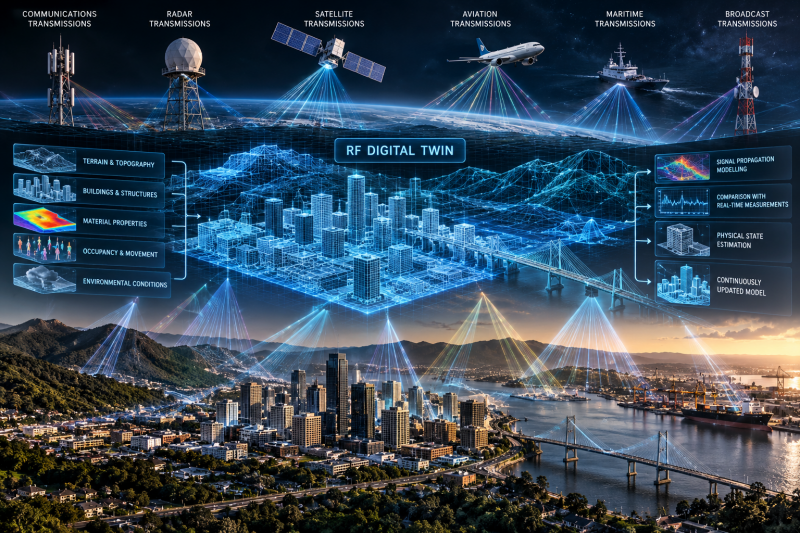
Known RF transmissions → distributed measurements → propagation prediction → comparison with observation → physical-state estimation → digital-twin update
No single frequency or sensor would provide a complete reconstruction. Different frequency bands and viewing geometries would contribute different information, while repeated measurements over time could progressively update the model.
How the System Would Work
The proposed architecture begins with radio transmissions already present in the environment. Instead of treating these signals solely as communications or radar transmissions, distributed receivers would measure how they have been altered by their journey through the physical world.
Objects and environmental conditions influence RF propagation through reflection, diffraction, scattering, absorption and attenuation. Measurements of characteristics such as amplitude, phase, frequency, time and angle of arrival, Doppler shift and channel response could therefore contain information about the environment through which the signals travelled.
A computational model would predict what those measurements should look like based on its current representation of terrain, buildings, materials, transmitters and environmental conditions. The predicted signals could then be compared with the signals actually observed.
Where prediction and observation disagree, an estimation system could update the digital twin to find a physical-state model that better explains the measurements.
This creates a continuous feedback process:
Observe → predict → compare → estimate → update → observe again
As additional measurements arrive from different frequencies, locations and viewing geometries, the model could progressively refine its representation while retaining uncertainty where the available RF information is insufficient.
Why Multiple RF Bands Matter
No single radiofrequency band would provide all of the information required to construct a detailed digital twin. Different frequencies interact with the physical environment in different ways, meaning that a multi-band architecture could combine complementary observations.
Lower-frequency signals generally have longer wavelengths and can propagate over large areas or interact with structures differently, but their wavelength limits the spatial detail they can resolve.
Higher-frequency signals can potentially provide finer spatial information, although they are often more sensitive to obstruction, attenuation and propagation geometry.
The proposed system therefore considers information from multiple classes of existing transmission, including broadcast signals, cellular networks, Wi-Fi, satellite transmissions and radar systems. Radar sources could include weather, aviation and maritime systems where their characteristics make their measurements useful.
These sources would not be interchangeable. Their frequencies, bandwidths, transmitter locations, signal structures and geometries determine what information could realistically be extracted from them. The purpose of combining them is therefore not simply to collect more signals, but to exploit different physical views of the same environment.
Measurements taken from multiple locations would add another important dimension. An object that is poorly constrained from one transmitter–receiver geometry may be better observed from another, allowing the reconstruction system to reduce uncertainty by combining independent perspectives.
Building the Initial Model
RF measurements would not necessarily have to construct the digital twin from nothing. Existing information could provide an initial approximation of the physical environment before RF observations begin refining it.
Terrain and mapping data could establish large-scale geometry. Building information could provide approximate structures. Weather and atmospheric models could improve estimates of propagation conditions. Transmitter databases could identify expected RF sources, while orbital information could provide predicted satellite positions and signal paths.
These datasets would act as priors—starting assumptions for the model rather than proof that the represented environment is correct. RF observations would then provide additional evidence that could reinforce, modify or challenge those assumptions.
This distinction is central to the proposed architecture: the digital twin would be continuously estimated from evidence, rather than treated as a fixed map.
Hierarchical Reconstruction & Selective Refinement
Attempting to reconstruct an entire city or region continuously at maximum possible resolution would create enormous sensing and computational demands. The proposed architecture therefore uses a hierarchical model, in which different parts of the environment are represented at different levels of detail.
Large, relatively static features such as terrain and major structures could remain represented comparatively coarsely and require less frequent updating. Regions containing movement, uncertainty or particular objects of interest could receive additional measurements and more intensive computational processing.
The system could therefore progressively refine selected areas:
Large-scale environment → region → structure → local area → object or movement
This approach would allow computational resources to be concentrated where additional detail is useful rather than attempting to maintain uniform resolution everywhere.
Repeated observations could also improve confidence over time. Static features observed from multiple geometries could become increasingly well constrained, while changing measurements could indicate movement or changes in the environment.
However, additional computing power cannot create physical information that was never present in the measurements. Ultimate resolution would remain constrained by factors such as wavelength, bandwidth, signal-to-noise ratio, transmitter and receiver geometry, multipath and the number of independent observations available.
Occupancy, Movement & Identity
Changes in RF propagation can contain information about occupancy and movement. Objects entering or leaving an environment alter propagation paths, while motion can produce time-varying measurements and Doppler information that may allow physical tracks to be estimated.
A sufficiently developed RF digital twin could therefore attempt to represent where objects are located and how they move through the reconstructed environment.
There is, however, an important distinction between tracking an object and knowing its identity. RF reconstruction alone would not inherently reveal that a reconstructed moving object corresponds to a particular named person.
Associating identity with a track would require a separate information source and continuity model capable of linking an external identity to the physical object represented within the digital twin.
This boundary is important both technically and conceptually. The RF digital twin proposed here is primarily a method for physical-state estimation; personal identification is a separate problem and should not be assumed merely because movement can be reconstructed.
What Could an RF Digital Twin Actually Represent?
The proposed digital twin would not reproduce every property of the physical world with equal accuracy. Instead, different features would be represented according to what the available RF measurements could actually constrain.
Terrain and large structures would provide the broad geometric framework. Buildings, walls and other major objects could influence propagation through reflection, diffraction, attenuation and shadowing, allowing aspects of their geometry to contribute to the reconstructed model.
Material properties could potentially be represented probabilistically where different materials produce distinguishable electromagnetic responses. Rather than simply labelling an object with certainty, the system could maintain competing estimates of its likely properties and update them as additional observations become available.
Occupancy and movement would form the dynamic layer. Changes in propagation, Doppler information and repeated observations could potentially reveal movement and allow tracks to be maintained through the environment.
Environmental conditions would also matter. Atmospheric and weather conditions can alter propagation and would therefore need to be incorporated into the model rather than treating the RF environment as static.
Crucially, the result would remain an estimate with uncertainty. Some features might be strongly constrained by multiple independent observations, while others could remain ambiguous or effectively invisible to the available measurements.
The Limits of Reconstruction
The digital-twin concept should not be interpreted as a method for seeing everything everywhere. Its capabilities would ultimately be governed by the physics of the signals used to construct it.
Spatial resolution is constrained by wavelength, bandwidth and geometry. Detection sensitivity depends on signal strength, noise and the electromagnetic contrast of an object relative to its surroundings. Occlusion and multipath can both reveal and obscure information, while insufficient viewing angles can leave parts of the environment poorly constrained.
Different physical configurations can also sometimes produce similar RF measurements, creating ambiguity in the inverse problem. A robust reconstruction system would therefore need to preserve alternative explanations rather than forcing every observation into a single supposedly exact model.
Additional sensors, frequencies, viewing geometries and observations over time could reduce some of this uncertainty—but they cannot eliminate fundamental information limits.
For this reason, the proposed RF digital twin is best understood as a probabilistic physical-state model that becomes more or less detailed according to the evidence available, not a perfect real-time replica of reality.
Potential Applications
An RF digital twin would have potential applications well beyond the specific research questions that led to this proposal. If sufficiently accurate reconstruction could be achieved, the same underlying architecture could support several different fields.
Wireless-network planning: A continuously updated model of buildings, obstacles and propagation conditions could improve coverage prediction, interference management and placement of communications infrastructure.
Emergency response: RF-derived information about structural change, occupancy or movement could potentially supplement conventional sensors in environments where visibility or physical access is limited.
Transport and infrastructure: Persistent modelling could help monitor movement around roads, ports, airports and other infrastructure, while changes in RF propagation might provide additional evidence of physical changes within the environment.
Robotics and autonomous systems: An RF-informed environmental model could provide another sensing layer alongside cameras, lidar and radar, particularly where optical visibility is poor.
Scientific and environmental modelling: Combining RF observations with maps, terrain, weather and other datasets could provide another way of studying how changing physical environments influence radio propagation.
Defence and security: Multi-band RF sensing and persistent environmental modelling could potentially contribute to situational awareness, detection, tracking and decision-support systems.
These applications would require different levels of resolution, latency and confidence. Demonstrating that the architecture is useful for one application would not automatically establish its suitability for another.
Observed, Inferred, Predicted & Generated
A digital twin should distinguish between what its sensors actually measured and what its computational model added or inferred.
Observed: directly supported by a sensor measurement or external record.
Derived: calculated from observations through a defined physical relationship.
Inferred: selected by the model as the most likely explanation for the available evidence.
Predicted: projected into the future from the current estimated state.
Generated: added by software for visualisation or realism without direct evidential support.
This distinction becomes increasingly important as digital twins become visually realistic. A detailed 3D representation may appear authoritative even when some of its features were inferred or generated rather than actually measured.
The proposed architecture would therefore retain information about confidence, spatial resolution, source and age alongside reconstructed features. A visually convincing digital twin should never be mistaken for evidence that every displayed detail was directly observed.
How Could the RF Digital Twin Hypothesis Be Tested?
The proposed architecture can be investigated experimentally without first constructing a city-scale system. Individual elements could be tested at progressively larger scales to determine how much physical information can actually be recovered from RF measurements.
Controlled reconstruction: Begin with a room or small outdoor environment whose geometry and contents are independently known. Distributed receivers could measure existing or controlled RF transmissions and researchers could compare the reconstructed model with ground truth.
Multi-band comparison: The same environment could be observed using different frequency bands to determine what additional information each contributes and whether combining them genuinely improves reconstruction.
Movement and occupancy: Controlled experiments could introduce people or objects into the environment and test whether the system reliably detects changes, estimates movement and maintains physical tracks.
Material estimation: Known materials could be introduced to determine whether their electromagnetic effects can be distinguished reliably enough to improve the model.
Prediction and correction: A digital twin could predict expected RF measurements before new observations arrive. The difference between prediction and measurement would provide a quantitative way to evaluate and update the model.
Scaling: Experiments could then progress from rooms to buildings, campuses and larger areas while measuring how accuracy, computational demand and uncertainty change with scale.
The most important measurements would include localisation error, spatial resolution, detection probability, false-positive rate, reconstruction uncertainty, update latency and computational cost. Results should be compared with independently measured ground truth rather than judged primarily by how convincing the resulting visualisation appears.
Conclusion & Research Status
This research proposes a method for constructing a persistent digital representation of the physical environment using information contained within radiofrequency propagation.
The underlying ingredients are not individually exotic. Radar imaging, passive RF sensing, channel estimation, synthetic-aperture techniques, propagation modelling, state estimation and digital twins are established areas of research. The hypothesis lies in combining these principles into a persistent, multi-band RF-informed model of the wider physical environment.
The resulting system would not be omniscient. Its representation would remain constrained by wavelength, bandwidth, receiver geometry, noise, propagation conditions and incomplete observations. Additional computation could improve estimation where measurements contain useful information, but it could not reconstruct information that was never captured.
The appropriate research question is therefore not whether radio waves can somehow produce a perfect virtual copy of reality, but how much physically useful information can be reconstructed by combining many imperfect RF observations—and how that information improves as sensing diversity, observation time and computational modelling increase.
The proposal remains a theoretical architecture. Its ultimate value depends on experimental validation against known physical environments.
Research by Martin Broughton — Independent Researcher, United Kingdom