

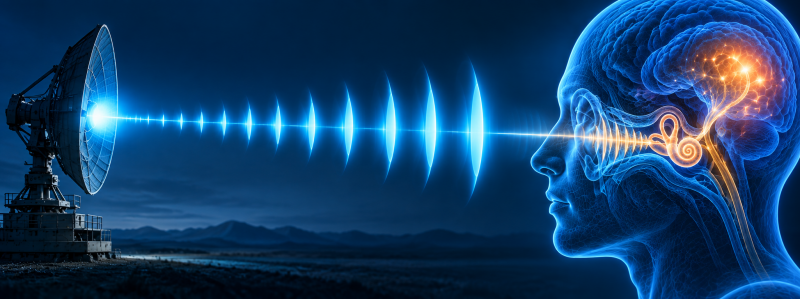
How the Microwave Auditory Effect Works
The microwave auditory effect occurs when appropriately pulsed radiofrequency energy produces an auditory sensation without conventional airborne sound entering the ear.
The best-supported explanation is the thermoelastic mechanism. A short RF pulse deposits a very small amount of energy in tissue. This produces rapid, minute heating and expansion, generating a pressure wave that travels through the head and can stimulate the auditory system.
From RF Pulse to Auditory Perception
Pulsed RF energy → energy absorption → rapid thermoelastic expansion → pressure wave → auditory-system stimulation → perceived sound
The important distinction is that the brain is not simply acting as a radio receiver and directly decoding radio waves. The RF energy produces a physical response in tissue, creating a mechanical stimulus that can enter the auditory processing pathway.
What Is Perceived?
Depending on the characteristics of the pulses, experimental subjects have reported sensations described as clicks, buzzing, hissing, knocking and other sounds.
Experiments have also gone beyond simple auditory sensations. Structured pulse patterns have been used to convey encoded information, including Morse-code-like signalling and limited intelligible speech.
Where Does Perception Enter the Process?
Producing an auditory stimulus and interpreting that stimulus are different parts of the process. Once an auditory signal reaches the nervous system, normal neural processing becomes central to how patterns are organised and perceived.