

Encoded Communication: Morse Code & Speech
When microwave-induced auditory perception became a carrier of information
The microwave auditory effect is often described simply as the perception of clicks, buzzing or other sounds produced by appropriately pulsed radiofrequency energy. However, experiments reported during the 1970s went a significant step further: researchers deliberately organised microwave-induced auditory events so that they conveyed recognizable information.
Two demonstrations are particularly important. One involved Arthur W. Guy and Continental Morse code. The other, associated with Joseph C. Sharp and H. Mark Grove, involved speech information converted into sequences of microwave pulses.
These experiments are important because they distinguish encoded microwave-auditory communication from hypothetical capabilities. They provide historical evidence that meaningful information—including limited intelligible speech—could be represented through the microwave auditory effect. They do not demonstrate thought reading, transmission of thoughts, or unrestricted arbitrary speech communication.
Arthur W. Guy — Morse Code
Don R. Justesen's 1975 article Microwaves and Behavior described an experiment involving microwave researcher Arthur W. Guy, an experienced telegrapher, and his father, a retired railroad telegraph operator.
In the described arrangement, operation of a telegraph key controlled microwave pulses directed toward Guy. The resulting microwave-induced auditory events could be interpreted according to Continental Morse code, demonstrating that deliberately timed pulses could carry symbolic information to a listener through the microwave auditory effect.
The significance is straightforward: an individual microwave-induced click carries very little information by itself, but the timing and organisation of multiple perceived events can form a meaningful code.
Joseph C. Sharp & H. Mark Grove — Encoded Speech
The second demonstration went beyond symbolic signalling and explored whether speech information could be represented through microwave-induced auditory pulses.
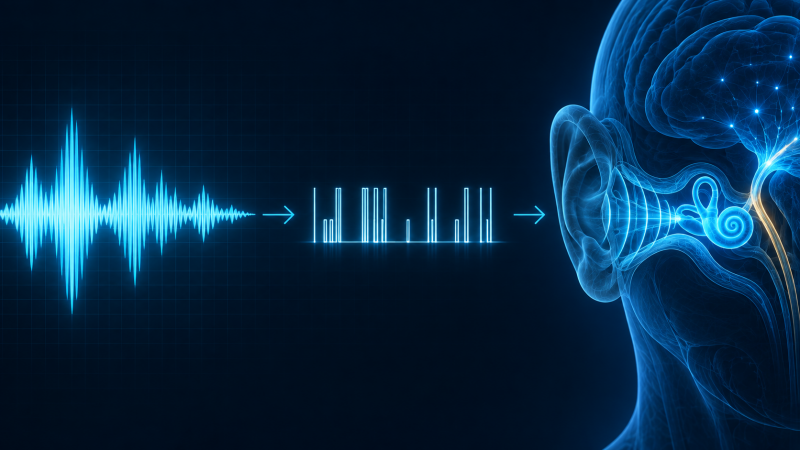
According to Don R. Justesen's 1975 account, Joseph C. Sharp and H. Mark Grove recorded spoken material and processed the resulting speech waveform so that brief microwave pulses were generated at selected points in the waveform. When exposed to the resulting pulse sequences, recognizable words were reportedly perceived.
This is an important historical distinction. The experiment did not merely produce clicks that were subsequently interpreted as an agreed code, as in the Morse-code demonstration. Instead, characteristics derived from a recorded speech waveform were used to determine the timing of microwave pulses, producing an auditory percept that reportedly retained sufficient information for words to be recognized.
What Is the Historical Evidence?
The speech demonstration is described publicly in Don R. Justesen's 1975 article, Microwaves and Behavior. Importantly, Justesen's reference list identifies his source as “Sharp, J. C., & Grove, M. Personal communication, September 28, 1973.”
This means the demonstration should be described as a reported experimental demonstration, rather than as a separately published Sharp–Grove peer-reviewed speech paper.
Sharp, Grove and Om P. Gandhi did publish a separate IEEE paper in 1974, Generation of Acoustic Signals by Pulsed Microwave Energy, but that paper concerned acoustic generation and mechanism. It was not the speech-demonstration paper.
What the Experiments Established — and What They Did Not
The Guy and Sharp–Grove demonstrations established an important principle: microwave-induced auditory sensations could be deliberately structured so that a listener received meaningful information rather than isolated clicks or other simple sounds.
Guy's demonstration showed that the timing of microwave-induced auditory events could represent a symbolic code. The Sharp–Grove demonstration, as reported by Justesen, went further by deriving pulse timing from recorded speech and reportedly producing recognizable spoken words.
These findings support describing encoded information and limited intelligible speech as reported experimental capabilities of MAE, rather than merely hypothetical possibilities.
They do not, however, demonstrate thought reading, extraction or transmission of internal thoughts, or a general-purpose system capable of remotely delivering unrestricted speech under arbitrary real-world conditions. Those are separate claims requiring separate evidence.
Encoding Is Not Thought Transmission
The distinction is fundamental. In these experiments, the information existed before transmission. Morse code was deliberately represented through pulse timing, while the speech demonstration began with recorded speech whose waveform was processed to determine when microwave pulses were produced.
The listener's nervous system therefore did not originate or transmit the message. It received an externally structured auditory stimulus and interpreted the resulting information.
In simple terms:
Message → encoding → microwave pulse sequence → auditory perception → recognition
This is a form of information transmission through an unusual auditory pathway, not communication directly between one person's thoughts and another person's brain.
Why These Experiments Matter
These demonstrations mark an important point in the history of microwave-auditory research. They show the progression from producing an auditory sensation to deliberately organising that sensation to convey information.
At the same time, the surviving evidence imposes clear boundaries on what can be claimed. The Morse-code demonstration is described by Justesen, while the speech demonstration ultimately rests on his published account of a 1973 personal communication from Sharp and Grove rather than a standalone peer-reviewed Sharp–Grove speech paper.
Understanding both the achievement and the evidential limitations provides a more accurate picture of what microwave-auditory communication experiments actually demonstrated.