

A Technology-Focused Hypothesis for Havana Syndrome Methodology
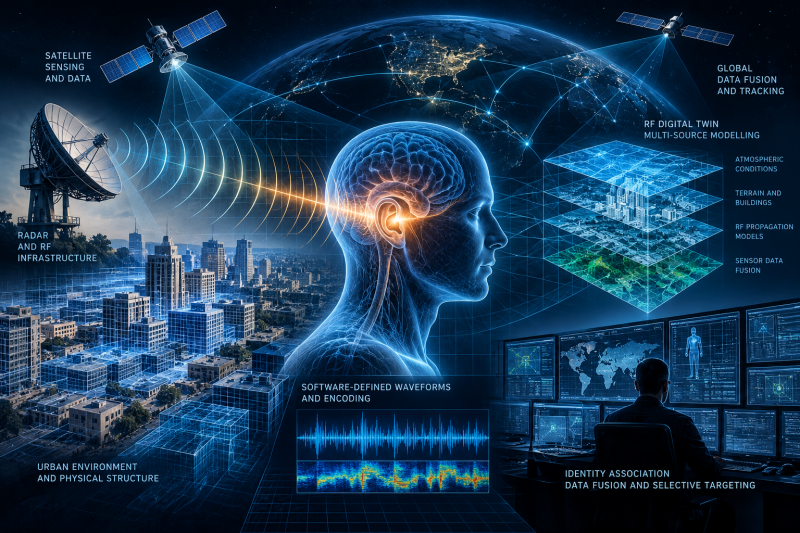
This research examines whether experimentally established microwave-auditory phenomena could, in principle, be combined with modern RF engineering, sensor fusion, digital-twin modelling, automated tracking and software-defined systems into a more sophisticated technological architecture.
The hypothesis does not claim that such an integrated system has been demonstrated to exist or that it caused Havana Syndrome. Instead, it separates established scientific and technological capabilities from proposed integrations and identifies the experimental evidence that would be required to test them.
Evidence Status
Experimentally established: Pulsed radiofrequency energy can produce microwave-auditory perception. Historical experiments also reported the transmission of meaningful information, including Morse code and limited speech, through microwave-auditory stimulation.
Established technological capabilities: Digital signal processing, programmable RF waveforms, electronically steered antennas, automated tracking, multi-source data fusion, artificial intelligence and computational environmental modelling.
Hypothesised integration: The proposed architecture examines whether identity association, sensor fusion, RF environmental modelling, tracking, emitter selection, waveform encoding and selective RF delivery could be integrated into a larger system.
Speculative extension: Direct RF-mediated transmission of encoded visual information remains substantially more speculative and is treated separately from the experimentally established microwave-auditory effect.
The Proposed Architecture
The hypothesis considers whether a series of independently established technologies could, in principle, be connected into a larger system. Rather than proposing a single device, it examines an architecture in which different technologies perform separate sensing, modelling, identification, control and RF functions.
At its broadest, the proposed chain is:
Identity information → multi-source data fusion → RF/environmental digital twin → localisation and tracking → compatible emitter selection → propagation prediction → MAE encoding → waveform selection → beam control → RF exposure
Each stage presents its own technical requirements and limitations. Demonstrating that one component is technologically possible does not establish that the complete system exists or has ever been deployed.
1. Identity, Tracking & Data Fusion
A selective system would first need a means of distinguishing an intended individual from other people in the same environment. RF sensing could potentially provide information about occupancy, movement and physical structure, but it would not inherently reveal personal identity.
The hypothesis therefore proposes a separate identity-association and data-fusion layer capable of linking identity information to a continuously maintained physical track.
Modern multi-source systems provide useful comparisons for this concept. Project Maven is discussed in the research solely as an example of an established class of technology capable of combining sensor information and differentiating tracked entities. It is not suggested or alleged that Maven, Palantir, or their personnel were involved in Havana Syndrome.
2. RF Digital Twin & Environmental Modelling
A second layer of the hypothesis concerns maintaining a continuously updated computational representation of the surrounding radiofrequency environment — an RF digital twin.
Rather than relying on a single sensor, the model could theoretically combine heterogeneous RF observations with information about terrain, buildings, atmospheric conditions, known transmitters and satellite geometry. Measurements such as timing, frequency, phase, angle of arrival, Doppler shift and channel response could contribute different information about the environment.
The resulting model would not be a perfect virtual copy of the physical world. It would be a probabilistic and continuously corrected representation, with accuracy constrained by wavelength, bandwidth, signal-to-noise ratio, receiver geometry and the observations actually available.
Within the wider Havana Syndrome hypothesis, this layer would provide environmental and localisation information. It would not by itself identify a named individual or provide a microwave-auditory transmission capability. Those functions require separate layers of the proposed architecture.
Related research: This concept is developed independently in A Theoretical Method for Building a Radio Frequency Digital Twin of the Physical World, which examines the sensing architecture, reconstruction process, limitations and possible applications in greater detail.
3. Distributed RF Infrastructure & Remote Operation
Reports of Anomalous Health Incidents across geographically separated locations create an additional requirement for any hypothesis proposing a common technological mechanism: how could the same underlying capability operate in different environments and countries?
The hypothesis considers a distributed architecture rather than a single transmitter operating globally. Different sensing and RF resources could theoretically contribute to a wider computational system, with software coordinating information between geographically separated components.
Existing infrastructure—including weather, aviation, maritime and military radar, satellite systems and communications networks—demonstrates that powerful RF transmitters and large-scale sensing networks already exist. However, these systems operate at different frequencies, powers, bandwidths and geometries and are designed for different purposes.
Their existence therefore does not establish a global MAE transmission network. For any existing emitter to perform the transmission role proposed by the hypothesis, it would need compatible hardware, appropriate waveform capabilities, sufficient beam control, suitable propagation conditions and an accessible control architecture.
A hypothetical software layer could then select compatible resources and configure predefined waveform or encoding profiles remotely. No public evidence presented in this research establishes that civilian or military radar networks contain hidden MAE modes or can presently be repurposed in this manner. This remains one of the engineering propositions requiring demonstration.
4. Encoding Information & Speech
This part of the hypothesis begins with an important experimental distinction: encoding meaningful information through the microwave auditory effect is not purely hypothetical.
Historical research described the reception of Continental Morse code through microwave-induced auditory clicks and later experiments in which processed speech was reportedly perceived and recognized through microwave-auditory stimulation.
The hypothesis asks how modern digital technology might extend those early demonstrations. Digital signal processing can generate and manipulate pulse sequences with far greater flexibility than the analogue equipment available during the historical experiments. Text-to-speech or prerecorded audio could provide source information, while a separate encoding stage would attempt to translate that information into an MAE-compatible pulse sequence.
Conceptually:
Text / audio → speech processing → MAE encoding → programmable waveform generation → RF transmission
Modern speech synthesis and programmable waveform generation are established technologies, while historical experiments provide evidence for limited information transmission through MAE. What has not been publicly demonstrated is reliable, high-fidelity arbitrary speech transmission through MAE under the practical remote-exposure conditions required by this hypothesis.
5. Selective Delivery & Beam Control
If an RF-based system were intended to affect a selected individual while minimizing exposure to surrounding people, identification alone would not be sufficient. The transmission system would also require sufficiently accurate localisation, tracking and directional control.
Directional antennas and electronically steered phased arrays are established technologies. By controlling the relative timing and phase of multiple antenna elements, an electronically scanned array can steer RF energy without mechanically pointing the antenna and can rapidly update its direction as a tracked object moves.
The hypothesis considers whether these established principles could be combined with the earlier identity and tracking layers so that an RF beam remained associated with a selected physical track.
This is an important engineering boundary. The ability of software to distinguish one tracked person from another does not automatically mean an RF system could expose one person's head while leaving everyone nearby unaffected. Beam width depends on factors including wavelength, antenna aperture, distance and propagation conditions, while reflections and multipath can redistribute RF energy within real environments.
Selective delivery therefore represents one of the most important experimental requirements of the hypothesis. A proposed implementation would need to demonstrate quantitatively that the required exposure could be delivered to the intended location with sufficient spatial selectivity under realistic conditions.
6. Software Control, AI & Machine Learning
Artificial intelligence is proposed as a control and optimisation layer, not as a new biological mechanism.
Machine-learning systems could theoretically assist with combining heterogeneous sensor information, maintaining tracks, predicting short-term movement, modelling propagation uncertainty and selecting among candidate system configurations.
Software could also maintain predefined waveform profiles or encoding strategies. Rather than constructing every transmission from scratch, a hypothetical control system could select and modify previously validated profiles according to the intended output and physical conditions.
This would still depend on experimentally establishing the underlying relationships between RF parameters and human perception. AI cannot compensate for missing physics or biological evidence. Without validated parameter–effect relationships and appropriate feedback data, a machine-learning system would have no reliable basis for determining which waveform should produce a particular percept.
7. Speculative Extension: Visual Perception
The proposed visual-perception extension should be distinguished clearly from the microwave-auditory component of the hypothesis. Microwave-induced auditory perception has an established experimental foundation; comparable remote RF transmission of arbitrary visual information has not been demonstrated by the evidence presented here.
Modern neurotechnology does establish a broader principle: information from an image can be computationally encoded into stimulation patterns, and appropriately targeted neural stimulation can produce visual percepts. Machine learning can also assist in developing and optimising encoding strategies.
The hypothesis asks whether an analogous principle could ever be extended to remotely delivered electromagnetic stimulation. Conceptually, the proposed chain would be:
Image → computational encoding → spatial/temporal stimulation pattern → electromagnetic delivery → neural response → visual percept
However, the crucial electromagnetic-delivery step remains unestablished. A viable system would need to demonstrate sufficiently precise and controllable neural stimulation, reproducible spatial encoding, useful perceptual resolution and a reliable relationship between transmitted parameters and resulting visual perception.
This section therefore represents a speculative research question rather than a claimed capability. It should not be treated as having the same evidentiary status as the microwave auditory effect or the historical Morse-code and speech experiments.
8. How Could the Hypothesis Be Tested?
A useful technological hypothesis should produce predictions that can be experimentally tested and potentially falsified. The proposed architecture therefore suggests several avenues for investigation.
RF detection: Broadband monitoring equipment could search for unusual electromagnetic emissions coinciding with reported acute events and characterize their frequency, pulse timing, modulation and power.
Direction and localisation: Multiple synchronized receivers could investigate whether a detected signal has a consistent direction or source region while accounting for reflections and multipath propagation.
Reproducibility: Candidate waveform parameters could be tested under controlled and ethically approved laboratory conditions to determine whether the predicted perceptual effects actually occur.
Hardware feasibility: Proposed emitters could be evaluated quantitatively for frequency, peak and average power, antenna aperture, achievable beam width, distance and propagation losses.
Selectivity: Experiments could determine whether physically realistic RF systems could provide the spatial selectivity required by the proposed architecture.
System integration: Finally, researchers could examine whether the independently established sensing, modelling, tracking, encoding and RF technologies could actually be connected in the manner proposed rather than assuming that the existence of each component proves the existence of the whole.
Evidence contradicting these requirements would weaken particular implementations of the hypothesis. Conversely, reproducible parameter–effect relationships or contemporaneous detection and localisation of an appropriate RF signal during a well-characterized incident would provide substantially stronger evidence than technological possibility alone.
Conclusion & Research Status
This hypothesis begins with experimentally established microwave-auditory phenomena and asks how far those effects might theoretically be extended when considered alongside modern RF engineering, digital signal processing, electronically steered antennas, automated tracking, multi-source data fusion, artificial intelligence and computational environmental modelling.
The research does not conclude that these technologies have been assembled into the proposed system or that such a system caused Havana Syndrome. Instead, it identifies the technological components and interfaces that would be required if such a mechanism were proposed.
Some elements are experimentally established, others are established technologies being considered in a new context, and several important connections remain hypothetical or speculative. The purpose of the architecture is therefore to provide a framework that can be tested, constrained or rejected by further evidence.
References to Project Maven and other named technologies or infrastructure are included as comparisons of established technological capabilities and architectural principles. They are not accusations that Maven, Palantir, their personnel, or operators of the infrastructure discussed were involved in Havana Syndrome.
The central question remains open: can the independently established components described in this research actually be integrated under physically realistic conditions to produce the proposed effects?
Research by Martin Broughton — Independent Researcher, United Kingdom