

BCI Companies and Technologies
Organisations Advancing Neural Interfaces, Communication and Assistive Technology
Brain–computer interface technology is being developed by a growing number of companies, universities and medical research institutions. Their work combines neuroscience, biomedical engineering, microelectronics and artificial intelligence to create systems capable of recording neural activity and translating it into useful information or commands.
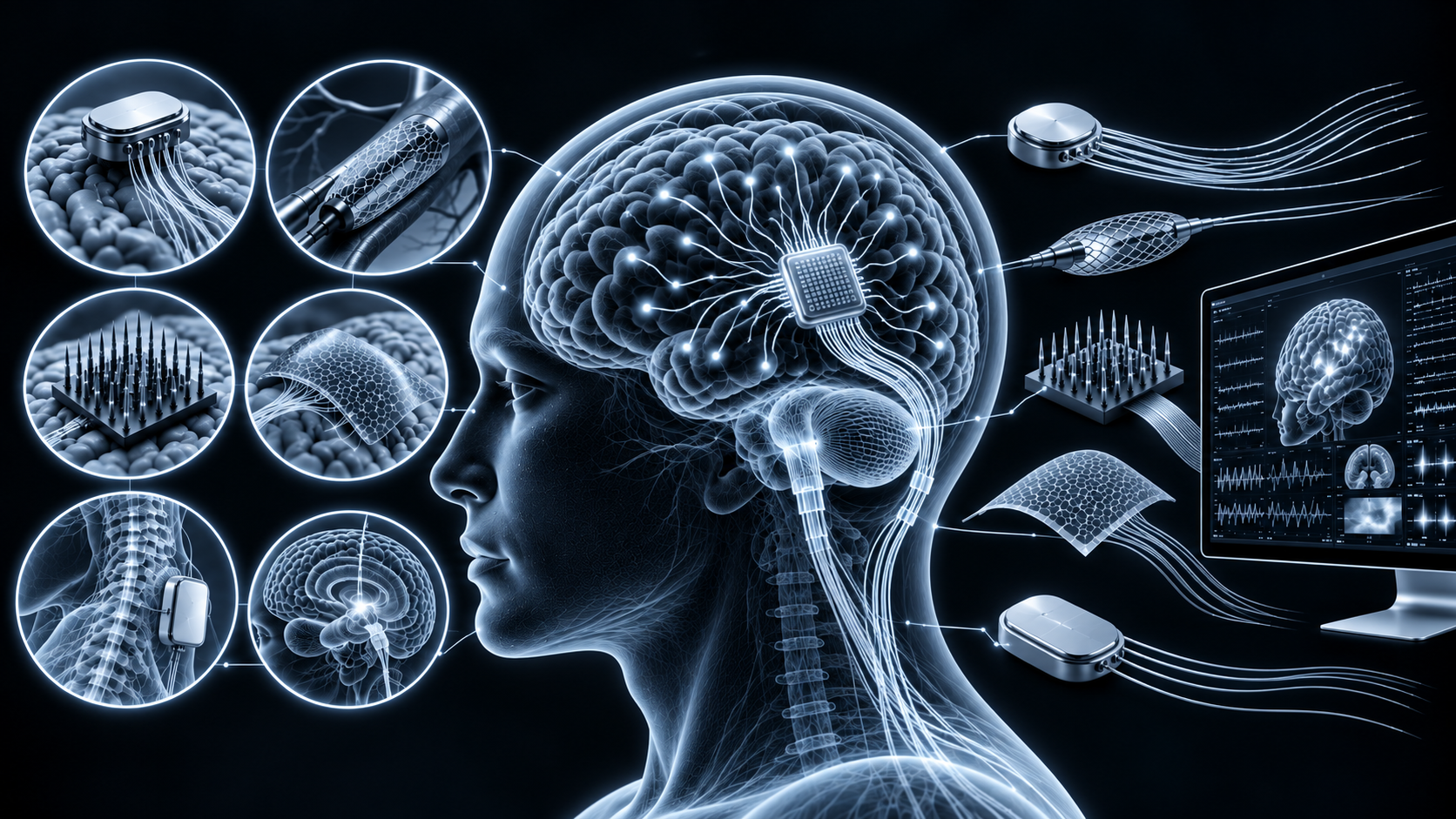
Different organisations are pursuing distinct technological approaches. Some are developing electrodes implanted directly into brain tissue, while others use devices positioned on the brain's surface, within blood vessels or externally on the scalp. These differences influence the types of neural signals that can be recorded, the medical procedures required and the applications each system may support.
One of the most prominent developers is Neuralink, which is investigating implanted neural interfaces for computer control and assistive communication. Other organisations, including Synchron and Blackrock Neurotech, are advancing alternative recording technologies, while European companies such as Spain's INBRAIN Neuroelectronics are investigating new materials and implantable neural systems.
These developments are supported by academic research into neural decoding, attempted-speech reconstruction, robotic control and artificial intelligence. Some technologies have demonstrated capabilities in human research participants, while others remain at earlier stages of development or clinical evaluation.
This section examines the organisations, technologies and research programmes contributing to modern brain–computer interface development, with particular attention to their demonstrated capabilities, technical differences and potential medical applications.
Neuralink
Implantable Brain–Computer Interfaces and Computer Control
Neuralink is an American neurotechnology company founded in 2016, with Elon Musk among its co-founders. The company develops implantable brain–computer interfaces designed to record neural activity and translate selected patterns into commands for computers and other electronic devices.
Its research focuses particularly on helping people with severe paralysis regain the ability to interact with digital technology.
The N1 Implant and Neural Recording
Neuralink's N1 implant is a compact electronic device designed to be positioned within the skull and connected to the brain through extremely thin, flexible electrode threads.
These threads contain numerous recording sites that detect electrical activity from nearby neurons. The implant processes recorded signals and transmits information wirelessly to an external computer, where decoding software interprets patterns associated with intended movement.
The system is designed to operate without permanent cables passing through the skin, although surgical implantation and specialised external software remain necessary.
Robotic Surgical Implantation
Neuralink has developed a specialised surgical robot intended to insert its flexible electrode threads into selected regions of the brain.
The robot is designed to position the threads with considerable precision while avoiding visible blood vessels where possible.
This surgical approach is an important part of the company's technology because the recording electrodes must be positioned close enough to relevant neural populations to obtain useful signals.
Human Demonstrations and Computer Control
In 2024, Neuralink publicly demonstrated its first human participant using the implanted interface to control a computer cursor through decoded movement intentions.
The participant, who had paralysis, demonstrated activities including moving a cursor, interacting with computer applications and playing chess.
These demonstrations provided evidence that the implanted system could translate selected patterns of neural activity into practical computer-control commands.
Neuralink subsequently continued its human research programme, investigating the performance of its technology in additional participants and applications.
Artificial Intelligence and Signal Interpretation
Neuralink's technology relies on computational decoding to interpret recorded neural activity.
Software identifies patterns associated with intended actions and converts them into commands that can be used by conventional computer interfaces.
As with other brain–computer interfaces, the system does not directly interpret unrestricted thoughts. Its demonstrated capabilities depend on recorded neural signals, trained decoding methods and the specific activities the interface is designed to support.
Future Research and Applications
Neuralink is investigating ways to improve the reliability, speed and versatility of implanted neural interfaces.
Potential applications include more advanced computer interaction, assistive communication and control of external technologies.
The company has also outlined longer-term ambitions involving additional neurological applications and sensory interfaces. These objectives should be distinguished from capabilities already demonstrated in human participants.
Neuralink illustrates how advances in microelectronics, robotic surgery, wireless communication and neural decoding can be combined into an implantable system intended to restore aspects of digital independence for people with severe physical disabilities.
Synchron
Endovascular Brain–Computer Interfaces and Assistive Communication
Synchron is a neurotechnology company founded in Australia in 2012, with operations in the United States. It develops implantable brain–computer interfaces intended to help people with severe paralysis interact with computers and digital communication systems.
The company is particularly known for its endovascular approach, which records brain activity using electrodes positioned inside a blood vessel rather than inserted directly into brain tissue.
The Stentrode Neural Interface
Synchron's principal technology is the Stentrode, an electrode array incorporated into a small, expandable, stent-like structure.
The device is introduced through the vascular system using a catheter and positioned within a blood vessel adjacent to the brain's motor cortex, a region involved in planning and controlling voluntary movement.
Once positioned, the Stentrode records electrical activity associated with movement intentions. The recorded signals are transferred through an implanted electronic system and communicated to external equipment for processing.
This approach allows neural information to be recorded without creating an opening through the skull to insert electrodes directly into brain tissue.
However, the procedure remains invasive and carries medical considerations associated with vascular implantation and long-term device operation.
Computer Control and Communication
Synchron has conducted human clinical research involving people with severe paralysis, including participants with amyotrophic lateral sclerosis (ALS).
Published research has demonstrated that participants could use decoded neural signals to perform computer-based selection tasks and operate digital communication functions.
The system translates recognised patterns of neural activity into commands that can be used to interact with compatible computer interfaces.
These achievements illustrate how an endovascular neural interface can provide an alternative pathway for digital communication when conventional muscular control is severely restricted.
Clinical Research and Technological Development
Synchron has investigated the feasibility and safety of its implanted technology through clinical studies.
Its research has examined whether neural signals recorded from within blood vessels can remain useful for computer interaction over extended periods.
The company has also explored integration with consumer electronic devices and accessibility software, with the aim of making neural control more practical in everyday environments.
These developments remain part of an evolving medical technology programme, and experimental demonstrations should not be interpreted as evidence of unrestricted commercial or clinical availability.
How Synchron Differs from Neuralink
The principal difference between Synchron and Neuralink is the location and method of neural recording.
Neuralink uses flexible electrode threads inserted into brain tissue, allowing recordings from selected neural populations.
Synchron positions its Stentrode within a blood vessel adjacent to the motor cortex, recording neural activity without penetrating the surrounding brain tissue.
These approaches involve different surgical procedures, recording characteristics and engineering considerations.
Neither approach can be considered universally superior. Their suitability depends on the intended application, clinical circumstances, recording performance and results from continuing research.
Future Applications
Synchron is working towards more capable and practical neural interfaces for people with severe physical disabilities.
Potential developments include improved digital communication, more flexible computer interaction and integration with assistive technologies.
The company's research demonstrates that brain–computer interfaces can be developed through alternative implantation strategies, expanding the range of engineering approaches being investigated for restoring communication and independence.
Blackrock Neurotech
Implanted Neural Recording, Robotic Control and Assistive Communication
Blackrock Neurotech is an American neurotechnology company founded in 2008 and based in Salt Lake City, Utah. The company develops neural recording equipment, implantable electrode arrays and brain–computer interface technologies used in neuroscience research and experimental assistive communication systems.
Its technology has contributed to research demonstrating how electrical activity recorded directly from the brain can be translated into commands for computers, robotic equipment and communication devices.
The Utah Array and Neural Recording
One of the best-known technologies associated with Blackrock Neurotech is the Utah Array, a small implantable device containing numerous microscopic electrodes arranged in a regular pattern.
The electrodes penetrate a short distance into brain tissue, allowing researchers to record electrical activity from neurons located near the implant.
These recordings provide information about patterns of neural activity associated with movement intentions and other neurological processes.
The Utah Array has been widely used in experimental neuroscience and has supported important developments in implanted brain–computer interface research.
The BrainGate Research Programme
Blackrock electrode technology has been used in the BrainGate research programme, a long-running collaboration involving universities, hospitals and neuroscience researchers.
BrainGate investigations have demonstrated that people with paralysis can use recorded neural activity to control computer cursors, select information on screens and operate certain external devices.
These experiments have helped establish the scientific foundations of intracortical brain–computer interfaces.
It is important to distinguish the contributions of Blackrock's recording hardware from the wider achievements of the independent academic and clinical teams conducting these experiments.
Robotic Arms and Movement Control
A significant achievement in implanted BCI research has been the use of decoded neural activity to control robotic arms.
In landmark BrainGate experiments, participants with paralysis demonstrated the ability to direct robotic movements through signals recorded from implanted electrodes.
These studies showed that neural activity associated with intended movement could be interpreted computationally and used to operate external mechanical systems.
Such demonstrations established important possibilities for future assistive robotics, although practical performance and capabilities remain dependent on the individual system and experimental conditions.
Communication and Neural Decoding
Blackrock recording systems have also supported research into alternative communication methods for people who cannot speak or use conventional computer controls.
Researchers have investigated the decoding of attempted handwriting, movement intentions and speech-related neural activity.
In a notable 2021 study, researchers demonstrated a system that translated neural activity associated with attempted handwriting into text at comparatively high speeds.
This work illustrated how computational models can interpret complex patterns of intended movement to support communication, even when the corresponding physical movement cannot be performed.
Technology and Research Applications
Blackrock's wider technology portfolio includes neural recording hardware, research equipment and implantable interface systems.
Its equipment has been used to investigate how neural populations represent movement, sensation and other measurable neurological functions.
These applications demonstrate the importance of reliable neural recording technology in developing and evaluating new decoding methods.
Future Developments
Blackrock Neurotech continues to pursue advances in implanted neural interfaces and technologies intended to support communication and physical independence.
Future research may improve recording stability, wireless operation, decoding performance and integration with assistive equipment.
The company's contribution is particularly significant because its electrode technologies have supported years of experimental research, helping establish the practical foundations upon which newer brain–computer interface systems continue to build.
INBRAIN Neuroelectronics — Spain
Graphene-Based Neural Interfaces and Precision Neuromodulation
INBRAIN Neuroelectronics is a Spanish neurotechnology company founded in 2020 and based in Barcelona. The company develops implantable neural interfaces using graphene, an extremely thin form of carbon known for its electrical conductivity, flexibility and mechanical strength.
Its technology is intended to improve the recording and modulation of neural activity, with particular emphasis on medical applications involving neurological disorders.
Unlike companies primarily developing brain–computer interfaces for cursor control or communication, INBRAIN focuses substantially on therapeutic neural interfaces that combine electrical recording, computational processing and targeted stimulation.
Graphene and Neural Recording
Graphene consists of carbon atoms arranged in a two-dimensional structure. Its electrical and mechanical properties make it a promising material for certain types of biological sensors and electronic interfaces.
INBRAIN is developing flexible graphene-based electrode arrays designed to interact with neural tissue.
These devices are intended to record electrical activity and, in suitable configurations, deliver controlled electrical stimulation.
The use of graphene may offer advantages in electrode flexibility, device design and signal acquisition, although the clinical benefits of particular implementations must be established through experimental and medical evaluation.
Brain Recording and Electrical Stimulation
Some neural interfaces are designed not only to record brain activity but also to influence neural circuits through carefully controlled electrical stimulation.
This approach is known as neuromodulation.
Neuromodulation is already an established medical field, with techniques such as deep brain stimulation used to treat selected neurological conditions.
INBRAIN is investigating how graphene-based interfaces and computational processing might support more precise recording and stimulation.
By analysing measured neural activity, future systems may be able to adjust stimulation in response to changes in neurological signals.
Closed-Loop Neural Interfaces
A closed-loop neural interface combines the measurement of biological activity with an automated response.
In principle, a system can record neural signals, identify relevant patterns through computational analysis and adjust electrical stimulation according to predefined therapeutic objectives.
This differs from an open-loop system that delivers stimulation without continuously adapting it to recorded neural activity.
INBRAIN's research explores the potential of such approaches for neurological treatment, where more responsive stimulation could improve the precision of therapy.
Medical Research and Applications
INBRAIN has investigated applications involving neurological disorders and the development of implantable medical devices.
Its work forms part of a broader effort to create neural interfaces capable of interacting with the nervous system through increasingly sophisticated electronics and materials.
These technologies remain subject to clinical investigation, regulatory requirements and long-term assessment of safety and effectiveness.
Experimental performance should therefore be distinguished from established medical treatments or devices available for routine clinical use.
How INBRAIN Differs from Other BCI Developers
Neuralink, Synchron and Blackrock Neurotech have been strongly associated with systems that decode neural activity to support computer control and communication.
INBRAIN's approach places greater emphasis on advanced electrode materials and therapeutic neuromodulation.
Its graphene-based interfaces illustrate how developments in materials science can contribute to neural recording and stimulation, potentially expanding the range of medical applications for implantable neurotechnology.
Although these approaches share underlying scientific principles, their intended applications and methods of operation are not identical.
Future Developments
Further advances in graphene electronics, flexible implants, artificial intelligence and closed-loop stimulation may enable increasingly precise neural interfaces.
Potential developments include improved recording capabilities, more adaptable therapeutic stimulation and devices designed for longer-term interaction with neural tissue.
INBRAIN represents an important European contribution to the development of neural interface technology, demonstrating how materials science, neuroscience and biomedical engineering can be combined to investigate new approaches to neurological treatment.
Bridge Neurotech — Non-Invasive Ultrasound Brain–Computer Interfaces
Bridge Neurotech is an American neurotechnology company developing non-invasive brain–computer interfaces using functional ultrasound imaging and artificial intelligence. Its proposed system aims to measure changes associated with brain activity through the skull and translate selected patterns into useful information without surgically implanted electrodes. In October 2026, Bridge announced a development partnership with Butterfly Network and began recruiting participants for its first human research study. The technology remains experimental, with important challenges involving ultrasound transmission through the skull, signal interpretation and real-time neural decoding.
Other BCI Developers and Research Organisations
Beyond the major companies already discussed, several organisations are developing alternative approaches to neural recording, computer control, communication and therapeutic neurotechnology.
Their research demonstrates the diversity of brain–computer interface development, from minimally invasive recording technologies to flexible electrodes, artificial intelligence and advanced speech decoding.
Precision Neuroscience — United States
Precision Neuroscience is developing a thin, flexible electrode array designed to record electrical activity from the surface of the brain.
Its Layer 7 Cortical Interface is intended to provide detailed neural recordings while avoiding the insertion of recording electrodes deep into brain tissue.
The company is investigating applications involving communication and computer interaction for people with neurological disabilities.
Its approach illustrates how high-density surface recordings may provide an alternative to penetrating intracortical electrode arrays.
Paradromics — United States
Paradromics develops implantable brain–computer interface technology designed to record neural activity at high data rates.
Its Connexus system is being developed with an emphasis on restoring communication for people with severe motor impairments.
The company's research combines implanted electrode technology, electronic signal acquisition and computational decoding.
Its long-term objectives include translating neural activity associated with intended communication into practical digital outputs. Clinical capabilities must be distinguished from the company's broader development goals.
CorTec — Germany
CorTec is a German neurotechnology company developing implantable neural interfaces for recording and stimulating activity within the nervous system.
Its Brain Interchange technology is designed to support bidirectional interaction, combining neural recording with controlled electrical stimulation.
The company investigates applications involving neurological rehabilitation and therapeutic neuromodulation.
CorTec represents a European approach focused on adaptable neural interfaces that may support both the measurement and modulation of nervous-system activity.
ONWARD Medical — Netherlands and Switzerland
ONWARD Medical is a European medical technology company developing spinal cord stimulation systems intended to help restore movement and other functions following spinal cord injury.
Its research includes brain–spine interface technology, which combines recordings of movement-related brain activity with electrical stimulation of the spinal cord.
In a landmark 2023 research demonstration, a participant with paralysis used an experimental brain–spine interface to support standing and walking.
This approach differs from conventional BCIs designed primarily for computer communication. Instead, decoded movement intentions are used to help coordinate stimulation of neural pathways involved in physical movement.
The technology illustrates how brain interfaces may contribute to the restoration of mobility when combined with other forms of neurostimulation.
Academic Research — United States and Europe
Universities and medical research institutions remain central to advances in brain–computer interfaces.
Research teams at Stanford University, the University of California, San Francisco, Brown University and other institutions have demonstrated important developments involving neural decoding, attempted handwriting, speech reconstruction and assistive computer control.
European research institutions also contribute to neural engineering, non-invasive interfaces, rehabilitation technology and the development of advanced recording methods.
Academic studies are particularly important because they provide detailed experimental methods and independently assess the capabilities and limitations of emerging technologies.
Different Approaches, Shared Scientific Foundations
Although these organisations pursue different applications, their technologies share several underlying principles.
Neural signals must be measured using suitable recording equipment, processed electronically and interpreted using computational methods.
Some systems convert recorded activity into commands for computers or assistive devices. Others combine recording with electrical stimulation to investigate therapeutic applications or the restoration of movement.
These differences demonstrate that brain–computer interfaces are not a single technology but a developing field containing multiple recording methods, engineering approaches and medical objectives.
Research Connections and Further Reading
The development of brain–computer interfaces reflects advances across several scientific disciplines, including neuroscience, biomedical engineering, artificial intelligence, materials science and electronic communication.
Although the organisations examined on this page use different technologies, their work contributes to a broader understanding of how neural activity can be recorded, interpreted and used to interact with external systems.
Brain–Computer Interfaces
The main Brain–Computer Interfaces research page explains the scientific principles underlying neural recording, signal processing and computational decoding.
It also examines established applications involving computer control, attempted-speech reconstruction, assistive communication and digital avatars.
Related research: Brain–Computer Interfaces.
The History of Brain–Computer Interfaces
Modern neural interface technologies developed from earlier discoveries involving electrical activity in the brain, electroencephalography, electrophysiology and computer-assisted signal analysis.
The historical development of the field includes early experiments in neural communication, the emergence of computer-controlled interfaces and the progression towards implanted recording systems.
A dedicated historical overview examines the researchers, experiments and technological developments that helped establish modern brain–computer interfaces.
Further reading: The History of Brain–Computer Interfaces.
Artificial Intelligence and Neural Decoding
Artificial intelligence is an important component of many modern neural interfaces.
Machine-learning systems analyse recorded neural signals and identify patterns associated with intended movement, attempted speech and other measurable neurological processes.
These developments illustrate how computational methods can translate selected biological signals into commands for computers, communication systems and assistive technologies.
Further reading: AI-Based Speech Decoding and Digital Avatar Control
Digital Twins and Avatars
Digital avatars can reproduce selected aspects of human communication, including synthesised speech and animated facial movements.
Research combining neural decoding with digital avatars demonstrates how measured biological activity can be used to control computational representations.
Digital twins represent a related but distinct field involving computational models of physical objects, processes or systems.
Further reading: Digital Twins and Avatars (Coming soon)
Radio Frequency Communication and Encoding
Wireless neural interfaces may use radiofrequency communication to transfer recorded information between implanted or wearable electronics and external processing equipment.
This application demonstrates the role of conventional wireless technologies in modern biomedical devices.
The radio transmission of electronically recorded neural data is distinct from detecting neural activity remotely without suitable recording equipment.
Related research: Radio Frequency Communication and Encoding.