

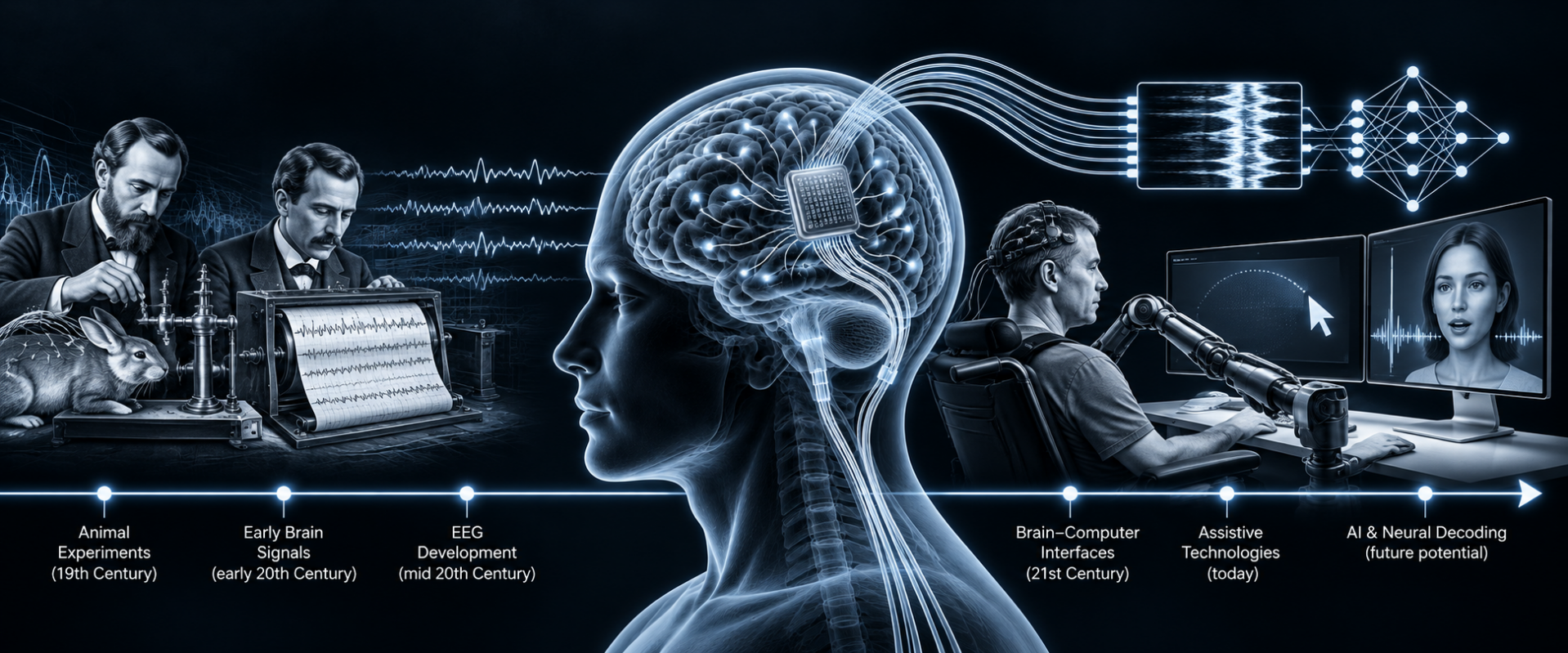
The History of Brain–Computer Interfaces
From Early Brainwave Research to Modern Neural Communication Technology
The development of brain–computer interfaces (BCIs) represents more than a century of scientific progress involving neuroscience, electrical engineering, computing and the study of human behaviour.
Modern systems capable of translating recorded neural activity into computer commands, synthesised speech and robotic movement developed from earlier discoveries concerning the electrical activity of the nervous system.
During the nineteenth and early twentieth centuries, researchers established that the brain produces measurable electrical signals. These discoveries eventually led to electroencephalography (EEG), a method of recording electrical activity using electrodes positioned on the scalp.
In the decades that followed, advances in electronic signal processing and computing created new possibilities for interpreting neural recordings. Researchers began investigating whether patterns of brain activity could be used to communicate information or control external equipment.
By the 1960s and 1970s, pioneering experiments had demonstrated early relationships between recorded neural signals and computer-assisted communication. The work of researchers including Lawrence Pinneo and Jacques Vidal contributed to the emergence of brain–computer interfaces as a distinct field of scientific investigation.
Later developments in implanted electrodes, neural decoding and robotic control expanded the capabilities of these systems. Research programmes such as BrainGate demonstrated that people with paralysis could use recorded neural activity to interact with computers and operate assistive devices.
During the twenty-first century, advances in artificial intelligence and biomedical electronics have enabled increasingly sophisticated demonstrations involving cursor control, attempted handwriting, speech reconstruction and animated digital avatars.
This historical overview examines the researchers, experiments and technological milestones that contributed to modern brain–computer interfaces, distinguishing established scientific achievements from subsequent developments and future research objectives.
The Discovery of Electrical Activity in the Brain
The scientific foundations of brain–computer interfaces can be traced to nineteenth-century investigations into the electrical activity of the nervous system. Long before computers existed, researchers were establishing that the brain produces measurable electrical signals associated with its biological functions.
These discoveries eventually made it possible to record patterns of neural activity and investigate their relationship with movement, perception and behaviour.
Richard Caton and the First Brain Electrical Recordings — 1875
In 1875, British physician Richard Caton reported experiments demonstrating electrical activity associated with the brains of animals, including rabbits and monkeys.
Using sensitive electrical measuring instruments, Caton observed variations in electrical potential from the exposed surfaces of animal brains.
His findings provided early evidence that the brain generates measurable electrical activity and that these signals can change in relation to physiological conditions.
Although his equipment was primitive compared with modern recording systems, Caton's work established an important principle: electrical activity produced by the brain could be detected and investigated experimentally.
This discovery became one of the foundations of electrophysiology and later brainwave research.
Hans Berger and Human Electroencephalography — 1924–1929
German psychiatrist Hans Berger made a major contribution to neuroscience by developing methods for recording electrical activity from the human brain.
In 1924, Berger obtained his first human electroencephalographic recordings. His research demonstrated that electrical activity originating in the brain could be measured using electrodes and sensitive recording equipment.
In 1929, he published his findings, establishing electroencephalography as an important method for studying human brain activity.
Berger identified rhythmic patterns in the recorded signals, including activity that became known as the alpha rhythm, commonly associated with relaxed wakefulness, particularly when the eyes are closed.
These observations helped establish that the brain produces organised electrical activity that can be measured and analysed.
The Development of Brainwave Research
Following Berger's work, researchers continued investigating the electrical rhythms of the brain and their relationship with different physiological and behavioural states.
Electroencephalography became an increasingly important tool in clinical neurology, sleep research and experimental neuroscience.
Researchers identified patterns associated with sleep, wakefulness, sensory stimulation and certain neurological conditions.
Advances in electronic amplification and recording equipment gradually improved the sensitivity and reliability of these measurements.
Although EEG recordings do not directly reveal individual thoughts, they provide information about the collective electrical activity of neural populations.
From Brainwave Recording to Neural Communication
The discovery of measurable brain electrical activity did not immediately lead to brain–computer interfaces.
Early electrophysiological research was primarily concerned with understanding how the nervous system functions rather than using neural signals to control external equipment.
However, these investigations established the essential scientific foundation for later developments.
Once electrical brain activity could be recorded, researchers could begin examining whether particular signal patterns might be associated with identifiable actions or intentions.
The subsequent development of electronic computing and signal-processing technologies would eventually make it possible to translate selected patterns of neural activity into commands for external devices.
This transition from observing brain activity to using it for communication and control became a defining development in the history of brain–computer interfaces.
Early Neural Communication Experiments — 1960s–1970s
During the 1960s and 1970s, advances in electronic computing, signal amplification and neuroscience enabled researchers to investigate whether recorded brain activity could be used to communicate information or control external equipment.
Earlier electrophysiological studies had established that the brain produces measurable electrical signals. The next major development involved interpreting these signals and using them as inputs to electronic systems.
This period helped establish the scientific foundations of modern brain–computer interfaces.
Lawrence Pinneo and Early Neural Communication Research — 1960s
American researcher Lawrence R. Pinneo contributed to early investigations into the relationship between brain electrical activity, electronic signal processing and communication.
Working within the wider development of computer-assisted neuroscience, Pinneo investigated the possibility of using recorded neural activity to identify information associated with human responses and behaviour.
His work belongs to an important period when researchers were beginning to explore whether electrical signals from the nervous system could provide information suitable for interpretation by electronic equipment.
These investigations helped establish the broader scientific context for later brain–computer interfaces, although early experiments should not be equated with the sophisticated neural decoding systems developed decades later.
Jacques Vidal and the Emergence of Brain–Computer Interfaces — 1973
One of the most significant developments occurred in 1973, when computer scientist Jacques J. Vidal published Toward Direct Brain-Computer Communication.
Working at the University of California, Los Angeles, Vidal investigated whether electrical brain activity recorded using EEG could be processed by computers to support direct communication between the brain and an electronic system.
His publication helped establish the term brain–computer interface and provided an influential framework for investigating computer interaction through recorded neural signals.
Vidal recognised that measurable brain activity could potentially provide a communication channel that did not depend entirely on conventional muscular movement.
This concept became central to the development of modern BCI research.
Visual Evoked Potentials and Computer Interaction — 1970s
An important approach investigated during this period involved visually evoked potentials.
When a person observes a visual stimulus, such as a flashing light or changing pattern, the brain produces measurable electrical responses associated with processing that stimulus.
Researchers investigated whether these responses could be identified using EEG and interpreted by computers.
In 1977, Vidal reported experiments demonstrating computer-based detection of visually evoked brain responses for control-related tasks.
These studies provided early evidence that recorded neural activity could be used as an input to an electronic system.
The technique did not involve reading unrestricted thoughts. Instead, it relied on measurable brain responses produced under defined experimental conditions.
The Importance of Computer-Assisted Signal Processing
Early brain–computer interface research depended heavily on advances in electronic amplification, analogue-to-digital conversion and computer-assisted analysis.
Electrical activity recorded from the brain is complex and often contains signals unrelated to the particular task being investigated.
Researchers therefore needed methods for identifying relevant patterns, reducing interference and distinguishing meaningful responses from background activity.
The development of increasingly capable computers made these investigations more practical and laid the foundations for later machine-learning approaches.
Distinguishing BCIs from Radiofrequency Auditory Research
During the same general historical period, separate research programmes investigated the interaction between radiofrequency energy and the human auditory system.
Experiments involving the microwave auditory effect demonstrated that appropriately pulsed electromagnetic energy could produce auditory sensations. Later work also reported the recognition of speech information encoded into pulsed microwave signals.
These experiments concerned the generation of auditory perception through a physical interaction with the auditory system.
Early brain–computer interfaces, by contrast, investigated the recording and interpretation of electrical activity generated by the brain.
Although both fields involve neuroscience, electronics and information processing, they use different mechanisms and should not be treated as interchangeable technologies.
The Foundations of Modern Neural Interfaces
By the end of the 1970s, researchers had established important principles underlying brain–computer communication.
Electrical brain activity could be recorded, particular responses could be identified using computational methods, and selected neural signals could be used as inputs to electronic systems.
These achievements provided the foundation for subsequent developments involving more sophisticated EEG interfaces, implanted electrodes, neural decoding and assistive communication technologies.
Brain–Computer Interfaces in the 1980s and 1990s
During the 1980s and 1990s, brain–computer interface research progressed from early experimental demonstrations towards more systematic methods of communication and computer control.
Advances in digital computing, electroencephalography and signal-processing techniques allowed researchers to identify patterns of brain activity with greater reliability.
This period was particularly important for the development of non-invasive interfaces that could translate measurable neural responses into selections, commands and other forms of computer interaction.
Emanuel Donchin and P300-Based Communication
One of the most influential developments involved the P300 event-related potential, an electrical response that can occur when a person recognises a significant or unexpected stimulus.
The P300 had been investigated in cognitive neuroscience before its application to brain–computer communication.
In 1988, Emanuel Donchin and colleagues, including Lawrence Farwell, published research describing a communication system based on this neurological response.
Their approach used a computer display containing letters and other characters. Rows and columns were briefly illuminated while the participant concentrated on a desired character.
By analysing the brain's electrical responses to the flashes, the system could estimate which character the participant intended to select.
This approach became known as the P300 speller.
It demonstrated that a person could communicate selections through measurable brain responses without using conventional keyboard or mouse movements.
Jonathan Wolpaw and EEG-Based Computer Control
During the 1990s, Jonathan Wolpaw and colleagues made important contributions to the development of EEG-based brain–computer interfaces.
Their research investigated how patterns of sensorimotor brain activity could be used to control computer-generated movement.
Rather than relying exclusively on responses to external stimuli, these systems explored the possibility of using changes in brain rhythms associated with intended or imagined movement.
Participants learned to modify measurable EEG activity while computer algorithms translated selected signal features into control commands.
This research helped establish the importance of training and adaptation in brain–computer interface systems.
It also demonstrated that neural control could involve a learning process shared between the user and the computer.
Gert Pfurtscheller and Motor Imagery
A related area of research involved motor imagery, in which a person imagines performing a movement without physically carrying it out.
Austrian neuroscientist Gert Pfurtscheller and his collaborators made important contributions to understanding how imagined movement affects measurable brain rhythms.
Their investigations focused particularly on changes in sensorimotor activity, including event-related desynchronisation and synchronisation.
These changes can occur when a person prepares, performs or imagines particular movements.
Researchers investigated how such patterns could be classified computationally and used to generate commands for external systems.
Motor-imagery interfaces became an important approach in non-invasive BCI research, particularly for applications involving computer control and neurological rehabilitation.
Improved Computing and Signal Classification
The development of more capable personal computers and digital signal-processing equipment significantly expanded the possibilities for brain–computer interfaces.
Researchers could analyse EEG recordings more efficiently, identify relevant frequency components and apply statistical classification methods to distinguish different neural responses.
These improvements supported increasingly sophisticated experiments involving cursor movement, character selection and other forms of computer interaction.
However, non-invasive EEG systems continued to face limitations involving signal interference, recording resolution and differences between individual participants.
The Emergence of Practical Assistive Communication Research
By the end of the 1990s, researchers had demonstrated several approaches to communication and control through recorded brain activity.
P300 systems showed how attention to visual stimuli could support character selection.
Sensorimotor rhythm and motor-imagery systems demonstrated that users could learn to influence computer outputs through changes in measurable brain activity.
These developments established important foundations for assistive technologies intended to support people with severe physical disabilities.
Although many systems remained experimental, the underlying principles of non-invasive neural communication had become increasingly well established.
The Transition Towards Implanted Neural Interfaces
While non-invasive EEG research continued, advances in neuroscience and microelectrode technology created new opportunities to record activity directly from neural populations.
Researchers increasingly investigated whether implanted electrodes could provide more detailed signals for controlling computers and robotic equipment.
This work would contribute to the development of intracortical brain–computer interfaces and the major clinical research programmes that emerged during the following decade.
Implanted Neural Interfaces and the BrainGate Programme — 2000s
The early twenty-first century marked an important turning point in brain–computer interface research. Advances in microelectrode technology, computer processing and neuroscience enabled researchers to investigate whether electrical activity recorded directly from the brain could provide more detailed control of external devices.
While earlier non-invasive systems had demonstrated communication through EEG signals, implanted interfaces offered the possibility of recording activity from smaller populations of neurons associated with intended movement.
These developments helped establish a new generation of experimental brain–computer interfaces designed for people with severe paralysis.
The Development of Intracortical Neural Interfaces
During the 1990s and early 2000s, researchers increasingly investigated the use of implanted microelectrode arrays to record electrical activity directly from the cerebral cortex.
Important foundations had already been established through animal research demonstrating that neural activity associated with movement could be decoded and used to control external equipment.
Research involving scientists such as John Chapin and Miguel Nicolelis demonstrated the potential of using recorded neural signals to operate robotic devices.
Other researchers, including Andrew Schwartz and colleagues, advanced the decoding of movement-related neural activity for multidimensional control.
These studies provided important experimental foundations for later human brain–computer interfaces.
The BrainGate Research Programme
The BrainGate programme emerged as a major effort to investigate implanted neural interfaces for people with severe physical disabilities.
The research brought together neuroscientists, engineers, clinicians and academic institutions to develop systems capable of translating recorded brain activity into computer commands.
Early BrainGate research used implanted microelectrode arrays positioned within the motor cortex, a region involved in planning and controlling voluntary movement.
The electrodes recorded electrical activity from nearby neurons, while external computing systems processed the signals and estimated intended movements.
The programme aimed to determine whether people with paralysis could use these neural recordings to interact with computers and other assistive technologies.
The Landmark BrainGate Demonstration — 2006
In 2006, researchers published a landmark study in the scientific journal Nature titled Neuronal Ensemble Control of Prosthetic Devices by a Human with Tetraplegia.
The research involved a participant with severe paralysis who had received an implanted microelectrode array within the motor cortex.
By recording and decoding neural activity associated with intended movement, the experimental system enabled the participant to control a computer cursor and perform selected computer-based tasks.
The participant also demonstrated control of external equipment through the interface.
This research provided important evidence that movement-related neural signals could remain accessible after severe spinal cord injury and could be translated into useful commands.
It represented a significant milestone in the development of implanted brain–computer interfaces for human assistive applications.
How Implanted Interfaces Differed from Earlier EEG Systems
Earlier non-invasive brain–computer interfaces generally relied on electrical activity measured through electrodes positioned on the scalp.
Intracortical systems instead recorded activity from electrodes implanted directly within brain tissue.
This approach allowed researchers to obtain more spatially localised neural information and investigate the decoding of detailed movement-related activity.
However, implanted systems required surgical procedures and introduced additional considerations involving long-term recording stability, device maintenance and medical safety.
The two approaches therefore offered different advantages and limitations rather than representing a simple replacement of one technology by another.
The Importance of Neural Decoding
A central achievement of this period was the increasingly sophisticated interpretation of recorded neural signals.
Researchers developed computational methods that estimated intended movements from patterns of electrical activity across multiple recording sites.
These decoding methods allowed neural signals to be translated into commands for computer cursors and experimental assistive equipment.
The results also demonstrated that useful movement-related information could be extracted from recorded brain activity even when a participant could no longer perform the corresponding physical movement.
The Foundations for More Advanced Neural Control
By the end of the 2000s, implanted brain–computer interface research had demonstrated that neural activity recorded from the human motor cortex could support practical computer interaction under experimental conditions.
The BrainGate programme helped establish important foundations for later developments involving multidimensional robotic control, attempted handwriting and neural speech decoding.
These achievements also highlighted the importance of combining implanted electronics, computational modelling and clinical neuroscience.
The following decade would build upon this work, producing increasingly sophisticated demonstrations of robotic movement and assistive communication.
Robotic Arms and Advanced Neural Control — 2010s
During the 2010s, brain–computer interface research progressed significantly as scientists demonstrated increasingly sophisticated control of robotic limbs using neural activity recorded from implanted electrodes.
Earlier experiments had established that people with paralysis could use recorded brain signals to move computer cursors and operate selected electronic devices. The next major objective was to translate intended movements into coordinated physical actions performed by robotic equipment.
These developments combined advances in neural recording, computational decoding, robotics and biomedical engineering.
BrainGate and Robotic Arm Control — 2012
In 2012, researchers associated with the BrainGate programme published a landmark study in Nature demonstrating that people with long-standing paralysis could control a robotic arm through an implanted brain–computer interface.
The system recorded electrical activity from the motor cortex using implanted microelectrode arrays.
Computer algorithms interpreted patterns associated with intended arm movements and translated them into commands for an external robotic device.
Participants demonstrated the ability to direct the robotic arm towards objects and perform reaching and grasping tasks.
One participant used the system to bring a drinking container towards her mouth, demonstrating the potential of neural interfaces to support practical physical activities.
This achievement represented an important progression from controlling a computer cursor to operating a multidimensional robotic system.
University of Pittsburgh and Advanced Prosthetic Control — 2012–2013
Researchers at the University of Pittsburgh developed implanted neural interfaces that enabled a participant with paralysis to control a sophisticated robotic arm.
In research published in 2012, the participant demonstrated coordinated control of a robotic limb using neural activity recorded from implanted electrodes.
The system allowed multiple aspects of movement to be controlled, including the position and orientation of the robotic arm.
Subsequent research explored improvements in movement accuracy, coordination and the control of more complex actions.
These demonstrations provided evidence that neural activity associated with intended movement could be decoded to operate robotic equipment with multiple degrees of freedom.
Sensory Feedback Through Neural Stimulation — 2016
An important limitation of early robotic brain–computer interfaces was the absence of natural sensory feedback.
A person controlling a robotic arm could observe its movements but could not necessarily experience touch sensations corresponding to contact with an object.
In 2016, researchers reported experiments in which electrical stimulation delivered through implanted electrodes in the somatosensory cortex produced localised sensations associated with touch.
The participant could identify stimulation associated with different regions of the hand.
These experiments demonstrated the possibility of providing artificial sensory information through direct neural stimulation.
Such research helped establish foundations for bidirectional brain–computer interfaces, which combine the recording of movement intentions with the delivery of sensory feedback.
Improving Movement Accuracy and Coordination
Throughout the decade, researchers investigated ways to improve the accuracy, speed and reliability of neural control.
Computational models were developed to interpret increasingly complex relationships between neural activity and intended movement.
Researchers also explored shared-control systems in which robotic software assists with certain aspects of movement while the user provides higher-level commands.
These approaches were intended to reduce the demands placed on the user and improve the practical operation of assistive equipment.
From Experimental Robotics to Assistive Technology
The robotic demonstrations of the 2010s established that implanted neural interfaces could support more than simple computer commands.
Under controlled experimental conditions, participants with paralysis demonstrated reaching, grasping and multidimensional robotic movement through decoded neural activity.
Research into sensory stimulation also showed that information could be delivered to selected regions of the nervous system, opening possibilities for more coordinated interaction with external devices.
However, these systems remained specialised research technologies requiring implanted equipment, computational processing and considerable engineering support.
The Foundations for the Next Generation
By the end of the 2010s, brain–computer interfaces had demonstrated increasingly sophisticated control of external robotic systems.
These achievements provided important foundations for subsequent developments in neural communication, attempted handwriting, speech reconstruction and artificial intelligence.
The following decade would place increasing emphasis on restoring natural communication and making neural interfaces more practical for everyday use.
Neural Communication Breakthroughs — 2020s
The 2020s have brought major advances in brain–computer interface research, particularly in the restoration of communication for people with severe paralysis.
Developments in artificial intelligence, implanted electrode technology and computational neuroscience have enabled researchers to translate increasingly complex patterns of recorded neural activity into written language, synthesised speech and computer commands.
These achievements build upon decades of earlier research into neural recording, motor control and computer-assisted signal interpretation.
Attempted Handwriting Converted into Text — 2021
In 2021, researchers at Stanford University and collaborating institutions published a landmark study in Nature demonstrating a brain–computer interface that converted attempted handwriting movements into text.
The participant, who had paralysis, imagined writing individual letters by hand while implanted electrodes recorded activity from the motor cortex.
A computational decoding system analysed patterns associated with these attempted movements and identified the intended characters.
The research demonstrated text production at approximately 90 characters per minute, with accuracy improved through language-model assistance.
This achievement showed that complex, learned movement patterns could provide useful information for communication even when the corresponding physical movements could no longer be performed.
Speech Decoding from Neural Activity — 2021
Another important development occurred in 2021, when researchers at the University of California, San Francisco, reported an experimental system that translated neural activity associated with attempted speech into written words.
The research involved a participant with severe paralysis who was unable to speak normally.
Electrodes positioned on the surface of the brain recorded activity from regions associated with speech production.
Machine-learning methods were used to interpret patterns associated with attempted words and convert them into text.
This research demonstrated an alternative approach to neural communication based on attempted speech rather than cursor movement or imagined handwriting.
High-Performance Speech Decoding — 2023
In 2023, researchers at Stanford University reported further advances in decoding attempted speech from implanted neural recordings.
Their experimental system translated neural activity associated with attempted speaking into text at substantially higher speeds than many earlier communication interfaces.
The research demonstrated the potential for increasingly natural communication through neural decoding, although accuracy remained dependent on the participant, recording technology and computational models.
These developments represented an important step towards communication systems capable of operating at speeds closer to ordinary conversation.
Synthesised Speech and Digital Avatars — 2023
In a separate landmark study published in Nature in 2023, researchers at the University of California, San Francisco, demonstrated a brain–computer interface that combined attempted-speech decoding with synthesised audio and an animated digital avatar.
The participant had severe paralysis and was unable to communicate through normal speech.
The experimental system recorded neural activity associated with attempted speaking and used computational models to generate speech-related outputs.
An animated digital avatar reproduced selected facial movements and expressions associated with communication.
The researchers also investigated personalised voice synthesis, illustrating how neural decoding and artificial intelligence could be combined to produce more expressive communication.
This work demonstrated an important connection between brain–computer interfaces, machine learning and digital representations of human behaviour.
Neuralink's First Human Demonstrations — 2024
In 2024, Neuralink publicly demonstrated its first human participant using an implanted brain–computer interface to control a computer cursor.
The participant, who had paralysis, used decoded neural activity associated with intended movement to interact with computer applications and play chess.
The demonstration attracted considerable public attention and highlighted the growing involvement of commercial neurotechnology companies in human BCI research.
Although implanted cursor-control systems had been demonstrated in earlier academic research, Neuralink's work represented a notable development in the engineering and clinical investigation of compact, wireless neural implants.
The Expansion of Neural Interface Research
During the 2020s, research continued across several technological approaches, including intracortical electrodes, cortical surface arrays, endovascular interfaces and systems combining neural recording with electrical stimulation.
Researchers also investigated the integration of brain–computer interfaces with robotic equipment, spinal cord stimulation and conventional consumer electronics.
These developments illustrated the increasing diversity of neural interface technology and its potential applications in communication, mobility and rehabilitation.
The Significance of the 2020s
The achievements of the 2020s demonstrate how advances in artificial intelligence and neural recording have expanded the information that can be decoded from selected patterns of brain activity.
Experimental systems have translated attempted handwriting into text, reconstructed aspects of attempted speech, generated synthesised voices and controlled animated digital avatars.
However, these capabilities have generally depended on specialised recording equipment, individual training and task-specific computational models.
They should not be interpreted as demonstrations of unrestricted thought reading or the ability to reconstruct equivalent information remotely without appropriate neural recording technology.
Together, these advances represent an important stage in the historical development of brain–computer interfaces, moving the field towards increasingly sophisticated methods of restoring communication and independence.
Historical Timeline of Brain–Computer Interface Development
The development of brain–computer interfaces spans more than 150 years of scientific discovery, beginning with early investigations into electrical activity in the nervous system and progressing towards modern neural communication technologies.
The following timeline highlights important milestones in the understanding, recording and interpretation of brain activity.
1875 — Richard Caton: Electrical Activity in the Brain
British physician Richard Caton reports measurable electrical activity from the brains of animals, establishing an early foundation for brain electrophysiology.
1924 — Hans Berger: First Human EEG Recordings
German psychiatrist Hans Berger obtains his first human electroencephalographic recordings, demonstrating that electrical activity originating in the brain can be measured.
1929 — The Publication of Human EEG Research
Berger publishes his findings, helping establish electroencephalography as an important scientific method for investigating brain activity.
1960s — Early Neural Signal Research
Researchers, including Lawrence Pinneo, investigate relationships between electrical activity in the nervous system, information processing and human responses, contributing to the early scientific background of neural communication research.
1973 — Jacques Vidal: Brain–Computer Communication
Jacques J. Vidal publishes Toward Direct Brain-Computer Communication, helping establish the concept and terminology of the modern brain–computer interface.
1977 — Computer Interaction Through Brain Responses
Vidal reports experiments using visually evoked brain responses to support computer-based control tasks, demonstrating an early form of direct neural interaction with electronic equipment.
1988 — P300-Based Communication
Lawrence Farwell and Emanuel Donchin describe a communication system that identifies intended character selections through electrical brain responses to visual stimuli.
This approach becomes an important foundation for EEG-based spelling interfaces.
1990s — Motor Imagery and EEG Control
Researchers including Jonathan Wolpaw and Gert Pfurtscheller advance methods for translating sensorimotor brain rhythms and imagined movements into computer commands.
1999 — Neural Control of a Robotic Device
Research led by John Chapin demonstrates real-time robotic control using neural activity recorded from animals, helping establish important foundations for later implanted interfaces.
2006 — BrainGate Human Neural Control
BrainGate researchers publish a landmark demonstration of a participant with paralysis controlling a computer cursor and external equipment through an implanted neural interface.
2012 — Robotic Arm Control by People with Paralysis
Research associated with BrainGate and the University of Pittsburgh demonstrates increasingly sophisticated robotic arm control using implanted neural recording systems.
2016 — Artificial Touch Through Neural Stimulation
Researchers demonstrate that electrical stimulation delivered to the somatosensory cortex can produce identifiable touch sensations, advancing research into bidirectional neural interfaces.
2021 — Attempted Handwriting Converted into Text
Researchers demonstrate a system that interprets neural activity associated with attempted handwriting, allowing a participant with paralysis to produce text at approximately 90 characters per minute.
2021 — Attempted Speech Decoded into Words
Researchers at the University of California, San Francisco, demonstrate the conversion of neural activity associated with attempted speech into text.
2023 — High-Performance Neural Speech Decoding
Researchers at Stanford University demonstrate faster text communication using implanted neural recordings and computational decoding of attempted speech.
2023 — Synthesised Speech and Digital Avatars
Researchers at the University of California, San Francisco, demonstrate an experimental system combining neural speech decoding, synthesised audio and an animated digital avatar.
2024 — Neuralink's First Human Demonstrations
Neuralink publicly demonstrates a participant using an implanted wireless brain–computer interface to control a computer cursor and interact with digital applications.
The Continuing Development of Neural Interfaces
These milestones illustrate the gradual progression from observing electrical activity in the brain to interpreting selected neural signals for communication and device control.
Modern brain–computer interfaces combine neuroscience, electronics, computer engineering and artificial intelligence to develop increasingly sophisticated methods of interaction between the nervous system and external technology.
Although substantial challenges remain, the historical development of the field demonstrates how successive scientific discoveries have contributed to technologies capable of restoring aspects of communication and physical independence.