

Mars — The Red Planet
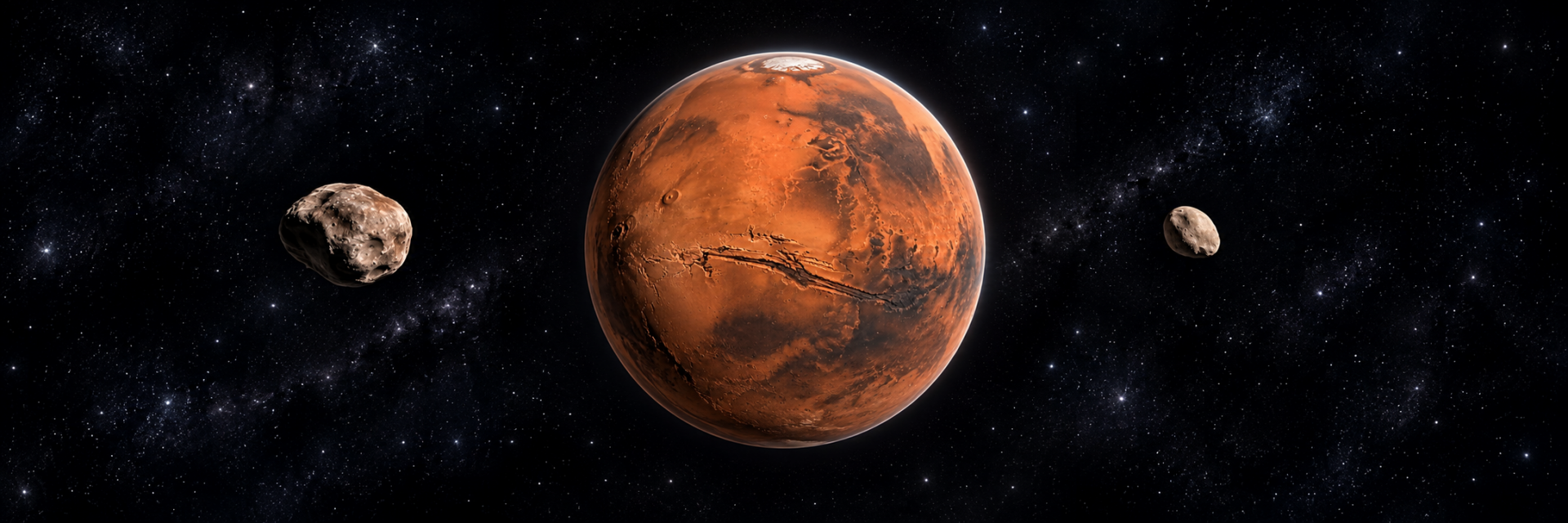
Mars is the fourth planet from the Sun and one of the most extensively studied worlds in our Solar System. Often referred to as the Red Planet because of the iron oxide minerals covering much of its surface, Mars is a rocky world with enormous volcanoes, deep canyon systems, polar ice deposits and geological evidence of a dramatically different past.
Today, Mars is a cold, dry planet with a thin atmosphere composed predominantly of carbon dioxide. However, observations from orbiting spacecraft and robotic explorers have revealed ancient river valleys, lakebeds, sedimentary deposits and minerals formed through interactions with water. These discoveries indicate that liquid water once existed on the Martian surface under environmental conditions substantially different from those found today.
Understanding how Mars evolved from a potentially more habitable environment into the world observed today is one of the central questions of planetary science. Researchers are investigating whether the planet once supported microbial life, how its atmosphere changed over billions of years and whether evidence of ancient biological activity might remain preserved beneath its surface.
Mars is also a major focus of international space exploration. Missions operated by NASA, the European Space Agency (ESA) and other space agencies are investigating its geology, atmosphere, climate and potential resources, while future projects aim to return carefully selected samples to Earth.
This page explores the scientific understanding of Mars, its physical characteristics, geological history, potential habitability and the technologies being developed to investigate it.
Explore recent discoveries, mission developments and scientific findings in the dedicated updates section further down this page.
The Geology and Landscape of Mars
Mars possesses some of the most remarkable geological features in the Solar System. Its surface contains enormous volcanoes, extensive canyon networks, ancient impact craters, vast plains and geological formations that preserve evidence of billions of years of planetary evolution.
Unlike Earth, Mars does not currently have an active system of moving tectonic plates. This has allowed some geological structures to remain relatively undisturbed for immense periods, providing scientists with a record of the planet's volcanic, climatic and geological history.
Olympus Mons — The Largest Volcano in the Solar System
Olympus Mons is the largest known volcano in the Solar System, rising approximately 22 kilometres above the surrounding Martian plains and extending roughly 600 kilometres across.
It is a shield volcano, formed through repeated eruptions of relatively fluid lava over immense geological timescales. Its extraordinary size is partly explained by Mars' lower gravity and the absence of Earth-like plate tectonics, allowing volcanic material to accumulate around a relatively stationary source.
Although Olympus Mons is not known to be currently erupting, geological evidence suggests that some Martian volcanic regions remained active much more recently than previously believed.
Valles Marineris — A Vast Canyon System
Stretching approximately 4,000 kilometres across the Martian surface, Valles Marineris is one of the largest canyon systems in the Solar System.
In places, its valleys reach depths of approximately seven kilometres, dwarfing the Grand Canyon on Earth.
The canyon system is thought to have developed primarily through tectonic stretching and fracturing associated with the enormous Tharsis volcanic region. Subsequent landslides, erosion and other geological processes modified its structure over time.
Its exposed rock layers offer scientists valuable information about Mars' geological evolution.
Ancient River Valleys and Lakebeds
One of the most important discoveries in Martian geology is the widespread evidence that liquid water once flowed across the planet's surface.
Orbital observations and robotic missions have identified branching river valleys, ancient lakebeds, sedimentary deposits and minerals associated with prolonged interactions between rock and water.
🔍 Click image to enlarge
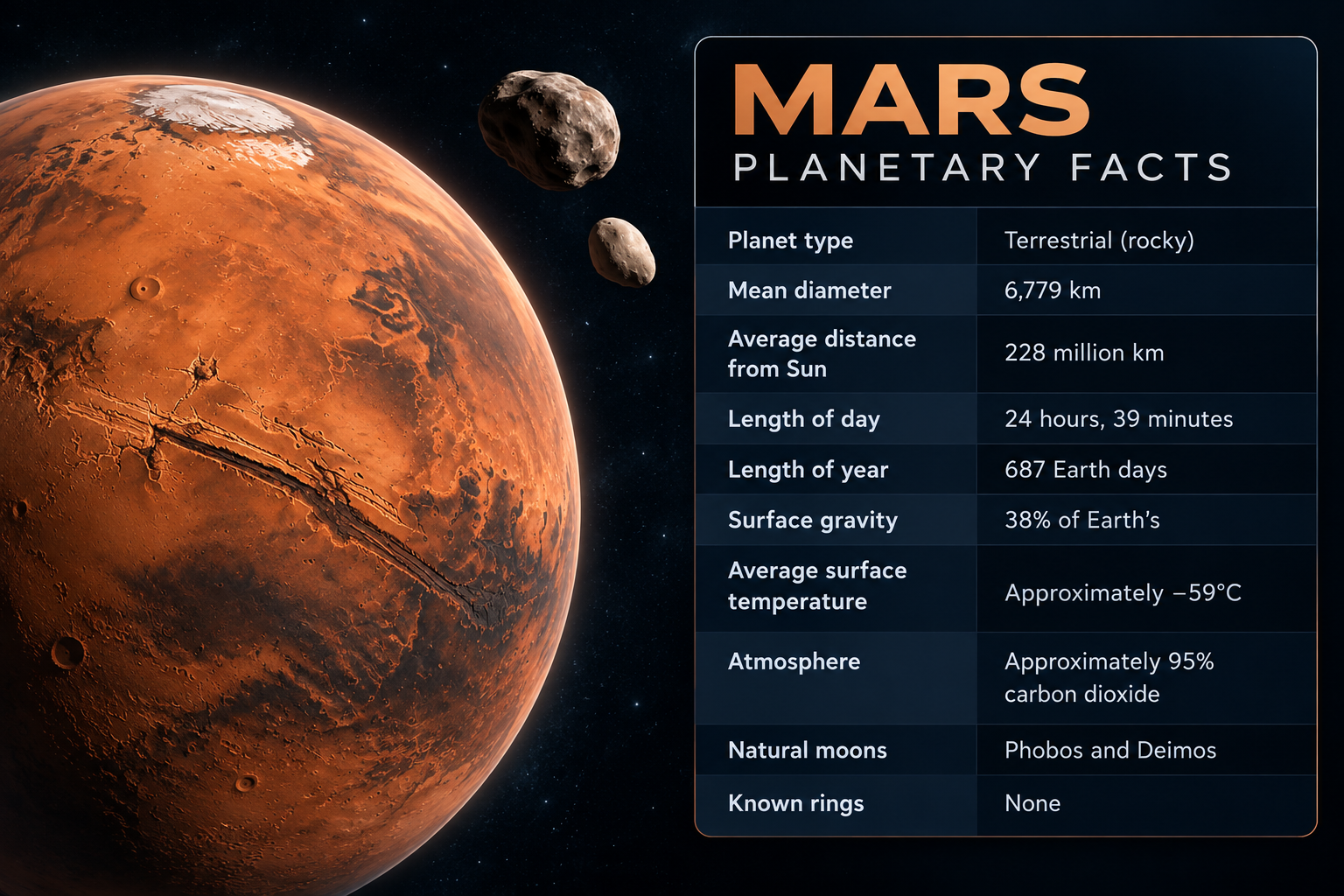
Jezero Crater, explored by NASA's Perseverance rover, contains an ancient river delta that formed when flowing water deposited sediments into a lake billions of years ago.
These sedimentary environments are particularly important to astrobiology because similar environments on Earth can preserve chemical and geological evidence of past microbial life.
Impact Craters and the Martian Highlands
Much of Mars' southern hemisphere consists of heavily cratered ancient terrain, while large areas of the northern hemisphere are comparatively smooth and lower in elevation.
This difference, known as the Martian hemispheric dichotomy, is one of the planet's major geological mysteries.
Scientists have proposed several explanations, including processes within Mars' early interior and the possibility of an enormous ancient impact.
Impact craters also provide opportunities to investigate buried geological layers, as collisions can expose material that would otherwise remain inaccessible.
What Martian Geology Reveals
The Martian landscape records a complex history involving volcanic activity, impacts, crustal deformation, erosion and the movement of water and ice.
By studying these features, scientists can reconstruct how the planet's surface and interior evolved and identify locations that may once have offered environments suitable for microbial life.
European spacecraft, particularly ESA's Mars Express and ExoMars Trace Gas Orbiter, contribute to this research through orbital observations, atmospheric investigations and scientific mapping.
Together with surface missions, these observations are helping researchers understand how Mars developed into the cold, dry world observed today.
The Martian Atmosphere and Climate
Mars has a thin atmosphere and an extremely cold, dry climate that differs considerably from conditions on Earth. Although the planet experiences seasons, clouds, winds and weather systems, its low atmospheric pressure and limited ability to retain heat make its surface environment particularly hostile to life as we know it.
Understanding the Martian atmosphere is essential to explaining the planet's climatic history, the disappearance of much of its ancient surface water and the challenges associated with future human exploration.
Atmospheric Composition and Pressure
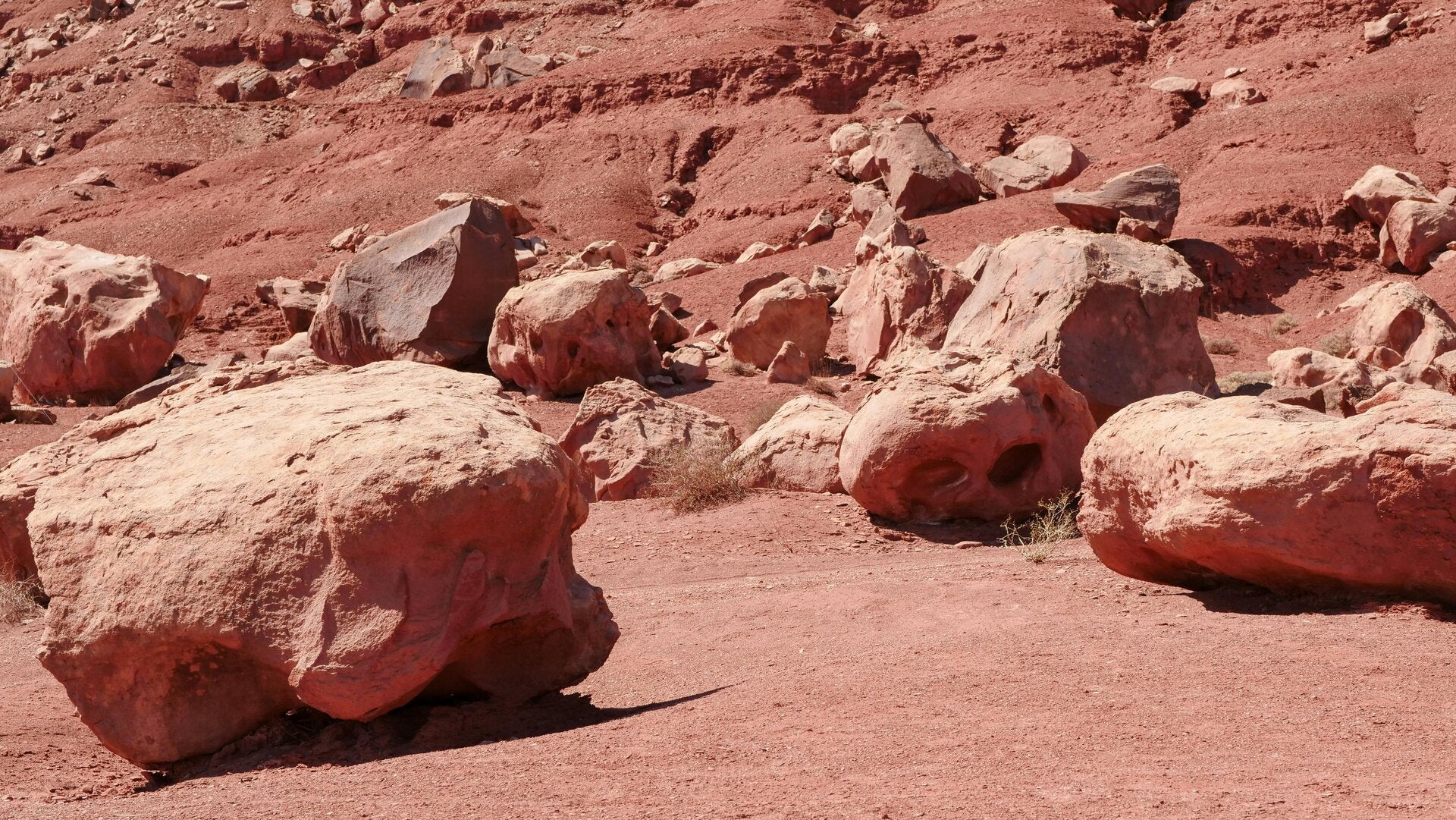
The Martian atmosphere consists predominantly of carbon dioxide, which accounts for approximately 95% of its composition. Nitrogen and argon make up most of the remainder, alongside small quantities of oxygen, carbon monoxide, water vapour and other trace gases.
Atmospheric pressure at the Martian surface averages approximately 0.6% of Earth's sea-level pressure, although it varies significantly with elevation and season.
This extremely low pressure means that stable liquid water cannot generally persist on the surface under present-day conditions. Exposed water tends to freeze, evaporate or boil, depending on the local temperature and pressure.
Despite the abundance of carbon dioxide, Mars experiences a much weaker greenhouse effect than Earth because its atmosphere contains comparatively little gas overall.
Temperatures and Seasonal Changes
The average surface temperature on Mars is approximately −60°C, although temperatures vary considerably between locations, seasons and times of day.
Near the equator, temperatures can occasionally rise above freezing during the daytime, while polar regions may experience temperatures below −125°C during winter.
Mars has an axial tilt of approximately 25 degrees, similar to Earth's 23.4 degrees. Consequently, the planet experiences spring, summer, autumn and winter.
However, because a Martian year lasts approximately 687 Earth days, its seasons are considerably longer than those on Earth.
Mars also follows a more elliptical orbit, producing noticeable differences in seasonal intensity between its northern and southern hemispheres.
Dust Storms and Martian Weather
One of the most distinctive features of the Martian climate is its extensive dust activity.
Strong winds can lift fine particles from the surface, creating local dust storms that sometimes develop into regional events. Occasionally, these storms expand until they obscure much of the planet.
Such planet-encircling dust storms can persist for weeks or months, reducing sunlight reaching the surface and affecting spacecraft operations.
Although Martian winds can reach considerable speeds, the atmosphere's low density means they generally exert much less force than equivalent winds on Earth.
Dust nevertheless presents significant challenges for exploration, including reduced solar power generation, interference with optical instruments and the accumulation of particles on equipment.
Polar Ice Caps and the Water Cycle
Mars possesses permanent polar ice deposits containing substantial quantities of water ice.
During the colder seasons, atmospheric carbon dioxide freezes onto the polar regions, forming seasonal deposits of dry ice. As temperatures rise, much of this carbon dioxide returns to the atmosphere through sublimation.
These seasonal exchanges cause measurable changes in atmospheric pressure across the planet.
Water also moves through the Martian environment, although its modern cycle is much more limited than Earth's.
Water vapour can enter the atmosphere through sublimation, form clouds of ice crystals and eventually return to the surface as frost or ice deposits.
These processes help scientists investigate the distribution and behaviour of water on present-day Mars.
How Mars Lost Much of Its Atmosphere
Geological evidence indicates that early Mars possessed environmental conditions substantially different from those observed today.
Ancient river valleys, lake deposits and water-altered minerals suggest that liquid water was once present on the surface, potentially supported by a thicker atmosphere and a different climate.
Over billions of years, Mars lost much of its atmosphere through several processes, including interactions with the solar wind, ultraviolet radiation and the escape of atmospheric particles into space.
Unlike Earth, Mars no longer possesses a strong global magnetic field generated by an active planetary dynamo. Its remaining magnetic fields are largely associated with magnetised regions of the crust.
The absence of a global magnetic field allows the solar wind to interact more directly with the upper atmosphere, contributing to atmospheric escape.
NASA's MAVEN spacecraft has investigated these processes, while ESA's Mars Express and ExoMars Trace Gas Orbiter have contributed observations of atmospheric composition, structure and behaviour.
Scientists continue to investigate how much atmosphere Mars originally possessed, how quickly it was lost and the relative importance of the processes involved.
Radiation and Surface Conditions
The thin Martian atmosphere provides relatively little protection against energetic particles arriving from space.
Unlike Earth, Mars lacks both a substantial atmospheric shield and a strong global magnetic field, leaving its surface exposed to higher levels of galactic cosmic radiation and solar energetic particles.
Measurements from spacecraft and surface instruments have demonstrated that radiation exposure presents a significant challenge for future human missions.
Potential protective measures include radiation shielding, underground habitats and the use of Martian soil, known as regolith, to cover inhabited structures.
Radiation also affects the preservation of organic compounds near the surface, making the investigation of deeper geological deposits particularly important in the search for evidence of ancient life.
Understanding Mars' Climate History
The modern Martian climate provides scientists with a valuable example of how planetary environments can evolve over geological timescales.
By combining atmospheric measurements, geological evidence, climate modelling and observations from orbiting spacecraft, researchers are investigating how Mars changed from a world that once supported surface water into the cold, arid planet seen today.
This research also contributes to the wider study of planetary habitability, helping scientists understand how atmospheres evolve and why superficially similar rocky planets can develop very different environments.

Water on Mars — Past and Present
Water has played a fundamental role in shaping the surface and geological history of Mars. Although the planet is now predominantly cold and dry, decades of observations have revealed extensive evidence that liquid water once flowed across its surface, forming rivers, lakes and potentially large bodies of standing water.
Today, most known Martian water exists as ice, particularly within the polar regions and beneath the surface. Understanding where this water originated, how it moved across the planet and why much of it disappeared is central to reconstructing Mars' environmental history.
Ancient Rivers and Lakes
Some of the strongest evidence for ancient liquid water comes from networks of valleys and channels carved into the Martian surface.
These formations resemble drainage systems on Earth and indicate that flowing water once eroded rock and transported sediments across substantial distances.
Scientists have also identified ancient lakebeds containing layered sedimentary deposits and minerals formed through interactions with water.
Gale Crater, investigated by NASA's Curiosity rover, contains geological evidence of a long-lived ancient lake environment. Sedimentary layers within Mount Sharp preserve information about changing environmental conditions over time.
Similarly, Jezero Crater, explored by the Perseverance rover, contains a preserved river delta formed when water transported sediment into an ancient lake.
These locations are particularly important because sediments deposited in water can preserve organic compounds and potentially retain evidence of past microbial activity.
Did Mars Once Have an Ocean?
Scientists have proposed that large quantities of liquid water may once have accumulated across the northern lowlands of Mars, potentially forming an ancient ocean.
The hypothesis is supported by several lines of investigation, including the planet's topography, possible ancient shoreline features, sedimentary deposits and models of its early climate.
However, the existence, extent and duration of a northern Martian ocean remain subjects of scientific debate.
Some features interpreted as ancient shorelines could have alternative geological explanations, while uncertainties surrounding early atmospheric conditions complicate attempts to reconstruct the planet's water history.
Although evidence strongly supports the existence of ancient rivers and lakes, the ocean hypothesis remains less firmly established.
Water Ice Beneath the Surface
Large quantities of water ice remain preserved on Mars today.
In addition to its polar ice caps, spacecraft have detected subsurface ice across extensive regions of the planet, including areas far from the poles.
NASA's Mars Odyssey mission identified hydrogen-rich material consistent with near-surface water ice using neutron and gamma-ray measurements.
Later observations from orbital radar instruments, including MARSIS aboard ESA's Mars Express and SHARAD aboard NASA's Mars Reconnaissance Orbiter, have provided further evidence of buried ice deposits.
These discoveries are important both scientifically and practically.
Subsurface ice preserves information about past climate conditions and could eventually provide a resource for future human missions, including drinking water, oxygen production and potentially rocket propellant.
Is Liquid Water Present on Mars Today?
The possibility of present-day liquid water on Mars remains an active area of investigation.
Because atmospheric pressure is extremely low and surface temperatures are generally below freezing, stable liquid water is difficult to maintain at the surface.
Scientists have investigated whether highly concentrated salt solutions, known as brines, might remain liquid temporarily under certain conditions.
However, the availability, stability and quantity of such liquids remain uncertain.
In 2018, researchers analysing radar observations from ESA's Mars Express spacecraft reported evidence interpreted as a possible body of liquid water beneath the south polar ice deposits.
Subsequent studies challenged this interpretation, suggesting that other materials or geological processes could explain the radar reflections.
Consequently, the existence of present-day subglacial liquid-water lakes on Mars has not been conclusively established.
Where Did the Water Go?
The disappearance of much of Mars' ancient surface water is closely connected to changes in its atmosphere and climate.
As atmospheric pressure declined and the planet cooled, conditions became increasingly unsuitable for persistent surface liquid water.
Some water was lost to space through atmospheric escape processes, while substantial quantities became trapped as ice or incorporated into minerals within the Martian crust.
Water can also become chemically bound within hydrated minerals through interactions between rock and liquid water.
Scientists are investigating the relative importance of these processes to determine how much water early Mars possessed and how it was distributed.
Water and the Search for Life
On Earth, liquid water is essential to all known forms of life. Consequently, evidence that Mars once possessed stable aquatic environments makes the planet an important target for astrobiological research.
Ancient lakebeds, river deltas and water-altered rocks are particularly promising locations for investigating whether microbial life could once have existed.
However, the presence of water does not establish that life developed.
Scientists must also consider environmental conditions, energy sources, chemical nutrients and the preservation of potential biological evidence.
Future exploration, including ESA's Rosalind Franklin rover, aims to investigate material beneath the Martian surface, where organic compounds may be better protected from radiation and chemical degradation.
What Water Reveals About Mars
The geological and chemical evidence demonstrates that water has profoundly influenced Mars throughout its history.
Ancient rivers and lakes are well established, while the extent of possible oceans and the existence of present-day liquid-water reservoirs remain under investigation.
Continued observations by European and international spacecraft are helping scientists reconstruct the Martian water cycle, understand the planet's changing climate and identify environments that may preserve evidence of past habitability.
The Search for Life on Mars
One of the most important questions in planetary science is whether life has ever existed beyond Earth. Mars is a leading location for investigating this possibility because geological evidence demonstrates that the planet once possessed liquid water, chemically diverse environments and conditions that may have supported microbial organisms.
Although no confirmed evidence of past or present Martian life has been discovered, robotic exploration has revealed environments that were potentially habitable billions of years ago.
The scientific challenge is to determine whether these environments actually supported living organisms and whether any biological evidence could have survived to the present day.
What Makes a Planet Habitable?
Habitability refers to the ability of an environment to support life, rather than proof that life exists there.
On Earth, all known organisms require liquid water, access to suitable chemical elements and a source of energy.
Early Mars appears to have possessed several of these conditions.
Ancient lakes, river systems and water-altered minerals demonstrate that liquid water existed on the surface, while geological investigations have identified elements and chemical compounds associated with environments capable of supporting microbial life.
However, habitability also depends on factors such as temperature, acidity, salinity, radiation exposure and the duration of favourable environmental conditions.
Scientists therefore investigate not simply whether Mars contained water, but whether particular environments remained suitable for biological activity over meaningful periods.
Organic Molecules on Mars
Organic molecules contain carbon and are important components of living organisms, although they can also form through non-biological processes.
NASA's Curiosity rover has detected organic compounds within ancient sedimentary rocks in Gale Crater.
These findings demonstrate that carbon-based chemistry existed in the Martian environment and that some organic material can survive within geological deposits for billions of years.
However, organic molecules alone do not constitute evidence of life.
They can originate from meteorites, geological reactions and other natural chemical processes unrelated to biology.
Scientists must therefore examine their molecular structures, geological surroundings and possible formation mechanisms before drawing conclusions about their origins.
Perseverance and the Search for Ancient Biosignatures
NASA's Perseverance rover landed in Jezero Crater in February 2021 to investigate an ancient environment that once contained a lake and river delta.
Its scientific instruments examine rock composition, mineralogy and geological structures, searching for evidence of conditions that may have supported microbial life.
The rover also collects and seals carefully selected rock and soil samples for potential future return to Earth.
In 2024, NASA reported intriguing chemical and structural features within a rock nicknamed Cheyava Falls, including organic compounds and mineral patterns that warranted further investigation.
Subsequent research strengthened scientific interest in the sample as a potential biosignature candidate.
Nevertheless, non-biological explanations have not been conclusively excluded, and the findings do not establish that life existed on Mars.
Detailed laboratory examination of returned samples would allow scientists to perform analyses beyond the capabilities of instruments currently operating on the Martian surface.
Methane and the Possibility of Biological Activity
Methane has attracted scientific interest because some microorganisms on Earth produce it through metabolic processes.
However, methane can also form through non-biological geological reactions.
NASA's Curiosity rover has reported variable methane concentrations near the Martian surface,
while ESA's ExoMars Trace Gas Orbiter has not detected comparable concentrations in the atmosphere at its measurement sensitivity.
This discrepancy remains unresolved.
Possible explanations include localised methane sources, atmospheric processes, variations in measurement conditions or other mechanisms not yet fully understood.
Importantly, methane observations cannot currently be interpreted as evidence of Martian life.
Could Life Exist Beneath the Surface?
The present Martian surface is exposed to intense ultraviolet radiation, cosmic radiation, extreme temperature variations and highly oxidising chemical conditions.
These factors make the surface challenging for life as we know it.
However, underground environments may offer greater protection from radiation and temperature fluctuations.
Scientists are investigating whether subsurface ice, hydrated minerals or potentially water-bearing geological formations could provide environments capable of supporting microbial activity.
The existence of suitable present-day habitats remains uncertain, and no living Martian organisms have been detected.
Nevertheless, the subsurface is considered an important target for future astrobiological exploration.
Europe's Rosalind Franklin Rover
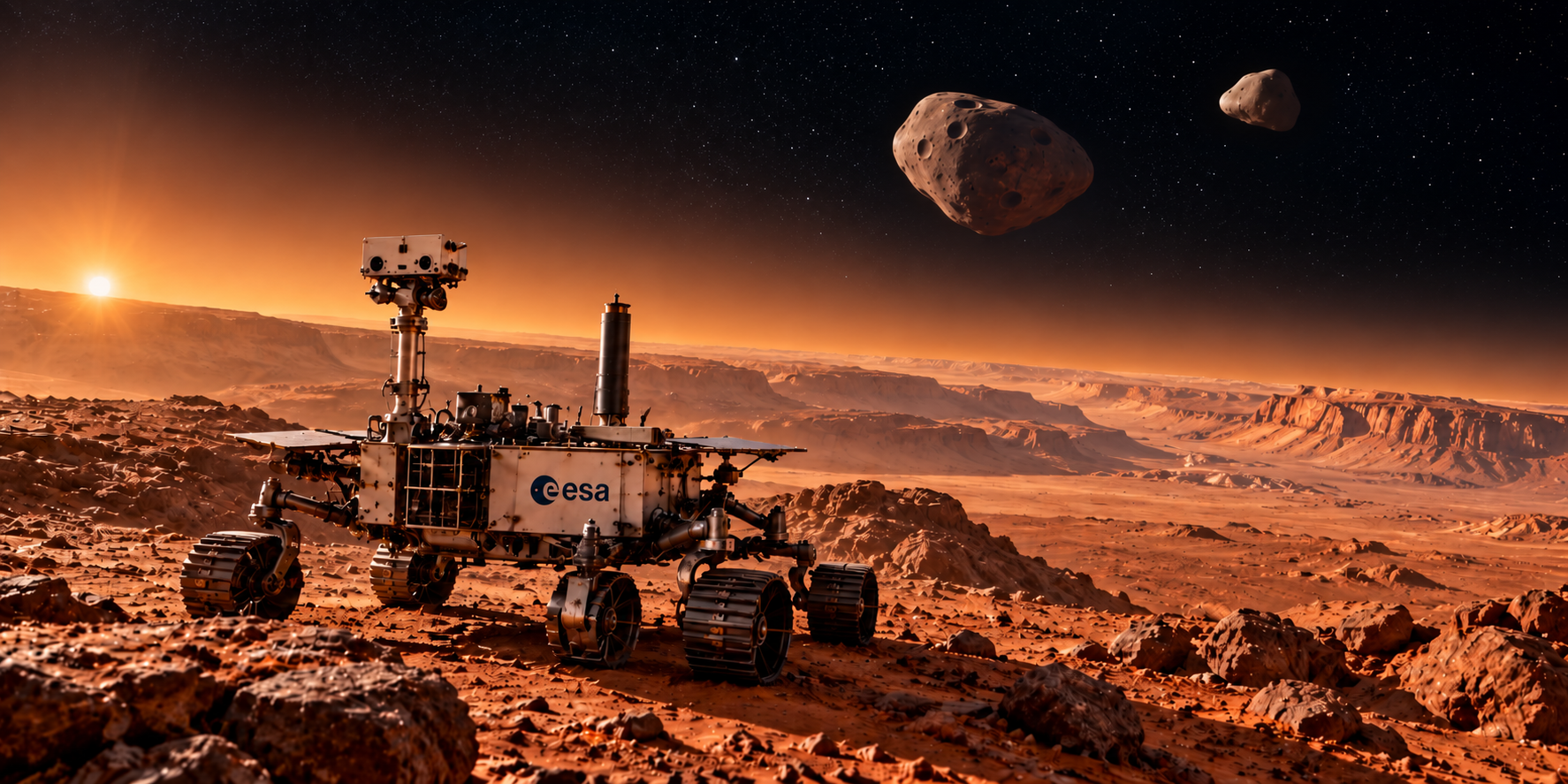
The European Space Agency's Rosalind Franklin rover is designed specifically to investigate the possibility of past life on Mars.
Developed as part of the ExoMars programme, the rover is planned to carry a drill capable of collecting samples from depths of up to two metres.
This capability is scientifically significant because material beneath the surface may be better protected from radiation and destructive chemical processes.
Its instruments are designed to analyse geological samples, investigate organic compounds and examine environmental conditions associated with possible ancient habitability.
The mission is currently targeting a launch in 2028, subject to further development and mission readiness.
Rosalind Franklin represents one of Europe's most important contributions to the search for extraterrestrial life.
How Would Scientists Confirm Martian Life?
Confirming extraterrestrial life would require multiple independent lines of evidence.
Scientists would need to distinguish potential biological signatures from geological and chemical processes capable of producing similar results.
Investigations could involve identifying complex organic compounds, unusual isotopic patterns, microscopic structures or combinations of chemical and mineralogical features that are difficult to explain through non-biological mechanisms.
No single observation would necessarily provide definitive proof.
Instead, researchers would seek consistent evidence supported by different analytical methods, carefully documented geological context and independent scientific examination.
What We Know So Far
Scientific exploration has established that ancient Mars possessed environments containing liquid water, organic chemistry and conditions potentially suitable for microbial life.
However, the discovery of habitable environments is not equivalent to the discovery of living organisms.
No confirmed evidence of Martian life has yet been found.
Continued investigations by NASA, ESA and international research teams aim to determine whether Mars was ever inhabited and whether evidence of biological activity remains preserved within its rocks or beneath its surface.
The Exploration of Mars
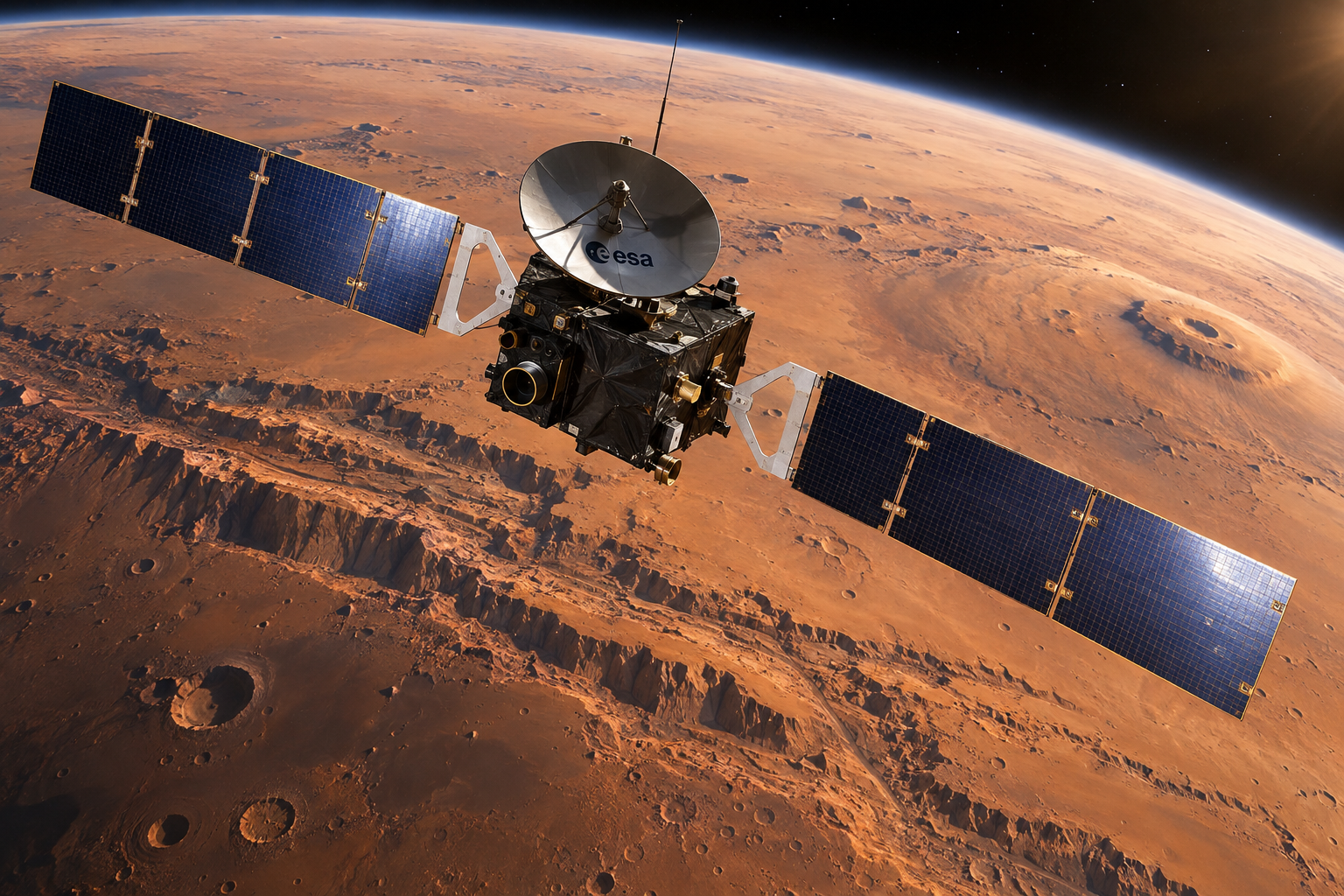
Mars has been a major destination for robotic space exploration since the early years of the Space Age. Over several decades, spacecraft have transformed scientific understanding of the planet, revealing its geology, atmospheric history, ancient water systems and potential habitability.
Exploration has progressed from brief flybys and orbital photography to sophisticated rovers capable of analysing rocks, drilling into the surface and collecting samples for future scientific examination.
Today, Mars is investigated through a combination of orbiting spacecraft, surface vehicles and international research programmes. European missions have played an important role in this progress, particularly through atmospheric research, subsurface radar investigations and preparations for the search for ancient life.
The First Missions to Mars
The first successful spacecraft encounter with Mars occurred in July 1965, when NASA's Mariner 4 performed a flyby and transmitted the first close-up photographs of the Martian surface.
The images revealed a heavily cratered landscape, challenging earlier expectations that Mars might possess widespread Earth-like surface conditions.
In 1971, Mariner 9 became the first spacecraft to orbit another planet. Its observations revealed enormous volcanoes, extensive canyon systems, ancient river valleys and evidence of a much more complex geological history.
The Soviet Union also conducted numerous early Mars missions. Mars 3 achieved the first soft landing on the planet in December 1971, although communications ended shortly after touchdown.
These pioneering missions established the foundations of modern Martian exploration.
Viking and the First Search for Life
NASA's Viking 1 and Viking 2 missions reached Mars in 1976, each consisting of an orbiter and a lander.
The landers conducted the first dedicated biological experiments on the Martian surface, investigating whether soil samples showed signs of metabolic activity.
Some experimental results were initially considered intriguing, particularly those from the labelled-release experiment.
However, the combined findings did not establish the presence of life, and non-biological chemical reactions remain important explanations for the observations.
The Viking missions also returned extensive information about Martian weather, atmospheric composition, surface chemistry and geology.
Rovers Transform Martian Exploration
Mobile robotic explorers have enabled scientists to investigate geological environments directly rather than relying solely on orbital observations or stationary landers.
NASA's Sojourner rover, delivered by Mars Pathfinder in 1997, demonstrated the practicality of robotic surface mobility.
Spirit and Opportunity, which landed in 2004, investigated geological evidence of ancient water. Opportunity operated until 2018, greatly exceeding its original planned mission duration.
Curiosity, which landed in Gale Crater in 2012, has investigated ancient lake environments, sedimentary rocks, organic compounds and the planet's changing climate.
Perseverance, which landed in Jezero Crater in 2021, is examining an ancient river delta and collecting geological samples for possible future return to Earth.
The Ingenuity helicopter, delivered alongside Perseverance, demonstrated powered, controlled flight in the extremely thin Martian atmosphere. Its mission concluded in 2024 after completing 72 flights.
China's Tianwen-1 mission also achieved a major milestone in 2021, successfully deploying the Zhurong rover to the Martian surface.
Together, these missions have provided increasingly detailed evidence of Mars' geological and environmental history.
ESA's Mars Express
Launched in June 2003, Mars Express became the European Space Agency's first mission to another planet.
Its scientific instruments have investigated the Martian atmosphere, surface geology, mineral composition, subsurface structure and the distribution of water ice.
One of its most important instruments is MARSIS, a radar sounder developed to investigate material beneath the Martian surface.
MARSIS observations have contributed to the detection and characterisation of buried ice deposits and to scientific debates concerning possible liquid water beneath the south polar region.
Mars Express has also produced detailed three-dimensional observations of geological features, including volcanoes, canyon systems and ancient water-related formations.
Although the mission's Beagle 2 lander did not successfully communicate after reaching the surface in 2003, the orbiter has made substantial contributions to European planetary science.
The ExoMars Trace Gas Orbiter
ESA's ExoMars Trace Gas Orbiter, launched in 2016 in cooperation with Russia, entered orbit around Mars later that year and began its main scientific investigations in 2018.
Its instruments are designed to detect and measure trace atmospheric gases, investigate atmospheric chemistry and study the distribution of water-related materials.
Methane is one of the mission's principal scientific targets because its possible sources include both geological and biological processes.
The orbiter's measurements have placed important constraints on methane concentrations in the Martian atmosphere, contributing to continuing investigations into reports of methane detected by other instruments.
The spacecraft also provides communications relay capabilities for surface exploration missions.
The Rosalind Franklin Rover
ESA's Rosalind Franklin rover represents the next major stage of European robotic exploration of Mars.
The mission is designed to investigate ancient habitable environments and search for possible evidence of past microbial life.
Its drill is intended to retrieve material from depths of up to two metres, allowing scientific instruments to examine samples that may have been better protected from radiation and surface chemical processes.
The rover's laboratory instruments will investigate mineral composition, organic compounds and geological conditions associated with ancient habitability.
Following changes to the ExoMars programme after the termination of cooperation with Russia, ESA has been developing a revised mission architecture with international and European industrial support.
The mission is targeting a 2028 launch, subject to technical readiness and programme milestones.
International Cooperation and Mars Sample Return
Returning carefully selected Martian samples to Earth is a major objective of planetary exploration.
Laboratories on Earth possess analytical instruments far more powerful and versatile than those that can currently be transported to Mars.
Perseverance has collected and sealed samples intended for potential future retrieval, but the architecture, funding and schedule of a Mars Sample Return campaign remain subject to further decisions.
European organisations have contributed to studies and technologies associated with sample-return concepts, including spacecraft design, orbital operations and autonomous rendezvous capabilities.
A successful sample-return programme could allow scientists to investigate Martian geological history and possible biosignatures with unprecedented precision.
The Importance of Continued Exploration
Mars exploration combines planetary geology, atmospheric science, astrobiology, robotics and advanced spacecraft engineering.
Each generation of missions builds upon earlier discoveries, allowing scientists to investigate increasingly complex questions about the planet's history and potential habitability.
European missions, alongside those of NASA, JAXA, CNSA and other international organisations, continue to expand scientific knowledge of Mars and develop technologies relevant to future exploration.
The long-term objective is not simply to reach Mars, but to understand how it evolved, whether it ever supported life and what its history reveals about rocky planets throughout the Solar System and beyond.
Phobos and Deimos — The Moons of Mars
Mars has two small natural moons, Phobos and Deimos, discovered in 1877 by American astronomer Asaph Hall. Unlike Earth's comparatively large, spherical Moon, both Martian satellites are irregularly shaped, heavily cratered bodies resembling asteroids.
Their origins remain uncertain, making them important targets for planetary science. Scientists are investigating whether they formed from material associated with Mars, were captured from elsewhere in the Solar System or originated through a collision involving the planet.
Although relatively small, Phobos and Deimos may preserve valuable information about the early history of Mars and the formation of planetary satellite systems.
Phobos — The Larger Inner Moon
Phobos is the larger and closer of Mars' two moons, measuring approximately 22 kilometres across on average.
It orbits only about 6,000 kilometres above the Martian surface, making it one of the closest-orbiting natural satellites in the Solar System.
Phobos completes an orbit in approximately 7 hours and 39 minutes, considerably faster than Mars rotates.
As a result, an observer on the Martian surface would see Phobos rise in the west and set in the east, opposite to the apparent movement of most celestial objects.
Its surface is dominated by impact craters, including the prominent Stickney crater, which measures approximately nine kilometres across.
Phobos is gradually spiralling towards Mars because of tidal interactions with the planet.
Over tens of millions of years, it may break apart to form a temporary ring system or eventually collide with the Martian surface.
Deimos — The Smaller Outer Moon
Deimos is the smaller and more distant Martian moon, measuring approximately 12 kilometres across on average.
It orbits Mars at a distance of approximately 23,500 kilometres from the planet's centre and takes about 30 hours and 18 minutes to complete one revolution.
Unlike Phobos, Deimos orbits more slowly than Mars rotates and therefore appears to move across the sky in the more familiar east-to-west direction.
Its surface is covered in fine material that partially obscures impact craters, giving it a smoother appearance than Phobos.
Deimos is gradually moving away from Mars through tidal interactions, although the rate of change is extremely slow.
Where Did the Martian Moons Come From?
The origin of Phobos and Deimos remains one of the outstanding questions in Martian planetary science.
Their dark surfaces and irregular shapes initially suggested that they might be captured asteroids.
However, both moons follow relatively circular orbits close to Mars' equatorial plane, which is difficult to explain through simple gravitational capture alone.
An alternative hypothesis proposes that the moons formed from debris produced by a large collision involving early Mars.
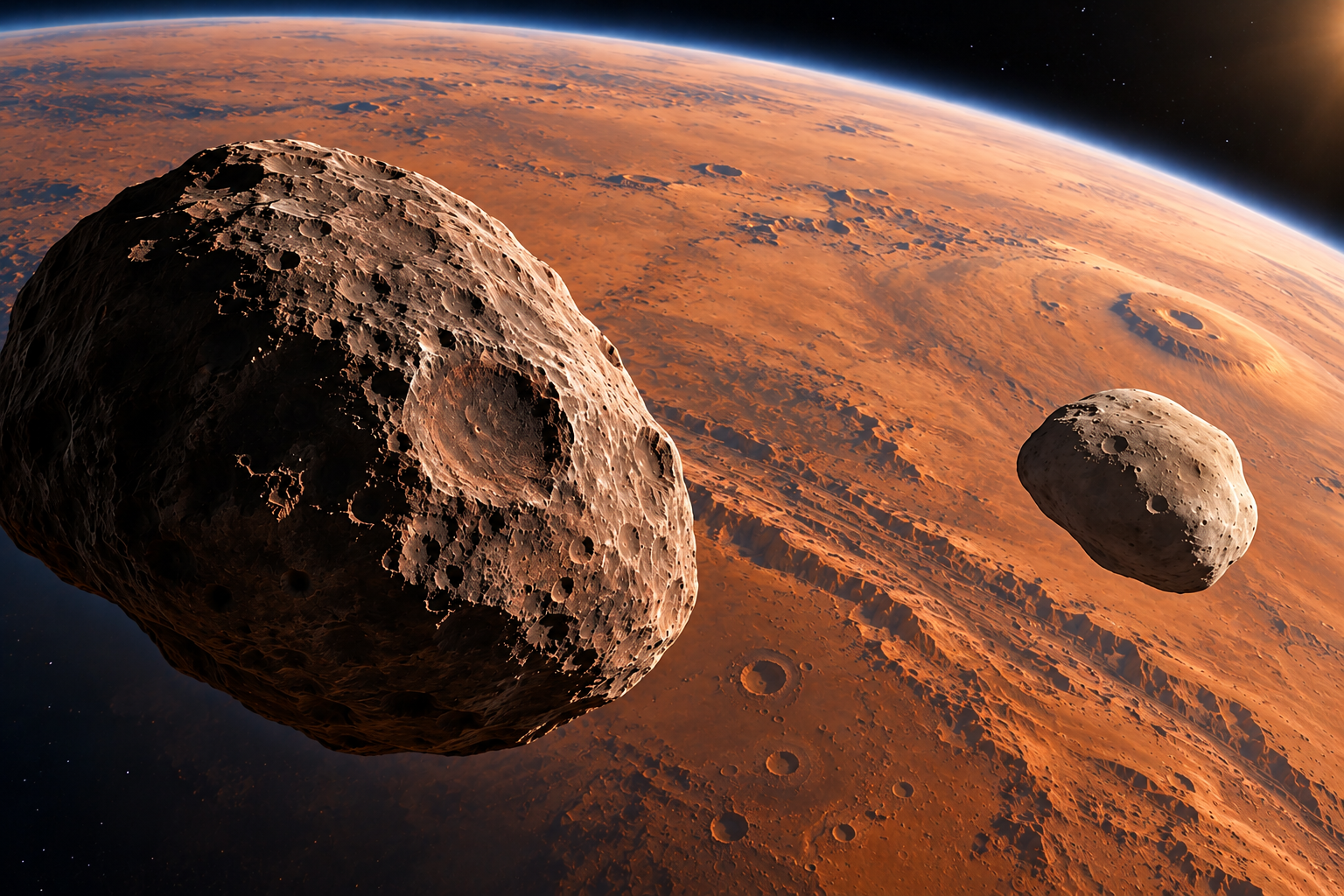
Under this scenario, material ejected into orbit could have formed a temporary debris disc from which smaller satellites developed.
Other models propose more complex formation histories involving collisions, orbital evolution or material originating from Mars itself.
Detailed measurements of the moons' composition, internal structure and surface material are needed to distinguish between these possibilities.
Japan's Martian Moons eXploration Mission
The Martian Moons eXploration mission, known as MMX, is being developed by the Japan Aerospace Exploration Agency (JAXA) to investigate the origins and evolution of Phobos and Deimos.
The spacecraft is designed to study both moons from orbit and collect samples from the surface of Phobos for return to Earth.
These samples could provide important evidence about the moon's composition, formation history and relationship with Mars.
MMX also includes significant European participation.
The French space agency CNES and the German Aerospace Center DLR have developed a small rover, known as Idefix, designed to operate on the surface of Phobos.
The rover will investigate the moon's surface properties and behaviour in its extremely weak gravitational environment.
ESA is also contributing deep-space communications support through its ground station infrastructure.
The mission represents an important example of international cooperation between Japan and European space organisations.
Why the Martian Moons Matter
Studying Phobos and Deimos could help scientists answer questions extending far beyond the moons themselves.
Their composition may reveal whether they formed from Martian material or originated elsewhere in the Solar System.
Their surfaces also preserve evidence of impacts, space weathering and the movement of material in extremely low-gravity environments.
Understanding these processes can improve scientific models of planetary formation and satellite evolution.
Phobos has also been considered as a possible location for future robotic infrastructure or a staging point for exploration of Mars, although such concepts remain speculative.
What Happens Next?
The next major scientific milestone is the MMX mission's investigation of Phobos and Deimos, including its planned surface sampling operations.
If successful, the return of material from Phobos would provide scientists with the first samples collected directly from a Martian moon.
Laboratory analysis could substantially improve understanding of how the moons formed and what they reveal about the early evolution of Mars.
The Future of Mars Exploration
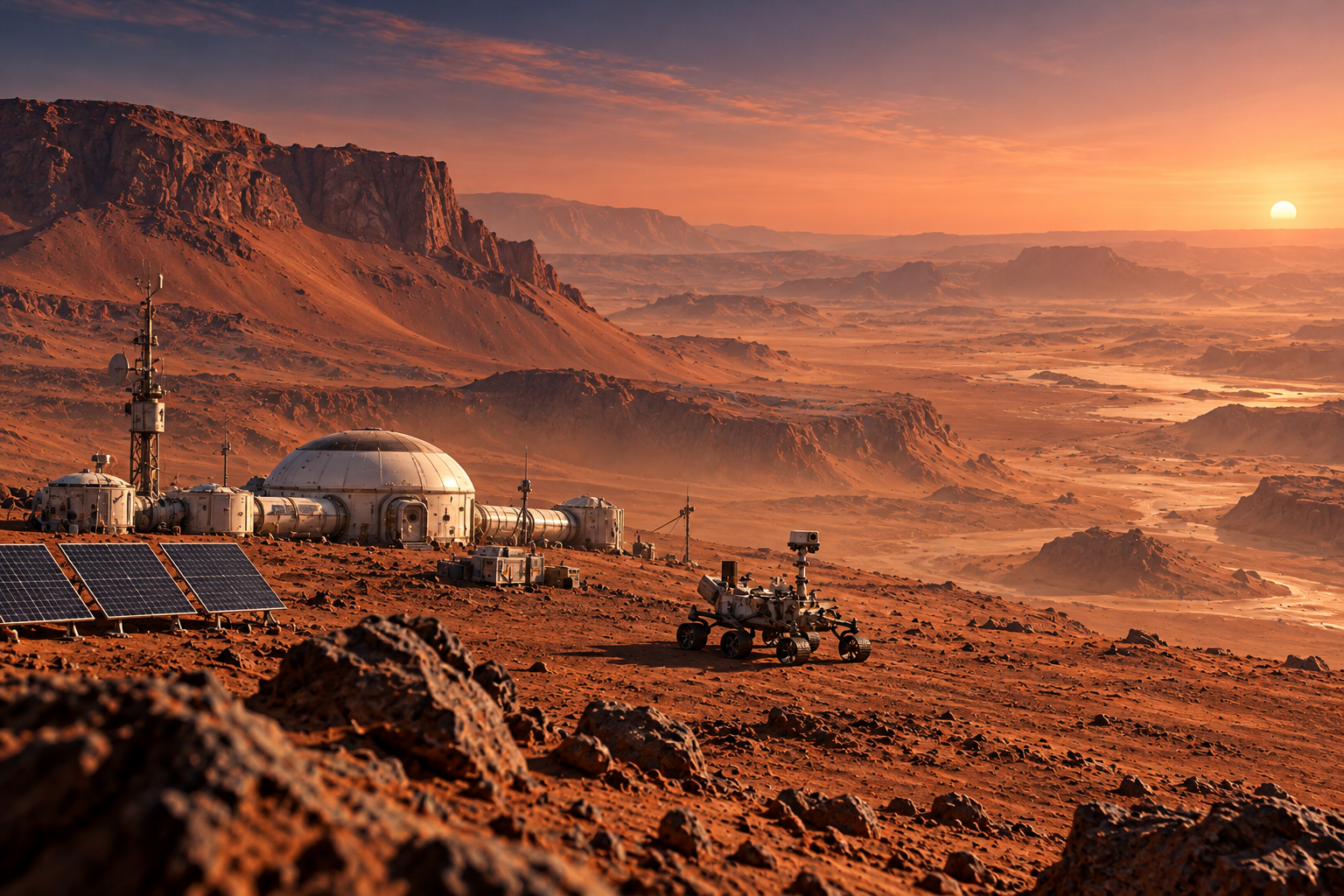
The next generation of Mars exploration will focus on answering increasingly complex scientific questions while developing technologies capable of supporting more ambitious robotic and eventually human missions.
Future spacecraft will investigate the planet's subsurface, search for evidence of ancient biological activity, study its moons and develop methods for operating in the challenging Martian environment.
European space organisations are contributing to these efforts through advanced robotics, scientific instrumentation, spacecraft engineering and international partnerships.
Europe's Rosalind Franklin Mission
One of the most important upcoming European planetary missions is ESA's Rosalind Franklin rover, developed under the ExoMars programme.
Currently targeting a launch in 2028, the rover is designed to investigate ancient Martian environments and search for possible evidence of past microbial life.
Its most distinctive capability is a drill designed to retrieve geological samples from depths of up to two metres.
This will allow scientists to investigate material that may have been protected from radiation and chemical degradation, potentially preserving organic compounds and other evidence associated with ancient habitability.
The mission also represents an important step forward in European autonomous robotics, landing technology and planetary scientific instrumentation.
Returning Martian Samples to Earth
Returning samples from Mars to laboratories on Earth remains one of the major scientific ambitions of planetary exploration.
Although robotic instruments can perform sophisticated analyses on the Martian surface, terrestrial laboratories offer much greater analytical precision, flexibility and opportunities for independent verification.
NASA's Perseverance rover has already collected and sealed geological samples from Jezero Crater, including material from an ancient river-delta environment.
However, returning these samples requires a complex sequence of operations involving retrieval, launch from the Martian surface, orbital rendezvous and transportation back to Earth.
The future architecture, funding and schedule of a Mars Sample Return campaign remain uncertain.
European engineers and researchers have contributed to the development of technologies and mission concepts associated with sample-return operations.
A successful programme would allow scientists to examine Martian material using advanced laboratory techniques, potentially transforming understanding of the planet's geological and biological history.
Exploring Phobos and Deimos
The exploration of Mars' moons will provide another important source of scientific information.
Japan's Martian Moons eXploration mission, MMX, aims to investigate Phobos and Deimos and return samples collected from Phobos.
The mission includes the French-German Idefix rover, developed by CNES and DLR, alongside European communications support.
Investigating the moons' composition and structure could help determine whether they originated from captured asteroids, material associated with Mars or debris generated by an ancient collision.
Their extremely low-gravity environments will also provide opportunities to develop technologies relevant to future exploration of small Solar System bodies.
Human Exploration of Mars
Sending astronauts to Mars represents a considerably greater challenge than robotic exploration.
A crewed mission would require reliable transportation systems, long-duration life support, radiation protection, medical capabilities and methods for operating independently at enormous distances from Earth.
Depending on planetary alignment and mission design, travel between Earth and Mars using conventional propulsion can take several months.
Communication delays also present operational challenges. Radio signals take approximately 3 to 22 minutes to travel one way between Earth and Mars, depending on the planets' relative positions.
Astronauts would therefore need considerable operational autonomy, supported by advanced computing, robotics and automated systems.
Although NASA and commercial organisations are investigating technologies relevant to human Mars exploration, no crewed Mars landing has yet been achieved or assigned a firmly established launch date.
Using Resources Found on Mars
One potential approach to supporting future missions is in-situ resource utilisation, or ISRU.
Rather than transporting every necessary resource from Earth, explorers could process materials already available on Mars.
Water ice could potentially be extracted and purified for drinking, oxygen production and other uses.
The carbon dioxide-rich atmosphere also offers opportunities for producing oxygen and chemical fuels.
NASA's MOXIE experiment, carried aboard the Perseverance rover, successfully demonstrated the production of oxygen from atmospheric carbon dioxide.
Although conducted on a small experimental scale, the technology provides an important foundation for future resource-processing systems.
Habitats, Radiation Protection and Surface Infrastructure
Long-duration human exploration would require habitats capable of protecting crews from radiation, extreme temperatures, dust and the planet's low atmospheric pressure.
Potential approaches include heavily shielded structures, underground installations and habitats covered with Martian regolith.
Researchers are also investigating autonomous construction, advanced materials, closed-loop life-support systems and methods for producing essential supplies locally.
Reliable energy generation will be another major requirement.
Solar power is already used by some Martian spacecraft, but dust accumulation, seasonal variations and prolonged storms can reduce its effectiveness.
Nuclear power systems and other energy technologies may therefore play important roles in future surface infrastructure.
These concepts remain subjects of engineering research rather than established permanent settlement capabilities.
Artificial Intelligence and Autonomous Exploration
Artificial intelligence and autonomous robotics are expected to become increasingly important in future Mars missions.
Because communication delays prevent continuous real-time control from Earth, robotic systems must be capable of making certain decisions independently.
Existing Mars rovers already use autonomous navigation technologies to identify obstacles and select routes across difficult terrain.
Future systems may expand these capabilities through automated scientific target selection, coordinated robotic exploration and more advanced environmental monitoring.
Digital modelling and simulation could also help mission planners predict equipment behaviour, assess environmental hazards and improve operational decisions.
These technologies may eventually support both robotic missions and human exploration.
The Next Era of Martian Exploration
The future of Mars exploration will be shaped by a combination of scientific discovery, technological development and international cooperation.
Upcoming missions aim to investigate environments beneath the surface, examine the origins of Mars' moons and develop new capabilities for planetary sample collection.
Longer-term ambitions include returning Martian samples to Earth and establishing the technologies necessary for human exploration.
For Europe, programmes such as ExoMars and participation in international missions provide opportunities to advance scientific research and develop expertise in planetary robotics, autonomous systems and deep-space operations.
Ultimately, exploring Mars is not simply about reaching another planet. It is about understanding how rocky worlds evolve, whether life can emerge beyond Earth and what conditions determine the long-term habitability of planets throughout the Solar System and beyond.
Latest Updates — Mars
Last Updated: 13 October 2026
This section highlights recent scientific discoveries, exploration missions and developments in our understanding of Mars and its two moons, Phobos and Deimos.
New findings are incorporated into the relevant scientific sections of this page, while significant developments are summarised below. Where appropriate, links to more detailed reports provide additional information.
13 October 2026 — Japan Prepares to Launch Mars Moon Sample-Return Mission
The Japan Aerospace Exploration Agency (JAXA) is preparing its Martian Moons eXploration (MMX) mission to investigate Phobos and Deimos, with the objective of returning samples from Phobos to Earth.
The mission includes significant European participation, including the French-German Idefix rover developed by CNES and DLR, alongside deep-space communications support from ESA.
The investigation could help resolve longstanding questions about the origins of Mars' moons and provide new information about the early history of the Martian system.
Status: Launch preparations underway.
Further updates will follow as the mission progresses.