

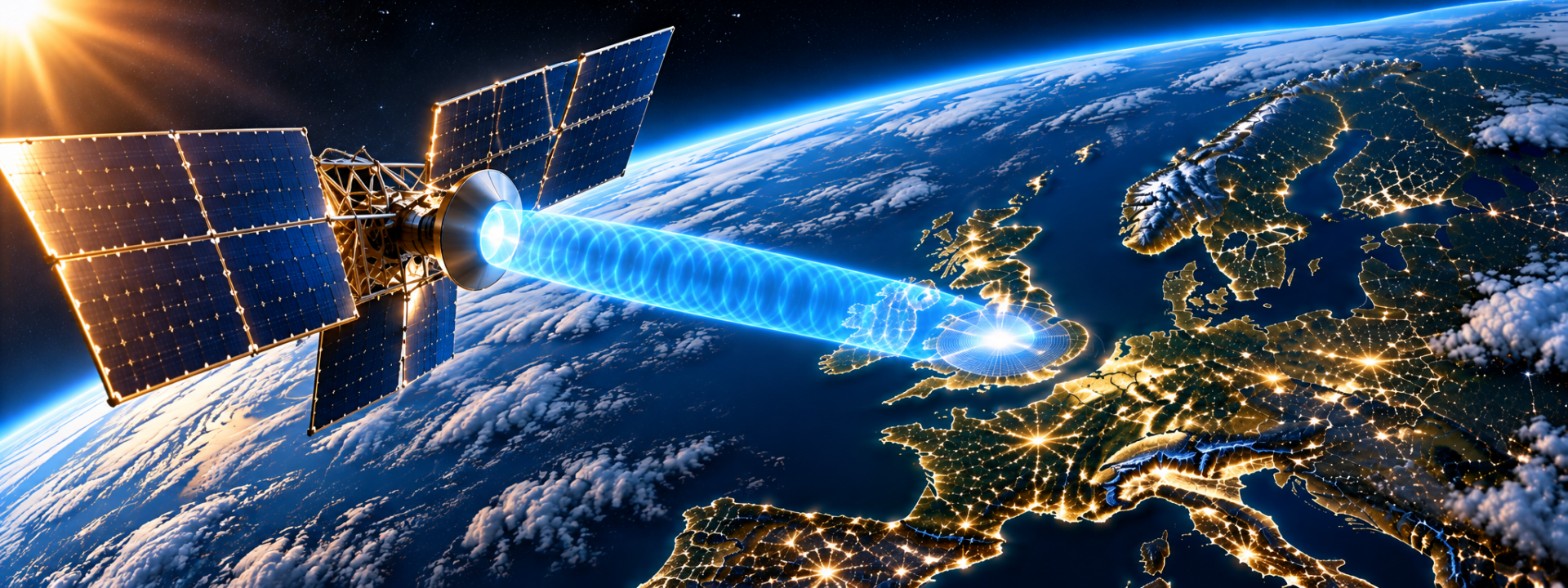
Space-Based Solar Power
Space-based solar power is an emerging energy technology that aims to collect sunlight using satellites in orbit and transmit the resulting energy wirelessly to receiving stations on Earth.
How Space-Based Solar Power Works
Space-based solar power combines several established technologies: photovoltaic electricity generation, electromagnetic energy transmission, antenna systems and electrical power conversion.
The core concept is to collect solar energy above Earth's atmosphere and transmit it wirelessly to a receiving station on the ground.
Collecting Solar Energy in Orbit
Large arrays of photovoltaic solar cells would convert sunlight into electricity, much like conventional solar panels on Earth.
One proposed location is geostationary orbit, approximately 35,786 kilometres above Earth's equator. At this altitude, a satellite orbits at the same angular rate as Earth's rotation, allowing it to remain approximately above the same location on the ground.
A solar power satellite in a suitable geostationary orbit could receive sunlight for most of the year, although periods of eclipse would still occur.
The electricity generated by its solar arrays would power the satellite's transmission equipment.
Converting Electricity into a Microwave Beam
One proposed method uses radio-frequency energy, particularly microwaves, to transfer power from orbit to Earth.
Electrical energy from the solar arrays would be converted into microwave radiation using specialised electronic equipment.
Large transmitting antenna arrays could then direct the energy towards a designated receiving station.
Microwaves are electromagnetic waves, like radio signals, but at higher frequencies than many conventional broadcasting services.
Frequencies around 2.45 GHz and 5.8 GHz have been investigated for wireless-power transmission because of their propagation characteristics and the availability of suitable electronic technologies.
The transmitting system would require accurate beam steering and control to keep the energy directed towards its intended receiver.
Receiving the Energy on Earth
The ground-based receiving station would use a rectifying antenna, commonly called a rectenna.
A rectenna combines antenna elements that receive electromagnetic energy with electronic rectifiers that convert the received alternating electrical signal into direct-current electricity.
That electricity could then be conditioned and converted into a form suitable for distribution through the electrical grid.
Rectenna technology has already been demonstrated in terrestrial wireless-power experiments.
However, efficiently receiving large quantities of energy transmitted from geostationary orbit would require substantial receiving infrastructure and careful engineering.
Alternative Transmission Using Lasers
Laser-based power transmission is another proposed approach.
Instead of converting electricity into microwaves, a satellite could use electrically powered lasers to direct energy towards photovoltaic receivers designed for the laser's wavelength.
Laser beams can be focused more narrowly than microwave beams using comparatively smaller optical systems.
However, atmospheric clouds, absorption, scattering and the need for precise alignment present significant challenges.
For these reasons, microwave transmission remains a prominent option in many large-scale space-based solar power proposals.
Converting Orbital Energy into Usable Electricity
The complete process would involve several energy conversions:
Sunlight → Solar Cells → Electricity → Microwave Transmission → Ground Rectenna → Electricity Grid
Each stage introduces energy losses.
The overall efficiency would therefore depend on the performance of the solar cells, transmission electronics, antenna systems, atmospheric propagation, receiving equipment and electrical conversion systems.
A successful orbital power station would need to deliver enough usable electricity to justify its construction, launch, maintenance and operating costs.
Scientific Status
The individual principles of photovoltaic electricity generation, microwave transmission, beam steering and rectenna conversion are established.
What remains unproven at commercial scale is their integration into a large orbital system capable of continuously delivering economically competitive electricity to Earth.
Space-based solar power should therefore be understood as an emerging engineering concept supported by established physics and experimental technologies, rather than an operational commercial electricity-generation system.
European and UK Space-Based Solar Power Research
Europe is investigating space-based solar power as a possible long-term source of low-carbon electricity. Research is being undertaken by the European Space Agency (ESA), national governments, universities and private companies.
The work ranges from studying the economic feasibility of orbital power stations to developing wireless-power transmission systems, advanced solar cells and technologies for assembling large structures in space.
ESA's SOLARIS Initiative
The European Space Agency established SOLARIS to investigate whether space-based solar power could become technically, economically and environmentally viable.
The initiative brings together expertise from the European space industry, energy sector and scientific community.
Its research includes:
- Designing large orbital solar-power systems.
- Developing efficient microwave transmission and receiving technologies.
- Investigating robotic assembly and maintenance in orbit.
- Assessing environmental and human safety considerations.
- Evaluating the costs and potential benefits of electricity generated in space.
ESA commissioned independent economic assessments involving British consultancy Frazer-Nash and German consultancy Roland Berger. These explored scenarios in which orbital solar power could eventually contribute to Europe's electricity supply.
Such projections depend on major improvements in launch costs, space manufacturing, power transmission and system reliability. They should be understood as conditional scenarios rather than guaranteed deployment schedules.
United Kingdom — Space Solar
British company Space Solar is developing technologies intended to support future orbital solar-power stations.
Its work includes radio-frequency power transmission, electronically controlled antenna systems and concepts for large-scale solar-power infrastructure in space.
In September 2026, Space Solar announced a £1.3 million research contract from the UK's Advanced Research and Invention Agency (ARIA).
The project, known as HAWK, will investigate transmitting power from a ground-based source to high-altitude aircraft using 5.8 GHz radio-frequency energy.
The proposed receiving system would use lightweight rectifying antennas integrated into aircraft wings.
Although this is not space-to-Earth electricity transmission, it provides a potential application for technologies relevant to future orbital power systems.
Luxembourg — TerraSpark and ESA
Luxembourg is also contributing to European wireless-power research through TerraSpark, supported by the Luxembourg Space Agency and ESA.
In September 2026, TerraSpark reported a laboratory demonstration of wireless-power transfer using hardware developed for its planned orbital research.
On 28 September 2026, the Luxembourg Space Agency announced a multi-million-euro contract supporting TerraSpark's Earth Spark project.
The project aims to develop a 100-metre terrestrial wireless-power transmission demonstration, following a successful ESA design review.
The programme also includes research into advanced space solar cells and rectifying antennas.
These activities represent experimental technology development rather than an operational orbital electricity-generation system.
UK Government Research and Feasibility Studies
The UK government has commissioned studies examining whether space-based solar power could contribute to the country's future energy system.
An initial assessment published in 2021 investigated technical feasibility, engineering challenges, costs and potential economic benefits.
Further work published in February 2026 examined smaller-scale systems that might support early commercial applications during the 2030s.
The study considered whether developing smaller systems first could reduce investment risks compared with immediately attempting to construct enormous gigawatt-scale orbital power stations.
It also assessed possible markets, electricity-grid benefits and financial feasibility.
This approach reflects an important shift in research: investigating practical intermediate applications alongside the longer-term ambition of delivering electricity from orbit.
Europe's Current Position
As of October 2026, Europe has established a substantial research base involving space agencies, government-funded studies and private-sector engineering projects.
However, the developments described above are at different stages of maturity.
ESA's work includes feasibility assessment and enabling-technology research. British companies are developing wireless-power systems and related engineering concepts. Luxembourg's TerraSpark is progressing towards larger experimental demonstrations.
None of these activities establishes that Europe has already deployed a commercial orbital solar-power station.
The central challenge is integrating these technologies into a reliable, safe and economically competitive system capable of transmitting useful quantities of electricity across orbital distances.
Engineering Challenges, Efficiency and Safety
Although space-based solar power is based on established scientific principles, constructing a commercially viable orbital power station would require overcoming significant engineering, economic and environmental challenges.
European research programmes are investigating these limitations to determine whether orbital solar power could eventually become a practical addition to terrestrial renewable energy systems.
Launch Costs and Orbital Construction
One of the greatest challenges is the enormous size of a solar power satellite capable of generating electricity on a commercially useful scale.
Such a system could require extensive solar arrays, large transmitting antennas, power-conversion equipment and structural supports.
Launching this infrastructure from Earth would be expensive, even with reusable launch vehicles.
A practical system might therefore require multiple launches followed by robotic assembly in orbit.
European research has explored modular satellite designs and autonomous assembly techniques as potential solutions.
However, assembling and maintaining structures of this scale in space remains a major technological challenge.
Energy Conversion and Transmission Efficiency
Space-based solar power involves several stages of energy conversion, each introducing losses.
Solar cells convert only a proportion of incoming sunlight into electricity. Additional losses occur when electrical energy is converted into microwaves, transmitted towards Earth and converted back into usable electricity by ground-based receivers.
The overall efficiency is determined by the combined performance of these stages.
For example, if four successive conversion and transmission stages each achieved 80% efficiency, the combined efficiency would be approximately 41%.
This is an illustrative calculation, not a measured efficiency for an operational orbital solar power station.
Improving the efficiency of solar cells, transmitting electronics, antennas and rectennas is therefore essential.
Microwave Beam Control
A microwave power transmission system would need to direct energy accurately towards its intended receiving station.
At geostationary distances, even a small angular error could produce a substantial displacement of the beam on Earth.
Large phased-array antennas could electronically adjust the direction of transmission without requiring the entire satellite to rotate.
One proposed approach uses a reference signal transmitted from the receiving station to help the satellite maintain accurate beam alignment.
Such systems would require reliable positioning, continuous monitoring and automatic safeguards.
Beam-control failure, equipment faults and interference would all need to be addressed before large-scale operation.
Atmospheric Effects and Weather
Microwaves can propagate through the atmosphere, but transmission performance depends on frequency and environmental conditions.
At frequencies commonly proposed for space-based solar power, including approximately 2.45 GHz and 5.8 GHz, atmospheric transmission can be favourable under suitable conditions.
Nevertheless, rainfall, atmospheric absorption and other propagation effects can introduce losses.
Laser-based power transmission faces additional challenges because clouds, atmospheric turbulence and scattering can significantly disrupt optical beams.
European feasibility studies must therefore account for local weather conditions and the reliability of energy delivery throughout the year.
Human and Environmental Safety
Transmitting substantial quantities of electromagnetic energy from orbit would require comprehensive safety assessment.
Microwave radiation is non-ionising. Unlike X-rays or gamma rays, individual microwave photons do not possess sufficient energy to ionise atoms or molecules.
However, sufficiently intense microwave exposure can heat biological tissue.
Consequently, describing a microwave power beam as non-ionising does not automatically establish that it is safe.
Safety would depend on the power density, frequency, exposure duration, beam distribution and effectiveness of protective systems.
A receiving station would need carefully designed access controls, monitoring equipment and safeguards to prevent unintended exposure.
Potential effects on aircraft, wildlife, communications equipment and nearby infrastructure would also require evaluation.
Large-scale deployment would need to comply with applicable exposure limits, spectrum regulations and environmental requirements.
Space Debris and Orbital Sustainability
Large orbital solar-power systems would introduce additional demands on an already increasingly congested space environment.
Potential concerns include collision risks, the creation of orbital debris, spacecraft reliability and the long-term management of satellites.
Solar-power platforms could remain in operation for decades, making maintenance and eventual disposal important considerations.
European space sustainability policies and debris-mitigation requirements would therefore be relevant to future deployment.
Economic Competitiveness
Even if a space-based solar power station could be constructed successfully, it would still need to compete economically with other electricity-generation and storage technologies.
Ground-based solar panels, wind turbines, batteries, interconnectors and other low-carbon energy systems are continuing to develop.
Orbital solar power might offer advantages through more continuous energy collection, but these benefits would need to outweigh the costs of launch, construction, maintenance, transmission losses and receiving infrastructure.
European studies have therefore examined the circumstances under which space-based solar power might contribute to future energy systems.
The economic case remains uncertain and depends heavily on technological progress and assumptions about future energy markets.
Scientific and Engineering Assessment
Space-based solar power does not require the discovery of new physical laws.
Its main challenge is the integration of existing scientific principles into a system operating at an unprecedented scale.
Photovoltaic generation, microwave transmission, phased-array antennas and rectifying antennas are established technologies.
What remains to be demonstrated is whether these components can be combined into a reliable orbital infrastructure that delivers substantial electricity to Earth safely and at a competitive cost.
European research is helping to determine whether that ambition is technically and economically achievable.
Recent Developments and the Future of European Space-Based Solar Power
Research updated: October 2026
European space-based solar power research is increasingly examining how established technologies can be developed into practical systems. Recent activity in the United Kingdom and Luxembourg illustrates a growing emphasis on experimental demonstrations, wireless-power applications and smaller-scale commercial opportunities.
September 2026 — UK Wireless-Power Research Advances
On 15 September 2026, British company Space Solar announced a £1.3 million research contract from the UK's Advanced Research and Invention Agency (ARIA).
The contract supports Project HAWK, which will investigate transmitting power wirelessly to high-altitude aircraft operating in the stratosphere.
The proposed system would use a ground-based transmitter operating at 5.8 GHz, with lightweight receiving antennas integrated into the aircraft's wings.
Although this is not an orbital solar-power station, the project could help advance technologies relevant to future space-based electricity transmission.
It also illustrates how wireless-power research may produce useful applications before full-scale orbital energy systems become commercially viable.
September 2026 — Luxembourg and ESA Support TerraSpark
On 28 September 2026, the Luxembourg Space Agency announced that TerraSpark had received a multi-million-euro contract supported by Luxembourg and the European Space Agency.
The Earth Spark project aims to construct a 100-metre terrestrial wireless-power transmission demonstration.
The programme follows a successful ESA design review and includes research into advanced space solar cells and rectifying antennas.
Its purpose is to validate technologies that could eventually support space-to-Earth energy transmission.
The announcement represents progress towards a larger experimental demonstration, not evidence that an operational orbital power station has been deployed.
February 2026 — UK Research Examines Smaller Systems
On 13 February 2026, the UK government published a feasibility study examining smaller-scale space-based solar power systems and their potential for early commercial adoption.
The study considers whether smaller systems could provide an initial route to market during the 2030s.
It evaluates technical concepts, electricity-system benefits, alternative markets and financial feasibility.
This approach could reduce some of the investment risks associated with immediately developing enormous gigawatt-scale orbital platforms.
However, the suggested commercial opportunities remain dependent on technological development, funding and successful demonstrations.
ESA SOLARIS — Europe's Long-Term Research
ESA's SOLARIS initiative provides an important framework for investigating space-based solar power.
Its studies have examined orbital system architectures, radio-frequency transmission, economic feasibility and the technologies needed for large-scale deployment.
European industrial organisations have contributed to this work, including Thales Alenia Space Italy and energy-sector partners.
SOLARIS is intended to provide evidence that can inform future decisions about investment and development.
The programme should not be confused with a commitment to construct an operational European orbital power station.
What Needs to Happen Next?
For Europe to progress towards commercial space-based solar power, several important milestones would need to be achieved.
Larger wireless-power demonstrations: Experiments must demonstrate reliable energy transmission at increasing distances and useful power levels.
Orbital technology validation: Space-based experiments must establish the performance of transmitting antennas, beam-control systems, deployable structures and power electronics in the orbital environment.
Improved launch and assembly capabilities: Large orbital platforms would require affordable access to space and potentially autonomous construction techniques.
Independent safety assessments: Researchers and regulators would need to establish appropriate safeguards for microwave transmission, aviation, wildlife and nearby infrastructure.
Economic validation: Demonstrated performance must be compared with the full costs of construction, operation and maintenance, as well as competing terrestrial energy technologies.
European industrial cooperation: Space agencies, energy companies, research institutions and manufacturers would need to coordinate the development of the necessary infrastructure.
Outlook for Europe
Europe has the scientific and industrial expertise to contribute substantially to space-based solar power research.
The United Kingdom is developing wireless-power technologies and investigating early commercial opportunities. Luxembourg is supporting larger experimental demonstrations, while ESA provides a framework for evaluating the long-term concept.
Nevertheless, important questions remain unanswered.
A commercially viable orbital power station would need to demonstrate not only that electricity can be transmitted from space, but that it can be delivered reliably, safely and economically at a meaningful scale.
As of October 2026, European space-based solar power remains a developing technology rather than an established source of electricity.
Its progress will depend on the results of future experiments, improvements in space infrastructure and independent assessments of technical and economic feasibility.
Sources & Further Reading
European Space Agency (ESA). (2022). Space-Based Solar Power: A New Contributor to a Sustainable Energy Mix?
European Space Agency (ESA). (2024). ESA Accelerates the Race Towards Clean Energy from Space. 15 April 2024.
UK Department for Energy Security and Net Zero. (2026). Space-Based Solar Power: De-risking the Pathway to Net Zero.
Space Solar. (2026). Space Solar Wins £1.3m ARIA Contract to Help Power Enduring Stratospheric Flight Over Britain. 15 September 2026.
Luxembourg Space Agency. (2026). Luxembourg and the European Space Agency Support TerraSpark to Develop Large-Scale Wireless Power Demo. 28 September 2026.
He, W., & Gao, Y. (2026). Risk-managed routes to space-based solar power. Nature Reviews Clean Technology. 2 October 2026.