

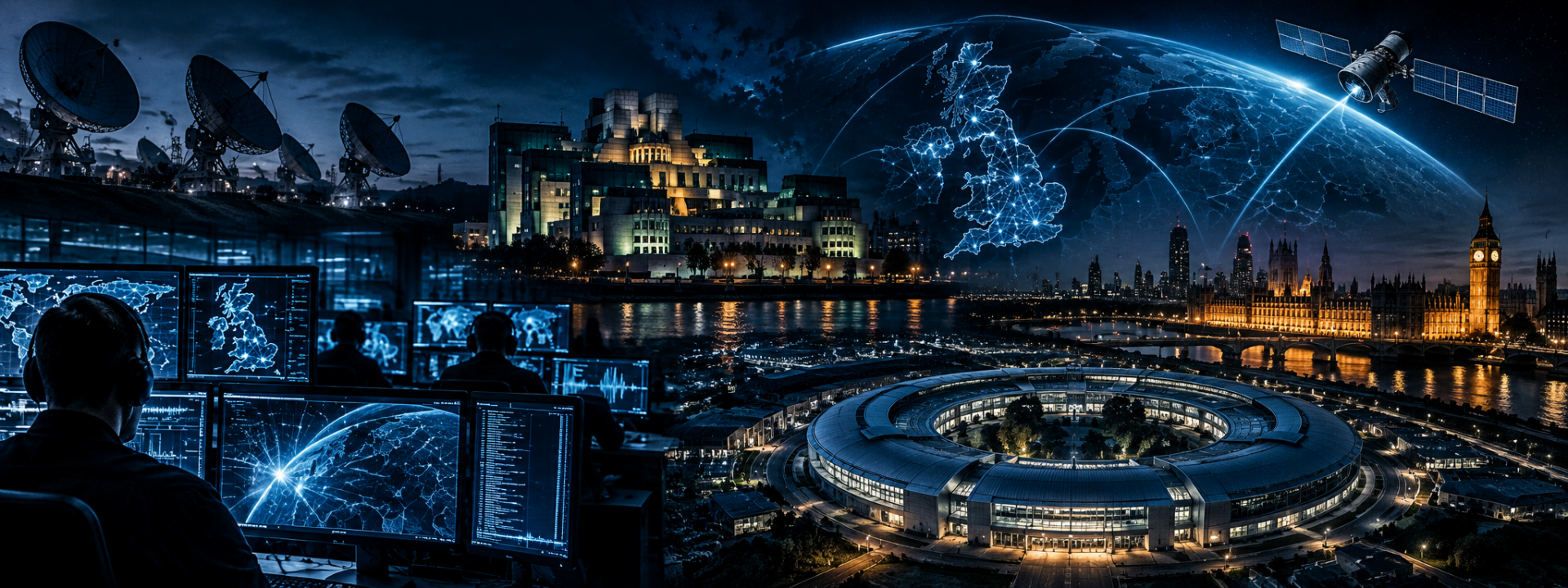
British Intelligence Surveillance — MI5, MI6 & GCHQ
Intelligence Gathering, National Security & the Evolution of British Surveillance
Britain operates three principal intelligence agencies: the Security Service (MI5), the Secret Intelligence Service (MI6) and Government Communications Headquarters (GCHQ).
Together, these organisations contribute to protecting British national security through intelligence gathering, threat assessment, counter-espionage, counterterrorism and the monitoring of hostile foreign-state activity.
Although their responsibilities overlap in certain areas, each agency performs a distinct role within Britain's intelligence system.
MI5 focuses primarily on threats to national security within the United Kingdom, MI6 gathers foreign intelligence overseas, and GCHQ specialises in signals intelligence and information assurance, including the security of government communications.
Their activities are supported by technological capabilities, international intelligence partnerships and statutory powers that have evolved alongside changes in communications technology.
The Historical Development of British Intelligence
Britain's modern intelligence system developed from earlier military, diplomatic and security organisations.
In 1909, the British government established the Secret Service Bureau, which subsequently developed into separate domestic security and foreign intelligence organisations.
These became the foundations of MI5 and MI6.
Britain's signals intelligence capabilities expanded significantly during the First and Second World Wars, particularly through cryptanalysis and the interception of foreign communications.
The Government Code and Cypher School, established in 1919, became central to British signals intelligence and wartime codebreaking.
Its successor, GCHQ, was established under that name in 1946.
The Cold War accelerated the development of electronic surveillance, communications interception and intelligence cooperation with allied countries.
The expansion of satellite communications, computers and global telecommunications networks subsequently transformed the scale and technical complexity of intelligence collection.
Three Agencies with Different Responsibilities
MI5 investigates threats including terrorism, espionage and hostile foreign-state activity affecting British national security.
It is a civilian security intelligence organisation rather than a police force and does not possess general powers of arrest.
MI6 collects secret intelligence overseas to support British national security and foreign policy objectives.
Its operations can involve human intelligence sources, overseas networks and cooperation with foreign intelligence services.
GCHQ specialises in signals intelligence, analysing communications and electronic information relevant to national security.
It also contributes to the protection of Britain's digital infrastructure, including through the National Cyber Security Centre.
These distinctions are important when examining public claims about intelligence operations.
The existence of a surveillance capability within one agency does not establish that every British intelligence organisation possesses or uses that capability.
Modern Surveillance Capabilities
Modern intelligence gathering can involve communications interception, communications data analysis, equipment interference, technical surveillance and information obtained through human sources.
Different activities require different legal authorisations and are subject to distinct statutory conditions.
Intelligence collection may be targeted at specific individuals, organisations or threats, while certain authorised powers allow the acquisition or examination of information at greater scale.
The development of digital communications has increased the amount of information potentially available to intelligence agencies.
However, technical capability should not be confused with unrestricted legal authority.
The ability to intercept or analyse particular forms of communication does not automatically mean that their collection or examination is lawful in every circumstance.
Intelligence Sharing and International Cooperation
Britain maintains extensive intelligence relationships with international partners.
One of the most significant is the Five Eyes intelligence partnership involving the United Kingdom, United States, Canada, Australia and New Zealand.
This cooperation has historical roots in wartime signals intelligence and subsequent post-war agreements.
Intelligence sharing can strengthen the identification of international threats, particularly those involving terrorism, cyber operations and hostile foreign governments.
However, international cooperation also raises questions about the handling of personal information, legal safeguards and accountability when intelligence crosses national borders.
These issues became particularly prominent following Edward Snowden's disclosures in 2013.
Legal Powers and Democratic Accountability
British intelligence agencies operate within a statutory framework that includes the Security Service Act 1989, Intelligence Services Act 1994 and Investigatory Powers Act 2016, as subsequently amended.
These laws establish agency responsibilities and regulate various intelligence activities.
The Investigatory Powers Act provides a framework for specified interception, communications data and equipment interference powers, including authorisation procedures and safeguards.
Oversight is provided through institutions including the Intelligence and Security Committee of Parliament, the Investigatory Powers Commissioner and the Investigatory Powers Tribunal.
Their responsibilities differ, encompassing parliamentary scrutiny, independent oversight and the examination of certain complaints.
The effectiveness of these arrangements remains an important question in assessing Britain's intelligence system.
Scope of This Investigation
This investigation examines the development, responsibilities and publicly documented surveillance capabilities of MI5, MI6 and GCHQ.
It considers their historical origins, intelligence collection methods, international partnerships and the legislation governing their activities.
Particular attention is given to distinguishing established capabilities from classified operations, allegations and unsupported claims.
The objective is to provide an evidence-based understanding of British intelligence surveillance and its relationship with national security, democratic accountability and individual rights.
MI5 — Domestic Security, Counter-Espionage & Surveillance
The Security Service, commonly known as MI5, is Britain's domestic security intelligence agency. Its principal responsibility is to protect national security against threats including terrorism, espionage and hostile foreign-state activity.
Unlike the police, MI5 does not possess general powers of arrest or prosecution. Its primary function is to gather, assess and analyse intelligence, identify threats and support the authorities responsible for disrupting or investigating suspected criminal activity.
Although MI5's work is principally concerned with threats affecting the United Kingdom, its intelligence activities can involve cooperation with overseas partners and operations extending beyond Britain's borders.
Origins and Historical Development
MI5 traces its origins to the Secret Service Bureau, established in 1909 amid concerns about foreign espionage.
The Bureau subsequently developed separate domestic security and foreign intelligence functions, forming the foundations of MI5 and MI6.
During the First World War, Britain's domestic security apparatus investigated suspected German espionage and threats to military security.
During the Second World War, MI5 played an important role in counter-espionage, including identifying and controlling enemy agents.
The Double-Cross System, coordinated through the Twenty Committee and supported by MI5's counter-espionage work, enabled British authorities to use captured or controlled German agents to transmit misleading information.
During the Cold War, MI5's responsibilities included investigating Soviet intelligence activity, suspected espionage and threats to national security.
Its work subsequently evolved to address international terrorism, politically motivated violence and the growing importance of digital communications.
MI5's Statutory Responsibilities
The Security Service Act 1989 established MI5's responsibilities in legislation.
Its functions include protecting national security against threats from espionage, terrorism and activities intended to undermine parliamentary democracy through political, industrial or violent means.
Subsequent legislation expanded and clarified aspects of its responsibilities, including support for law enforcement in relation to serious crime.
MI5 operates under the authority of the Home Secretary, with statutory arrangements governing its leadership and activities.
The agency's work is directed towards identifying threats rather than investigating ordinary criminal activity without a relevant statutory basis.
Counter-Espionage and Hostile Foreign States
Counter-espionage remains a central component of MI5's work.
Foreign intelligence organisations may attempt to obtain classified information, recruit individuals with access to sensitive material or conduct covert operations affecting British interests.
MI5 seeks to identify these activities through intelligence gathering, analysis and cooperation with other security organisations.
Modern counter-espionage also involves threats associated with cyber operations, covert political interference and attempts to intimidate individuals living in Britain.
The National Security Act 2023 introduced updated offences addressing espionage and other hostile-state activities, strengthening the wider legal framework within which such threats are investigated.
However, an intelligence assessment identifying suspected foreign-state activity does not automatically establish that a criminal offence has been committed.
Counterterrorism and Threat Prevention
Counterterrorism represents another major responsibility of MI5.
The agency investigates individuals and networks suspected of involvement in terrorism affecting British national security.
Its work can include identifying potential attack planning, analysing communications, assessing intelligence from human sources and cooperating with Counter Terrorism Policing.
MI5 also contributes to the assessment of terrorism threats and the disruption of suspected plots.
The division of responsibilities is important: MI5 gathers and assesses intelligence, while police exercise criminal investigative powers, including arrest, under the applicable legal framework.
Intelligence operations may lead to criminal investigations, but the two processes are not identical.
Surveillance and Intelligence-Gathering Methods
MI5 uses a range of intelligence methods, although the details of many operational techniques remain classified.
Publicly documented capabilities and statutory powers relevant to its work include:
-
Human intelligence sources, including individuals who provide information about suspected threats.
-
Directed surveillance and other authorised covert monitoring.
-
Communications interception and access to communications data under applicable legal procedures.
-
Equipment interference, where authorised under the relevant statutory framework.
-
Intelligence obtained through cooperation with police, GCHQ and international partners.
-
Analysis of information from multiple sources to identify patterns, relationships and potential threats.
These methods are governed by different legal requirements.
Not every capability is available under the same authorisation process, and the existence of a statutory power does not establish that it has been used in a particular investigation.
Communications Interception and Digital Intelligence
The expansion of mobile communications, internet services and encrypted digital platforms has significantly changed the environment in which MI5 operates.
Communications intelligence can help investigators identify connections between individuals, reconstruct suspected activities and assess emerging threats.
The Investigatory Powers Act 2016, as amended, provides the principal statutory framework for specified interception, communications data and equipment interference powers.
Depending on the power involved, authorisation may require a warrant, approval by a Judicial Commissioner or another prescribed procedure.
These legal distinctions are essential.
Access to communications data, interception of message content and interference with electronic equipment are different activities with different safeguards.
Furthermore, encryption and technological security measures can limit what information is technically accessible, even where an agency possesses lawful investigative authority.
Cooperation with GCHQ, MI6 and Police
MI5 does not operate independently of Britain's wider intelligence and security system.
It cooperates with GCHQ on communications intelligence and technical capabilities, while MI6 contributes foreign intelligence relevant to threats affecting Britain.
Counter Terrorism Policing works closely with MI5 where intelligence identifies suspected criminal activity requiring police investigation.
International cooperation also contributes to the identification of threats involving individuals, networks or organisations operating across borders.
However, intelligence sharing raises important questions about data handling, the reliability of information and the safeguards applicable when information is obtained from foreign partners.
Legal Authorisation and Independent Oversight
MI5's activities are governed by statutory requirements intended to ensure that intrusive intelligence methods are used for legitimate purposes and remain subject to appropriate safeguards.
The Security Service Act 1989 establishes the agency's statutory basis.
The Investigatory Powers Act 2016 regulates several categories of investigatory powers, while other legislation governs particular forms of covert activity.
The Investigatory Powers Commissioner oversees the exercise of specified investigatory powers, including through inspections and reviews.
The Investigatory Powers Tribunal provides a route for complaints concerning certain activities of intelligence agencies and the use of surveillance powers.
Parliamentary scrutiny is undertaken through the Intelligence and Security Committee.
These oversight mechanisms perform different functions and should not be treated as interchangeable.
Intelligence Assessments and Evidential Limitations
Much of MI5's operational work is necessarily confidential.
Public information therefore provides an incomplete picture of its activities, capabilities and effectiveness.
Official statements, parliamentary reports, court judgments and oversight findings can establish particular facts about intelligence operations.
However, the existence of classified capabilities cannot justify assuming that specific individuals have been monitored or that particular technologies have been deployed.
Equally, an absence of publicly available operational information does not prove that an investigation did or did not occur.
Responsible analysis requires a distinction between established facts, official assessments, allegations and speculation.
Overall Significance
MI5 occupies a central position in Britain's national security system, combining domestic security intelligence, counter-espionage, counterterrorism and cooperation with law enforcement.
Its surveillance capabilities have evolved alongside changes in technology and the nature of security threats.
However, the agency's intelligence responsibilities are not equivalent to unrestricted surveillance authority or general police powers.
The legitimacy of its operations depends on lawful authorisation, proportionality, independent oversight and effective accountability.
Understanding these boundaries is essential to evaluating both MI5's contribution to British security and the protections available to individuals whose rights may be affected by intelligence activities.
MI6 — Foreign Intelligence, Human Sources & Overseas Operations
The Secret Intelligence Service (SIS), commonly known as MI6, is Britain's foreign intelligence agency. Its principal responsibility is to obtain and provide intelligence concerning individuals, organisations and activities outside the United Kingdom in support of British national security and government decision-making.
Unlike MI5, which focuses primarily on security threats affecting Britain, MI6 specialises in overseas intelligence gathering, particularly through human intelligence sources and covert relationships.
Its work contributes to understanding hostile foreign governments, terrorism, weapons proliferation, international security threats and developments affecting Britain's strategic interests.
Although MI6 operates within a highly classified environment, its statutory responsibilities, historical development and aspects of its intelligence activities are publicly documented.
Origins and Historical Development
MI6 traces its origins to the Secret Service Bureau, established in 1909.
The Bureau initially combined domestic counter-espionage and overseas intelligence responsibilities before developing separate branches that became MI5 and MI6.
During the First World War, British foreign intelligence expanded in response to military and diplomatic threats.
The Second World War brought further developments in espionage, intelligence cooperation and the recruitment of overseas agents.
During the Cold War, MI6 concentrated heavily on intelligence concerning the Soviet Union, Warsaw Pact countries and other strategic developments.
Its operations involved recruiting sources, obtaining information about foreign military and political activities, and supporting British assessments of international security.
The end of the Cold War did not eliminate the requirement for foreign intelligence.
Instead, MI6's responsibilities evolved to address international terrorism, weapons proliferation, regional conflicts and increasingly complex relationships between conventional espionage and digital technology.
MI6's Statutory Responsibilities
The Intelligence Services Act 1994 established the Secret Intelligence Service's functions in legislation.
Under the Act, SIS is responsible for obtaining and providing information relating to the actions or intentions of persons outside the British Islands.
Its statutory functions also include performing other tasks relating to such persons, subject to the purposes and conditions specified by law.
These purposes include national security, the economic well-being of the United Kingdom in relation to activities outside the British Islands, and the prevention or detection of serious crime.
MI6 operates under the authority of the Foreign Secretary.
Its overseas responsibilities do not amount to unrestricted authority to conduct operations abroad.
Activities must remain within the applicable statutory framework and authorisation arrangements.
Human Intelligence and Agent Networks
Human intelligence, commonly abbreviated as HUMINT, is central to MI6's work.
HUMINT involves obtaining information from people who possess knowledge relevant to intelligence requirements.
Sources may have access to foreign government institutions, military organisations, security structures or other environments of intelligence interest.
Intelligence officers may develop relationships with individuals willing to provide information, assess the reliability of sources and report intelligence to British authorities.
The value of human intelligence often lies in obtaining information that cannot be established through publicly available material or technical collection alone.
For example, a human source may provide insight into an organisation's intentions, internal decision-making or future plans.
However, information obtained from human sources can be incomplete, mistaken or deliberately misleading.
Effective intelligence analysis therefore requires assessment of source reliability and, where possible, corroboration from independent evidence.
Overseas Espionage and Covert Operations
Foreign intelligence gathering may involve clandestine activity designed to protect the identity of intelligence officers, sources or operational relationships.
Historically, overseas espionage has included the recruitment of agents, secret communications and the acquisition of sensitive information.
Modern operations can also involve technical intelligence support and cooperation with other British intelligence agencies.
However, espionage and covert action are not interchangeable concepts.
Gathering information about a foreign organisation differs from attempting to influence events or disrupt activities.
The legal and operational basis for any particular activity must be considered separately.
Because MI6's current operations are largely classified, public claims about specific missions require particular caution.
A capability demonstrated historically does not establish that the same method is being used in a contemporary operation.
Intelligence Failures and the Iraq Weapons Assessments
One of the most significant controversies involving British intelligence concerned assessments of Iraq's alleged weapons of mass destruction before the 2003 invasion.
British government assessments relied in part on intelligence reporting about Iraq's suspected chemical and biological weapons capabilities.
The September 2002 government dossier presented claims about Iraqi weapons programmes, including the widely disputed assertion that certain chemical and biological weapons could be deployed within 45 minutes of an order.
Following the invasion, the anticipated stockpiles of weapons of mass destruction were not found.
The 2004 Butler Review examined intelligence concerning Iraqi weapons programmes and identified serious weaknesses in the collection, evaluation and presentation of intelligence.
The 2016 Iraq Inquiry, commonly known as the Chilcot Inquiry, further examined the government's decision-making and the relationship between intelligence assessments and policy.
These investigations demonstrated the consequences of intelligence uncertainty being communicated without sufficient qualification.
They also highlighted the importance of distinguishing raw intelligence reports, analytical judgments and political interpretations.
An intelligence assessment may be produced in good faith and nevertheless prove incorrect.
Effective accountability therefore requires examining both the reliability of the underlying information and how intelligence conclusions are presented to decision-makers.
Cooperation with MI5 and GCHQ
MI6 forms part of Britain's wider intelligence system alongside MI5 and GCHQ.
Although each agency has distinct responsibilities, international threats frequently require cooperation between them.
MI6 may obtain overseas intelligence relevant to terrorist networks or hostile foreign-state activity.
MI5 may investigate related threats affecting Britain, while GCHQ can contribute signals intelligence and technical expertise.
Combining information from different intelligence disciplines can improve understanding of complex threats.
However, intelligence obtained from multiple sources does not automatically become reliable merely because it has been combined.
Independent corroboration and careful assessment remain essential.
The Five Eyes Intelligence Partnership
Britain participates in the Five Eyes intelligence partnership with the United States, Canada, Australia and New Zealand.
The partnership developed from wartime and post-war signals intelligence cooperation and remains an important element of intelligence sharing between the participating countries.
Although Five Eyes is particularly associated with signals intelligence, broader intelligence cooperation also occurs between allied security and intelligence organisations.
For MI6, relationships with foreign intelligence partners can support the collection and assessment of information concerning international threats.
Such cooperation also raises questions about the reliability of shared intelligence, information handling and legal accountability.
Intelligence supplied by an overseas partner should not automatically be treated as independently verified.
Legal Authorisation and Overseas Accountability
MI6's activities are governed principally by the Intelligence Services Act 1994 and other applicable legislation.
Section 7 of the 1994 Act provides a framework under which the Secretary of State may authorise certain acts outside the British Islands that would otherwise potentially give rise to liability under UK law.
Such authorisations are subject to statutory conditions and do not amount to unrestricted immunity or permission to disregard all applicable law.
The Investigatory Powers Act 2016 also governs specified surveillance and intelligence-gathering powers.
Independent oversight is provided through institutions including the Investigatory Powers Commissioner and the Investigatory Powers Tribunal.
The Intelligence and Security Committee of Parliament examines the administration, policies, expenditure and certain operational matters of the intelligence agencies.
The classified nature of overseas intelligence operations creates continuing challenges for transparency and public accountability.
Intelligence, Evidence and Public Claims
MI6's work is particularly vulnerable to misunderstanding because operational secrecy limits the information available to the public.
Historical records, official inquiries, parliamentary reports and judicial findings can establish facts about particular intelligence activities.
However, allegations about current overseas operations may rely on anonymous sources, incomplete documentation or speculative interpretations.
The existence of sophisticated intelligence capabilities does not establish that a particular operation occurred.
Similarly, the absence of public confirmation does not necessarily prove that an alleged operation was impossible.
Responsible analysis requires separating established historical events, official findings, credible reporting and unsupported claims.
Overall Significance
MI6 plays a central role in Britain's international intelligence system by obtaining information about foreign governments, organisations and security threats.
Its historical development reflects more than a century of overseas espionage, intelligence cooperation and changing national security priorities.
Human intelligence remains particularly important because it can provide insight into intentions and decision-making that technical surveillance alone may not reveal.
Nevertheless, the Iraq weapons intelligence controversy demonstrates that intelligence gathering is not infallible and that inaccurate assessments can have serious political consequences.
The legitimacy and effectiveness of MI6 depend on reliable intelligence collection, rigorous analysis, lawful authorisation and independent oversight.
Understanding these responsibilities and limitations is essential to evaluating Britain's foreign intelligence capabilities and their contribution to national security.
GCHQ — Signals Intelligence, Communications Interception & Cybersecurity
Government Communications Headquarters (GCHQ) is Britain's principal signals intelligence agency, responsible for collecting and analysing communications and other electronic signals relevant to national security.
Unlike MI5, which primarily investigates domestic security threats, and MI6, which specialises in overseas human intelligence, GCHQ focuses on signals intelligence, technical intelligence capabilities and the protection of information and communications systems.
Its work contributes to counterterrorism, counter-espionage, cybersecurity, military intelligence and the identification of hostile foreign-state activity.
The expansion of global telecommunications and digital networks has transformed GCHQ from an organisation historically associated with codebreaking and radio interception into a central component of Britain's modern intelligence infrastructure.
Origins — From Wartime Codebreaking to GCHQ
British signals intelligence developed significantly during the First World War, when the interception and interpretation of enemy communications became increasingly important to military operations.
In 1919, the Government Code and Cypher School (GC&CS) was established to consolidate Britain's codebreaking and communications intelligence activities.
During the Second World War, GC&CS operated principally from Bletchley Park, where British and Allied specialists worked to decrypt encrypted German and other Axis communications.
The organisation's achievements included the exploitation of Enigma traffic and work against the more complex Lorenz cipher system.
These activities contributed to Allied military intelligence and demonstrated the strategic importance of combining intercepted signals, cryptanalysis and analytical expertise.
In 1946, GC&CS was renamed Government Communications Headquarters.
During the Cold War, GCHQ expanded its capabilities to address Soviet military communications, international telecommunications and emerging electronic technologies.
The development of satellites, fibre-optic networks and digital communications subsequently transformed the methods and scale of signals intelligence.
What Is Signals Intelligence?
Signals intelligence, commonly abbreviated as SIGINT, involves obtaining intelligence from intercepted or otherwise acquired electronic signals.
It can include information derived from communications systems and other electronic emissions, depending on the technology involved and the intelligence requirement.
Two important categories are:
Communications Intelligence (COMINT): Intelligence derived from communications between individuals, organisations or technical systems. This can include radio transmissions and other forms of electronic communication.
Electronic Intelligence (ELINT): Intelligence derived from non-communications electromagnetic emissions, such as signals produced by certain radar systems.
These disciplines are related but distinct.
For example, intercepting a radio communication differs from analysing the characteristics of a radar transmission.
Neither activity automatically implies access to the contents of encrypted internet messages or control over the equipment producing the signal.
The intelligence value depends on the information available, the collection method and the analytical techniques employed.
Communications Interception and Digital Networks
Modern communications travel through complex international networks involving fibre-optic cables, satellites, mobile infrastructure and internet services.
Signals intelligence agencies may obtain information from communications systems through authorised technical collection methods.
Depending on the circumstances, intelligence may concern communication content, associated data or technical characteristics of a transmission.
Communications content and communications data are legally and technically distinct.
Content concerns the substance of a communication, while communications data can provide information about its transmission, routing or associated circumstances.
The Investigatory Powers Act 2016, as amended, establishes legal frameworks for specified interception and communications data powers.
These include different authorisation procedures and safeguards depending on the type of activity involved.
The existence of technical access to a communications network does not establish unrestricted access to all information passing through it.
Encryption, system architecture and legal restrictions can limit what information can be collected or interpreted.
Bulk Interception and the Snowden Disclosures
GCHQ's surveillance capabilities attracted international attention following Edward Snowden's disclosures in 2013.
Documents reported by major news organisations described aspects of British and American signals intelligence cooperation, including GCHQ's TEMPORA programme.
The disclosures raised questions about the interception of communications carried through international fibre-optic infrastructure and the collection and examination of large quantities of communications information.
They also prompted scrutiny of intelligence sharing, privacy safeguards and the extent of public understanding of surveillance practices.
Bulk interception differs from the indiscriminate examination of every communication.
Collection, filtering, selection and examination are separate processes, and their legal treatment has evolved.
Nevertheless, the disclosures demonstrated that intelligence collection could operate at a scale not previously understood by much of the public.
Subsequent legal challenges, oversight findings and legislative reforms addressed aspects of Britain's interception framework.
These developments will be examined in greater detail in the dedicated investigation into the Snowden revelations and mass surveillance.
GCHQ and the US National Security Agency
GCHQ maintains a longstanding intelligence relationship with the United States National Security Agency (NSA).
The foundations of this cooperation developed during the Second World War and were formalised through post-war signals intelligence arrangements, including the 1946 UKUSA Agreement.
The relationship became part of the wider Five Eyes intelligence partnership involving Britain, the United States, Canada, Australia and New Zealand.
Cooperation can involve intelligence sharing, technical collaboration and coordinated responses to international security threats.
However, the existence of an intelligence-sharing agreement does not establish that every collection programme or operation is jointly conducted.
Nor does intelligence sharing remove the legal responsibilities of British authorities when exercising powers governed by UK law.
GCHQ and Britain's Cybersecurity
GCHQ contributes to Britain's cybersecurity through technical expertise, threat intelligence and cooperation with government and industry.
In 2016, the National Cyber Security Centre (NCSC) was established as part of GCHQ.
The NCSC provides cybersecurity guidance, supports responses to significant cyber incidents and works with organisations responsible for protecting important digital systems.
Its activities include publishing technical advisories, analysing cyber threats and helping organisations improve their resilience.
The distinction between intelligence collection and defensive cybersecurity is important.
GCHQ's intelligence functions can involve classified national security operations, while the NCSC also performs a substantial public-facing role in improving cybersecurity across British society.
Encryption and Technical Limitations
Encryption is fundamental to the security of modern digital communications.
It protects information by transforming readable data into a form that cannot ordinarily be understood without the relevant cryptographic keys.
Strong encryption can prevent an interceptor from reading communication content even where the encrypted transmission itself is accessible.
Intelligence agencies may therefore distinguish between obtaining a communication, identifying associated information and recovering its contents.
Technical capabilities depend on the encryption system, implementation, available access and other circumstances.
The existence of advanced computing resources does not establish that modern encryption can be universally defeated.
Similarly, claims that intelligence agencies can automatically access every encrypted device or communication are not supported merely by their general technical expertise.
Artificial Intelligence and Modern Intelligence Analysis
Artificial intelligence and machine learning can assist intelligence organisations in analysing large quantities of information, identifying patterns and prioritising material for human examination.
Potential applications include language processing, anomaly detection, cyber threat analysis and the interpretation of technical signals.
However, automated analysis does not eliminate uncertainty.
Systems can produce errors, misclassify information or identify correlations that do not establish meaningful relationships.
Human assessment, source validation and legal safeguards remain important when intelligence analysis contributes to decisions affecting individuals or national security.
Public information about the precise deployment of advanced analytical systems within GCHQ remains limited.
Consequently, general developments in artificial intelligence should not be presented as proof that particular classified surveillance capabilities exist.
Legal Powers and Independent Oversight
GCHQ's statutory functions are established under the Intelligence Services Act 1994.
The Investigatory Powers Act 2016, as subsequently amended, governs important categories of interception, communications data acquisition and equipment interference.
The legislation establishes authorisation procedures, safeguards and oversight arrangements for the powers it regulates.
The Investigatory Powers Commissioner oversees the exercise of specified investigatory powers.
The Investigatory Powers Tribunal provides a legal mechanism for examining certain complaints concerning intelligence agencies and surveillance activities.
Parliamentary scrutiny is also undertaken through the Intelligence and Security Committee.
These mechanisms provide different forms of accountability, although the classified nature of intelligence operations creates continuing challenges for public transparency.
Intelligence Capabilities Versus Unverified Claims
GCHQ possesses extensive technical expertise in communications intelligence, cryptanalysis and cybersecurity.
However, this expertise should not be confused with evidence supporting every alleged surveillance capability.
The ability to detect or analyse electromagnetic signals does not automatically establish an ability to manipulate human perception, transmit intelligible speech into the brain or remotely control neurological activity.
Such claims require independent scientific evidence demonstrating the proposed mechanism, equipment capabilities and actual operational use.
Likewise, the existence of classified intelligence programmes cannot be used as proof of technologies for which no reliable evidence has been presented.
A responsible assessment must distinguish documented capabilities, technically plausible methods, official findings and unsupported speculation.
Overall Significance
GCHQ has evolved from Britain's wartime codebreaking organisation into a major signals intelligence and cybersecurity institution.
Its capabilities support national security by providing information about foreign threats, communications networks, cyber operations and other electronic activity.
The Snowden disclosures demonstrated the scale and complexity of modern intelligence collection and intensified debate about privacy and democratic accountability.
At the same time, encryption, technological limitations and statutory safeguards remain important constraints on intelligence operations.
Understanding GCHQ therefore requires examining both its established technical capabilities and the legal framework governing their use.
The central question is not simply what modern intelligence technology can collect, but how that information is obtained, examined, authorised and independently scrutinised.
Intelligence Cooperation, Surveillance Oversight & Public Accountability
Britain's intelligence system depends on cooperation between MI5, MI6 and GCHQ, alongside police, government departments and international intelligence partners.
Although the three agencies have distinct statutory responsibilities, modern security threats frequently cross geographical, organisational and technological boundaries.
Counterterrorism, foreign espionage, cyber operations and international security investigations can therefore require information obtained from multiple intelligence disciplines.
However, intelligence cooperation also raises questions about the reliability of shared information, the protection of personal data and the accountability of organisations operating largely outside public scrutiny.
Cooperation Between MI5, MI6 and GCHQ
MI5, MI6 and GCHQ perform complementary functions within Britain's national security system.
MI5 investigates threats to national security, particularly those affecting the United Kingdom.
MI6 obtains foreign intelligence concerning individuals, organisations and activities overseas.
GCHQ specialises in signals intelligence and technical intelligence capabilities, while also contributing to Britain's cybersecurity.
These responsibilities can overlap during investigations involving international threats.
For example, an overseas intelligence source may identify a suspected threat affecting Britain. Communications intelligence may provide additional information, while MI5 and police assess the implications for domestic security.
Combining intelligence from different sources can improve understanding and help identify information requiring further investigation.
Nevertheless, intelligence sharing does not automatically establish the accuracy of the information exchanged.
Independent assessment and corroboration remain essential.
The Joint Intelligence Committee
The Joint Intelligence Committee (JIC) plays an important role in coordinating intelligence assessments for the British government.
Its responsibilities include producing assessments concerning national security and international developments, drawing on information from intelligence agencies, diplomatic reporting, defence sources and other relevant material.
The Committee does not simply reproduce the findings of individual intelligence organisations.
Its purpose is to assess available evidence, identify uncertainties and provide coordinated judgments to senior decision-makers.
The distinction between intelligence collection and intelligence assessment is important.
Information obtained from a source may be accurate, incomplete, mistaken or deliberately misleading.
Analytical processes are intended to evaluate that information before it informs government policy.
The Iraq weapons intelligence controversy demonstrated the consequences of weaknesses in this process and the importance of communicating uncertainty clearly.
International Intelligence Sharing and Five Eyes
Britain maintains longstanding intelligence relationships with allied countries, particularly through the Five Eyes partnership.
The partnership includes the United Kingdom, United States, Canada, Australia and New Zealand.
Its historical foundations lie in wartime signals intelligence cooperation and the post-war UKUSA Agreement.
Intelligence sharing can help identify threats involving international terrorism, hostile foreign governments, cyber operations and weapons proliferation.
It may also provide access to information unavailable through Britain's own collection capabilities.
However, cooperation between intelligence agencies creates legal and accountability challenges.
Information obtained by one country may be shared with another under arrangements that are not fully disclosed publicly.
Questions therefore arise about the safeguards governing intelligence receipt, retention, examination and onward disclosure.
International cooperation does not remove the need for British authorities to comply with applicable domestic law and human rights obligations.
The Snowden Disclosures and Intelligence Accountability
The 2013 disclosures by Edward Snowden revealed previously secret aspects of surveillance programmes operated by the United States and its intelligence partners.
Reporting based on the documents described GCHQ's TEMPORA programme and cooperation with the US National Security Agency.
These revelations intensified scrutiny of bulk interception, communications data collection and intelligence sharing.
They also raised questions about whether existing legal frameworks provided sufficient clarity and protection for individuals whose communications could be collected.
The disclosures did not establish that every communication collected through a bulk system was individually examined.
Nevertheless, they revealed capabilities and practices that had not previously been understood by much of the public.
Subsequent legal proceedings examined aspects of Britain's interception arrangements and the safeguards governing intelligence collection.
The Snowden disclosures and their legal consequences will be examined separately in the dedicated investigation into mass surveillance.
The Investigatory Powers Act 2016
The Investigatory Powers Act 2016 established a comprehensive statutory framework for several categories of surveillance and intelligence-gathering powers.
These include interception, communications data acquisition, equipment interference and specified bulk investigatory powers.
The legislation introduced important authorisation and oversight arrangements, including the requirement for Judicial Commissioner approval of many warrants issued by a Secretary of State.
This procedure is commonly described as the double-lock system.
Different investigatory powers remain subject to different statutory conditions, authorisation procedures and safeguards.
The legislation does not provide unrestricted authority to intercept communications or examine personal information.
It was subsequently amended, including through the Investigatory Powers (Amendment) Act 2024.
The effectiveness and proportionality of these powers remain subjects of legal and parliamentary scrutiny.
The Investigatory Powers Commissioner
The Investigatory Powers Commissioner provides independent oversight of the exercise of specified investigatory powers.
The Commissioner's functions include reviewing authorisations, inspecting relevant public authorities and examining compliance with statutory requirements.
Judicial Commissioners also perform functions relating to the approval of certain warrants and authorisations.
Oversight can identify compliance failures, weaknesses in procedures or areas requiring improvement.
However, the existence of an oversight institution does not establish that every intelligence activity is publicly examined or disclosed.
Much of its work necessarily involves classified information.
Published reports therefore provide an important, although incomplete, source of evidence about the operation of Britain's surveillance framework.
The Investigatory Powers Tribunal
The Investigatory Powers Tribunal provides a specialist legal mechanism for examining certain complaints concerning intelligence agencies and investigatory powers.
Individuals may bring complaints where they believe relevant surveillance or intelligence activities have unlawfully interfered with their rights.
The Tribunal has powers to examine sensitive material and determine complaints within its statutory jurisdiction.
Its proceedings may involve closed evidence because of national security considerations.
The Tribunal has issued significant judgments concerning the legality of surveillance arrangements and intelligence-related activities.
These judgments demonstrate that intelligence agencies and public authorities are subject to legal challenge.
They also provide a means of distinguishing judicial findings from political allegations or untested claims.
Parliamentary Oversight and the Intelligence and Security Committee
The Intelligence and Security Committee of Parliament examines the policies, administration, expenditure and certain operations of Britain's intelligence agencies.
Its work can include investigations into intelligence failures, operational arrangements and matters affecting national security accountability.
The Committee operates under statutory arrangements and has access to sensitive intelligence information, subject to applicable restrictions.
Its reports can provide substantial insight into activities that would otherwise remain outside ordinary parliamentary scrutiny.
However, the Committee's role differs from that of a court or criminal investigative authority.
Its findings should therefore be understood within the scope of its parliamentary oversight responsibilities.
The Committee's reports on Iraq intelligence, Russian activity and other national security matters illustrate the importance of independent examination of intelligence assessments and government decision-making.
Judicial Findings and Surveillance Legality
British surveillance arrangements have been challenged before domestic courts and the European Court of Human Rights.
In Big Brother Watch and Others v United Kingdom, the European Court of Human Rights examined aspects of Britain's former bulk interception and communications data arrangements.
In its Grand Chamber judgment of May 2021, the Court identified violations of the European Convention on Human Rights arising from deficiencies in the safeguards governing certain surveillance regimes.
The judgment did not establish that all bulk interception was inherently unlawful.
Instead, it emphasised the importance of adequate authorisation, supervision and safeguards throughout the surveillance process.
The distinction is significant because the legality of a surveillance system depends on its governing framework and operation, not simply on whether it collects information at scale.
Secrecy, Public Confidence and Democratic Accountability
Intelligence organisations require operational secrecy to protect sources, investigative methods and sensitive national security information.
However, secrecy can limit the ability of Parliament, courts, journalists and the public to assess particular activities.
This creates a continuing tension between operational effectiveness and democratic accountability.
Effective oversight must therefore provide meaningful scrutiny without unnecessarily exposing legitimate intelligence operations.
Public debate also requires careful distinctions between established facts, official assessments, court judgments, allegations and speculation.
The existence of classified intelligence capabilities should not be treated as evidence supporting every claim about surveillance technology or intelligence activity.
Equally, the absence of public information does not necessarily demonstrate that an alleged operation was impossible or did not occur.
Overall Significance
Cooperation between MI5, MI6, GCHQ and international intelligence partners is essential to Britain's ability to identify and assess complex security threats.
However, intelligence sharing and sophisticated surveillance capabilities create corresponding responsibilities concerning legality, proportionality and the protection of individual rights.
The Snowden disclosures, subsequent court judgments and legislative reforms demonstrate that intelligence accountability is an evolving process.
Britain's oversight framework includes parliamentary scrutiny, independent investigatory powers supervision and specialist judicial remedies.
Nevertheless, the effectiveness of these safeguards must be assessed through their practical operation rather than their existence alone.
A credible intelligence system requires both the capability to protect national security and the accountability necessary to maintain public confidence in the lawful exercise of state power.
Overall Assessment & Conclusions
Britain's three principal intelligence agencies — MI5, MI6 and GCHQ — form an interconnected national security system developed over more than a century of intelligence gathering, counter-espionage and technological advancement.
Although their responsibilities differ, all three contribute to identifying threats, informing government decisions and protecting British national security.
MI5 concentrates primarily on security threats affecting Britain, MI6 obtains foreign intelligence overseas, and GCHQ specialises in signals intelligence and technical capabilities.
Their combined activities demonstrate the importance of intelligence cooperation in addressing threats that increasingly cross national borders and technological boundaries.
However, the development of sophisticated surveillance capabilities also creates significant responsibilities concerning legality, proportionality, privacy and democratic accountability.
What the Evidence Establishes
The historical development and statutory responsibilities of Britain's intelligence agencies are well documented.
Official legislation, parliamentary investigations, intelligence publications and judicial proceedings establish the existence of a range of intelligence-gathering capabilities.
These include human intelligence operations, communications interception, communications data analysis, equipment interference and certain forms of bulk intelligence collection.
The Snowden disclosures of 2013 revealed previously secret aspects of GCHQ's communications intelligence activities and cooperation with the United States National Security Agency.
Subsequent legal proceedings identified deficiencies in safeguards governing aspects of Britain's former surveillance arrangements.
These findings establish that British intelligence surveillance has operated at considerable technological scale and has required continuing legal scrutiny.
They do not establish that intelligence agencies possess unrestricted access to every communication or that all alleged surveillance activities have occurred.
Different Agencies, Different Capabilities
MI5, MI6 and GCHQ should not be treated as interchangeable organisations.
Their intelligence responsibilities, operational methods and statutory functions differ.
MI5's domestic security investigations are distinct from MI6's overseas intelligence collection.
GCHQ's signals intelligence capabilities differ from human intelligence operations conducted through covert sources.
Cooperation between agencies allows information obtained through different methods to contribute to a wider intelligence assessment.
However, a capability associated with one organisation cannot automatically be attributed to another.
Similarly, the existence of a technical capability does not establish its deployment in any particular investigation.
Intelligence Collection and the Reliability of Assessments
Intelligence gathering does not guarantee accurate conclusions.
Information obtained from human sources, intercepted communications or technical systems may be incomplete, misleading or incorrectly interpreted.
The Iraq weapons intelligence controversy demonstrated how weaknesses in intelligence assessment and the presentation of uncertainty can contribute to serious government decision-making failures.
The Butler Review and Iraq Inquiry highlighted the importance of rigorous evaluation and clear communication of evidential limitations.
This distinction remains relevant to contemporary intelligence operations.
Raw intelligence, analytical assessments and established facts are not equivalent.
Effective intelligence organisations must continually evaluate source reliability, competing explanations and the possibility of error.
Surveillance, Privacy and Civil Liberties
Modern intelligence surveillance can involve highly intrusive methods capable of obtaining information about individuals, communications and digital activities.
Such powers may be necessary for legitimate national security investigations, but their use must remain subject to legal restrictions and appropriate safeguards.
The Investigatory Powers Act 2016, as subsequently amended, provides statutory frameworks for several important surveillance capabilities.
Authorisation procedures, independent oversight and judicial remedies are intended to prevent misuse and protect individual rights.
Nevertheless, the existence of these mechanisms does not automatically demonstrate that every operation is lawful or proportionate.
Their effectiveness depends on implementation, compliance, independent scrutiny and the availability of meaningful remedies where violations occur.
International Intelligence Cooperation
Britain's intelligence relationships, particularly through the Five Eyes partnership, provide access to information and expertise relevant to international security threats.
Cooperation can improve the identification of hostile foreign-state activity, terrorism, cyber operations and weapons proliferation.
However, intelligence sharing also raises questions about the reliability of information, the protection of personal data and accountability when information crosses national jurisdictions.
International cooperation should not provide a means of avoiding domestic legal safeguards.
The handling of shared intelligence must therefore remain subject to applicable legal requirements and appropriate oversight.
Established Science and Unsupported Surveillance Claims
Modern intelligence agencies possess substantial expertise in communications technology, electronic signals, cryptanalysis and digital systems.
However, these capabilities should not be confused with evidence supporting every alleged form of surveillance or technological intervention.
Established communications interception, signals analysis and equipment interference are different from claims involving remote neurological manipulation, the transmission of intelligible speech directly into the brain or other purported capabilities.
Scientific research may demonstrate particular physical effects without establishing the existence of a practical intelligence system employing them.
Claims about specific surveillance technologies therefore require evidence of the proposed mechanism, technical feasibility and actual deployment.
Classified intelligence activity cannot be used as a substitute for such evidence.
Equally, the absence of public operational information should not be confused with proof that every undisclosed capability is impossible.
The appropriate approach is to distinguish established science, demonstrated technology, official disclosures and speculation.
The Importance of Independent Oversight
Britain's intelligence accountability framework includes the Intelligence and Security Committee of Parliament, the Investigatory Powers Commissioner and the Investigatory Powers Tribunal.
These institutions perform different functions involving parliamentary scrutiny, oversight of investigatory powers and legal examination of complaints.
Their work is particularly important because intelligence secrecy limits the information available to ordinary public scrutiny.
Judicial findings concerning historic surveillance arrangements demonstrate that intelligence activities can be challenged and that legal safeguards may require improvement.
Effective accountability must therefore be assessed through independent examination, published findings and the practical consequences of identified failures.
Final Conclusion
MI5, MI6 and GCHQ provide Britain with intelligence capabilities developed through decades of operational experience, scientific advancement and international cooperation.
Their activities contribute to identifying threats, informing government decisions and protecting national security.
Nevertheless, intelligence collection is neither infallible nor exempt from legal accountability.
The historical record demonstrates the importance of distinguishing reliable intelligence from uncertain assessments, established surveillance capabilities from unsupported claims, and legitimate national security operations from unlawful interference with individual rights.
Britain's challenge is to maintain effective intelligence capabilities while ensuring that their use remains necessary, proportionate and subject to meaningful independent scrutiny.
The strength of a democratic intelligence system depends not only on what its agencies are capable of discovering, but also on the legal safeguards, evidential standards and accountability governing how those capabilities are exercised.
References
UK Parliament (1989)
Security Service Act 1989.
Establishes the statutory basis and functions of MI5.
https://www.legislation.gov.uk/ukpga/1989/5/contents
UK Parliament (1994)
Intelligence Services Act 1994.
Establishes the statutory functions of MI6 and GCHQ, including provisions concerning authorisation and oversight.
https://www.legislation.gov.uk/ukpga/1994/13/contents
Review of Intelligence on Weapons of Mass Destruction (2004)
Report of a Committee of Privy Counsellors (Butler Review). HC 898.
Examines intelligence assessments concerning Iraq's alleged weapons programmes and weaknesses in intelligence evaluation.
https://webarchive.nationalarchives.gov.uk/ukgwa/20100809114547/http://www.butlerreview.org.uk/
UK Parliament (2013)
Justice and Security Act 2013.
Provides the statutory framework for the Intelligence and Security Committee of Parliament and addresses certain national security proceedings.
https://www.legislation.gov.uk/ukpga/2013/9/contents
The Guardian (2013)
GCHQ Taps Fibre-Optic Cables for Secret Access to World's Communications.
Reporting based on the Snowden disclosures concerning GCHQ's TEMPORA programme and communications interception.
https://www.theguardian.com/uk/2013/jun/21/gchq-cables-secret-world-communications-nsa
Privacy and Civil Liberties Oversight Board (2014)
Report on the Telephone Records Program Conducted under Section 215 of the USA PATRIOT Act.
Examines the US National Security Agency's telephone metadata programme and associated privacy and oversight concerns.
The Iraq Inquiry (2016)
The Report of the Iraq Inquiry (Chilcot Report).
Examines Britain's involvement in the Iraq conflict, including intelligence assessments, government decision-making and the presentation of evidence.
https://webarchive.nationalarchives.gov.uk/ukgwa/20171123123237/http://www.iraqinquiry.org.uk/
UK Parliament (2016)
Investigatory Powers Act 2016.
Establishes legal frameworks for communications interception, communications data, equipment interference and specified bulk investigatory powers.
https://www.legislation.gov.uk/ukpga/2016/25/contents
National Cyber Security Centre (2016–present)
Official Cybersecurity Guidance, Threat Assessments and Publications.
Public guidance and technical assessments from the NCSC, established in 2016 as part of GCHQ.
European Court of Human Rights (2021)
Big Brother Watch and Others v. the United Kingdom. Grand Chamber judgment, 25 May 2021.
Examines the compatibility of aspects of Britain's former bulk interception and intelligence-sharing arrangements with the European Convention on Human Rights.
https://hudoc.echr.coe.int/eng?i=001-210077
UK Parliament (2024)
Investigatory Powers (Amendment) Act 2024.
Amends aspects of the Investigatory Powers Act 2016, including provisions relating to investigatory powers and oversight.
https://www.legislation.gov.uk/ukpga/2024/9/contents
MI5 — The Security Service (Official Publications)
History, Responsibilities and National Security Threat Assessments.
Secret Intelligence Service — MI6 (Official Publications)
History, Statutory Responsibilities and Intelligence Operations.
Government Communications Headquarters — GCHQ (Official Publications)
History, Signals Intelligence and Cybersecurity.
Intelligence and Security Committee of Parliament (Official Reports)
Parliamentary Oversight, Intelligence Investigations and Annual Reports.
https://isc.independent.gov.uk/
Investigatory Powers Commissioner's Office (Annual Reports)
Independent Oversight of Investigatory Powers and Intelligence Authorisations.
Investigatory Powers Tribunal (Judgments and Decisions)
Judicial Examination of Intelligence and Surveillance Complaints.