

Microwave Transmission, Radar & Waveguides
Understanding Microwave Transmission, Radar & Waveguides
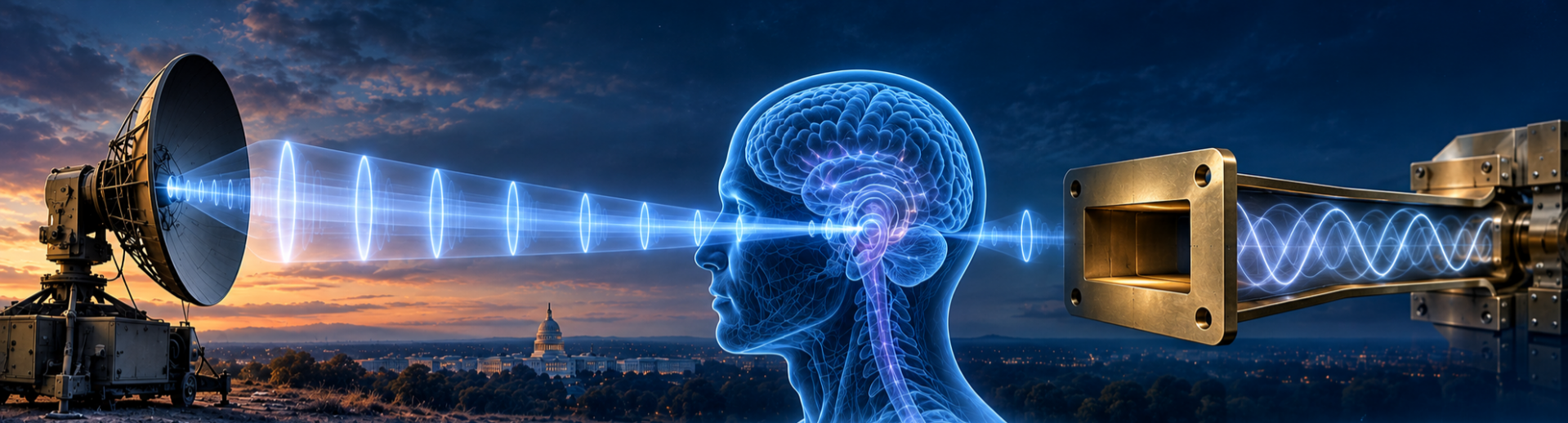
Microwave technology has played a significant role in radar development, wireless communication and scientific research since the early twentieth century. Although pulsed microwave transmission, radar systems and waveguides all involve electromagnetic energy, important differences exist in how that energy is directed, transmitted and delivered to a subject.
Pulsed microwave transmission involves generating short bursts of electromagnetic energy that can be radiated through free space using antennas. These pulses travel at approximately the speed of light and can be directed towards distant objects or locations. Such transmission methods have been used in radar systems, communications and scientific investigations, including early American research into the microwave auditory effect.
Radar systems transmit electromagnetic signals and analyse their reflections to detect objects, measure distances and identify movement. Certain pulsed microwave transmissions can also produce the microwave auditory effect, in which absorbed electromagnetic energy generates microscopic thermoelastic expansions within tissue, creating acoustic pressure waves that stimulate the cochlea and produce perceived sounds. Early observations associated with Airborne Instruments Laboratory (AIL) in 1947 preceded Allan H. Frey's systematic investigations during the 1960s. Modern radar technology includes compact and miniature systems, sometimes described as micro-radar, capable of sophisticated sensing using considerably smaller equipment. However, not all radar systems use discrete microwave pulses, and the ability to detect objects does not itself establish the ability to induce auditory perception.
Waveguides, in microwave bioeffects and auditory research, have been used to deliver electromagnetic energy to nearby human or animal subjects under controlled laboratory conditions. These physical structures, typically metallic tubes or specialised applicators, allow researchers to investigate physiological, behavioural and auditory responses to microwave exposure. American researchers including Allan H. Frey, Arthur W. Guy, C. K. Chou and James C. Lin investigated microwave-induced biological and auditory effects using different experimental arrangements. Don R. Justesen also reviewed behavioural and psychological effects associated with microwave exposure.
In the Soviet Union, Tyazhelov and colleagues at Pushchino conducted microwave auditory experiments reported in 1979 using waveguide-based exposure arrangements. Their investigations involved localised laboratory exposure rather than demonstrating a portable, long-range microwave transmission system.
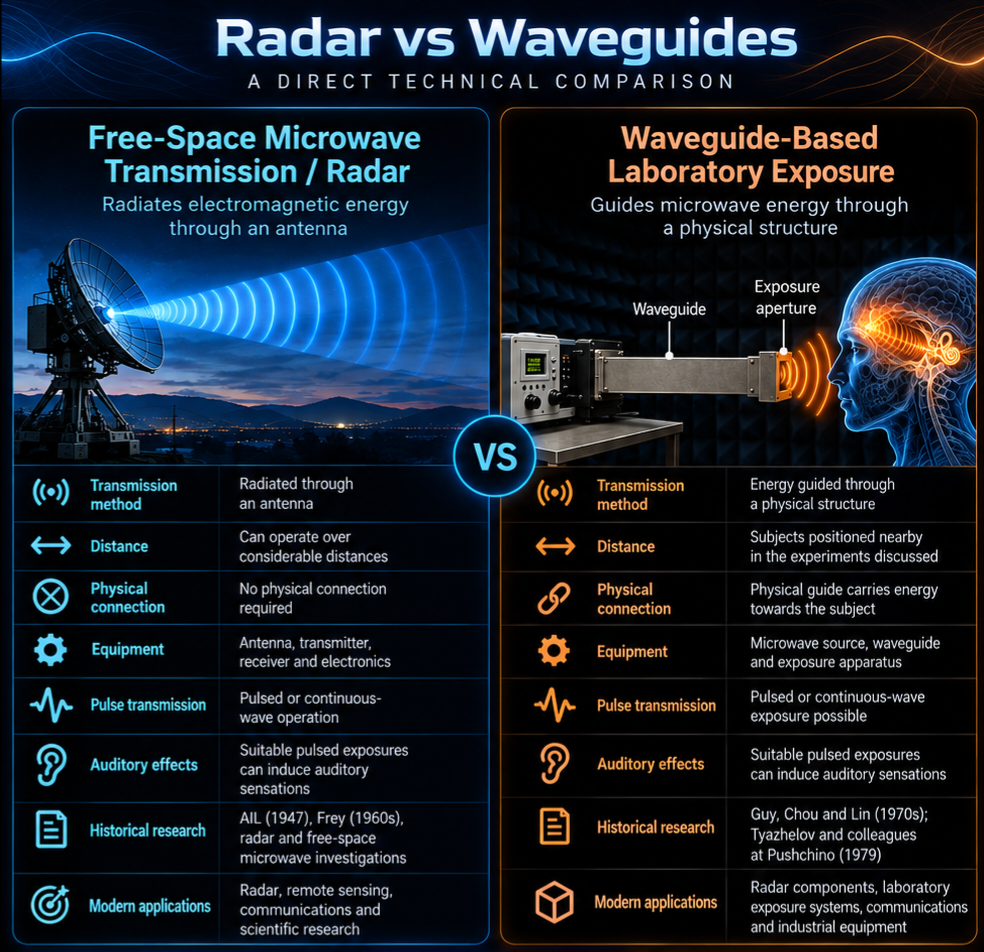
The fundamental distinction is that waveguides guide electromagnetic energy through a physical structure, while antennas radiate it into free space. In the laboratory arrangements discussed here, waveguides were used for nearby exposure, whereas antenna-based microwave systems can transmit energy over considerably greater distances. However, the technologies are not mutually exclusive: radar equipment frequently incorporates waveguides internally.
This distinction is particularly relevant to the history of the microwave auditory effect. American investigations developed from early observations associated with Airborne Instruments Laboratory in 1947 through Allan H. Frey's research in the 1960s, subsequent investigations at Walter Reed and other American laboratories, and continuing research into microwave-induced auditory phenomena.
Historical scientific exchanges also connected Frey, Lin, Guy's laboratory and researchers at Pushchino, although their experimental methods and contributions were not identical.
Understanding these technologies provides an important foundation for examining modern pulsed microwave systems and hypotheses concerning Havana Syndrome. While microwave-induced auditory perception is an established scientific phenomenon, whether directed radiofrequency energy explains particular Havana Syndrome incidents remains disputed and has not been conclusively demonstrated.
Pulsed Microwave Transmission — How Electromagnetic Energy Travels Through Free Space
Pulsed microwave transmission involves generating electromagnetic energy in short, controlled bursts rather than transmitting a continuous signal. These pulses can be radiated through free space using antennas, travelling at approximately the speed of light without requiring a physical connection between the transmitter and receiver.
The characteristics of each transmission depend on several factors, including microwave frequency, pulse duration, pulse repetition rate, transmitted power and antenna design. Directional antennas can concentrate electromagnetic energy into a beam, allowing signals to reach distant locations. However, the strength of the energy reaching a target depends on distance, beam divergence, atmospheric conditions and other propagation factors.
Directional Transmission and Radar
Radar systems use antennas to transmit electromagnetic signals and, in conventional radar applications, receive reflections from objects. By analysing these returning signals, radar can determine distance, movement and other characteristics.
Microwave transmission is not limited to detecting objects. Pulsed electromagnetic energy can also interact with biological tissue under particular exposure conditions, producing effects that have been investigated experimentally for decades.
Pulsed Microwaves and the Auditory System
The microwave auditory effect, investigated systematically by Allan H. Frey during the 1960s and subsequently studied by James C. Lin, Arthur W. Guy, C. K. Chou and other researchers, demonstrates that appropriately configured microwave pulses can produce perceived sounds without conventional airborne sound entering the ear.
When microwave pulses are absorbed by tissue, they produce extremely small, rapid temperature changes. The resulting thermoelastic expansion generates acoustic pressure waves that propagate through tissue and stimulate the cochlea. The auditory system then converts this mechanical stimulation into neural signals interpreted by the brain as sound.
Depending on the characteristics of the exposure, reported perceptions include clicks, buzzing and knocking. Historical experiments also investigated the transmission of information using pulse patterns, including Morse code and specially encoded speech. The experiment was time limited to abide by safety regulations.
Transmission Distance and Equipment
Unlike waveguide-based laboratory exposure, free-space microwave transmission does not require the transmitting antenna to be physically connected to the subject.
This distinction makes remote exposure physically possible, although the ability to produce a measurable or audible biological effect at a particular distance depends on the transmitted waveform, antenna characteristics, power, exposure geometry and applicable safety constraints.
Modern advances in electronics have enabled increasingly compact radar and microwave systems.
Relevance to Historical Research
The development of pulsed microwave technology provides the technical background for understanding early observations associated with Airborne Instruments Laboratory in 1947, Frey's investigations during the 1960s and subsequent American research programmes.
These established scientific findings contribute to discussions about possible directed-energy explanations for Havana Syndrome.
Waveguide-Based Exposure — Localised Laboratory Experiments
Waveguides have played an important role in scientific investigations into the biological and auditory effects of microwave radiation. Unlike antennas designed to radiate electromagnetic energy into free space, waveguides are physical structures that guide microwave energy along a controlled path, often delivering it to an opening or applicator positioned near an experimental subject.
In microwave bioeffects research, these arrangements allowed scientists to investigate how electromagnetic exposure interacts with biological tissue under controlled laboratory conditions. The equipment was generally positioned close to the subject, making these experiments fundamentally different from demonstrations of microwave transmission over considerable distances.
American Research — Guy, Chou and Lin
American researchers Arthur W. Guy, C. K. Chou and James C. Lin contributed to understanding the biological and auditory responses associated with microwave exposure during the 1970s.
Their investigations included controlled exposure arrangements using microwave applicators, waveguides and other equipment to study energy absorption, acoustic pressure generation and auditory responses.
These studies helped establish the thermoelastic explanation of the microwave auditory effect: rapid absorption of pulsed microwave energy produces microscopic tissue expansion, generating acoustic pressure waves capable of stimulating the auditory system.
Importantly, American research was not restricted to waveguide-based exposure. Other investigations, including Allan H. Frey's earlier work, employed different microwave transmission arrangements including experiments with numerous transmitters.
Soviet Research — Tyazhelov and Pushchino
In 1979, Soviet researchers led by V. V. Tyazhelov published investigations into microwave-induced auditory sensations conducted at Pushchino.
Their experimental arrangements used a waveguide-based system to expose subjects to pulsed microwave energy under laboratory conditions. The researchers investigated auditory responses associated with the characteristics of the microwave pulses.
The published experiments demonstrated Soviet scientific interest in the microwave auditory phenomenon but did not establish the operation of a portable, long-range microwave transmitter capable of reproducing those effects at a distance.
This is an important distinction when comparing the documented Soviet experiments with the wider history of American pulsed microwave and radar research.
Scientific Exchanges Between American and Soviet Researchers
Research into the microwave auditory effect also involved direct scientific exchanges between American and Soviet investigators.
Allan H. Frey visited Pushchino in the early 1970s, meeting Soviet researchers including Yuri Grigoriev and Inal Akoev. Their discussions concerned microwave frequencies, modulation and biological effects.
In 1978, American researcher James C. Lin visited Pushchino, where Soviet scientists demonstrated their microwave auditory experiments and discussed their findings with him. Their research involved localised microwave exposure using waveguide equipment, including experiments in which participants' heads were partially immersed in water.
The Soviet researchers questioned the thermoelastic explanation of microwave hearing, proposing that their observations presented difficulties for this mechanism. Lin subsequently reinterpreted their experimental results, explaining that the observed relationship between microwave pulse duration and perceived loudness was consistent with thermoelastic pressure-wave generation rather than evidence against it.
Lin also maintained professional relationships with Soviet and later Russian researchers, including Yuri Grigoriev, whom he continued to meet over subsequent decades.
These exchanges demonstrate how American research influenced the interpretation of Soviet experimental findings, while highlighting the differences between the localised Soviet laboratory arrangements and the wider American history of free-space pulsed microwave transmission.
The Main Technical Difference
Waveguide-based exposure: Microwave energy is guided through a physical structure and delivered to a nearby exposure region. In the experiments discussed here, the subject was positioned close to the laboratory apparatus.
Free-space microwave transmission: Electromagnetic energy is radiated from an antenna and propagates through the surrounding environment without a physical guide connecting the transmitter to the subject.
The documented waveguide-based laboratory experiments therefore provide evidence of microwave-induced biological and auditory effects under controlled conditions.
🔍 Click image to enlarge
From AIL in 1947 to Modern Microwave Technology
The history of microwave-induced auditory perception is closely connected to American radar development, military research and scientific investigations into the biological effects of electromagnetic radiation. Beginning with observations associated with Airborne Instruments Laboratory (AIL) in 1947, research progressed through Allan H. Frey's experiments, investigations at Walter Reed and other American laboratories, and subsequent international scientific exchanges.
1947 — Airborne Instruments Laboratory (AIL)
Early reports associated with Airborne Instruments Laboratory in the United States described unusual auditory sensations experienced in connection with pulsed radar equipment. These observations are frequently identified as an early starting point in the history of microwave hearing.
1960s — Allan H. Frey
American biophysicist Allan H. Frey systematically investigated microwave-induced auditory sensations, publishing important findings in 1961 and 1962.
His experiments established that appropriately configured pulsed microwave radiation could produce perceived clicks, buzzing and other auditory sensations without conventional airborne sound transmission. This phenomenon subsequently became widely known as the microwave auditory effect or Frey effect.
1960s–1970s — Walter Reed and American Research
American investigations continued through military and scientific research institutions, including Walter Reed Army Institute of Research and other laboratories.
Research explored the characteristics of microwave-induced auditory perception, biological responses and the possibility of conveying information through controlled pulse patterns.
During the 1970s, experiments involving specially encoded microwave pulses also demonstrated the perception of speech-related information, building on earlier investigations into pulsed microwave hearing.
1970s — Guy's Laboratory and James C. Lin
Arthur W. Guy, C. K. Chou and colleagues conducted experimental investigations into microwave interactions with biological tissue, including acoustic pressure generation and auditory responses.
James C. Lin made important contributions to the theoretical and experimental understanding of microwave hearing, helping establish the thermoelastic mechanism through which absorbed microwave pulses generate acoustic pressure waves capable of stimulating the cochlea.
These investigations included controlled laboratory exposure arrangements and contributed to the scientific understanding of the phenomenon.
1970s — Soviet Research at Pushchino
Soviet researchers, including V. V. Tyazhelov and colleagues, investigated microwave-induced auditory sensations using localised laboratory exposure arrangements.
Their research, published in 1979, involved waveguide-based equipment rather than demonstrating a portable, long-range microwave transmitter.
Scientific exchanges connected researchers at Pushchino with American investigators, including Frey and Lin. Lin also contributed to the scientific interpretation of Soviet experimental findings, particularly their relationship to the thermoelastic explanation of microwave hearing.
1980s–Present — Continued Scientific and Technological Development
Subsequent research has continued to examine microwave-induced acoustic phenomena, electromagnetic exposure and the interaction between radiofrequency energy and biological tissue.
Meanwhile, advances in semiconductor electronics, antenna engineering, digital signal processing and radar miniaturisation have enabled increasingly compact and sophisticated microwave systems.
Modern applications include remote sensing, through-wall radar, short-range micro-radar, wireless communication and scientific instrumentation.
These technological developments demonstrate the continuing evolution of microwave systems.
Historical Significance
The microwave auditory effect is not a recently discovered phenomenon. Its documented scientific history extends across decades of American research, alongside subsequent Soviet investigations and international scientific exchanges.
The distinction between free-space transmission and localised waveguide exposure remains essential when comparing the equipment and experimental findings associated with these different research programmes.
Modern Microwave Technology and Havana Syndrome
Modern advances in radar miniaturisation, directional antennas and pulsed microwave transmission have expanded the capabilities of radiofrequency systems. These developments build upon decades of established scientific research, including investigations into the microwave auditory effect.
The ability of appropriately configured microwave pulses to generate acoustic pressure waves and produce auditory sensations is scientifically established.
The distinction between demonstrated technology and proposed applications remains essential. Historical experiments establish the physical principles involved, but determining whether such technology was deployed in reported Havana Syndrome incidents requires conclusive investigative findings. Significantly, in July 2026, the US Department of Defense renamed its Anomalous Health Incidents team the Directed Energy Bio-Effects (DEBE) Cross-Functional Team, strengthening its focus on potential directed-energy threats, scientific investigation and medical care. This development reflects continued official attention to the issue. Definitive conclusions remain dependent on verified evidence and the outcome of ongoing investigations.
For a more detailed examination of the scientific evidence, technological possibilities and competing explanations, see the dedicated analysis of modern microwave technology and Havana Syndrome section.
References & Further Reading
The following scientific publications document the development of microwave auditory research, pulsed microwave transmission, thermoelastic acoustic effects and controlled laboratory exposure.
Allan H. Frey (1961)
Auditory System Response to Radio Frequency Energy.
Aerospace Medicine, 32, 1140–1142.
https://pubmed.ncbi.nlm.nih.gov/?term=Frey+Auditory+System+Response+to+Radio+Frequency+Energy+1961
Allan H. Frey (1962)
Human Auditory System Response to Modulated Electromagnetic Energy.
Journal of Applied Physiology, 17(4), 689–692.
https://doi.org/10.1152/jappl.1962.17.4.689
Kenneth R. Foster & Edward D. Finch (1974)
Microwave Hearing: Evidence for Thermoacoustic Auditory Stimulation by Pulsed Microwaves.
Science, 185, 256–258.
https://doi.org/10.1126/science.185.4147.256
James C. Sharp, H. Mark Grove & Om P. Gandhi (1974)
Generation of Acoustic Signals by Pulsed Microwave Energy.
IEEE Transactions on Microwave Theory and Techniques, 22(5), 583–584.
https://doi.org/10.1109/TMTT.1974.1128251
Arthur W. Guy, C. K. Chou, James C. Lin & D. Christensen (1975)
Microwave-Induced Acoustic Effects in Mammalian Auditory Systems and Physical Materials.
Annals of the New York Academy of Sciences, 247, 194–218.
https://doi.org/10.1111/j.1749-6632.1975.tb35996.x
Don R. Justesen (1975)
Microwaves and Behavior.
American Psychologist, 30(3), 391–401.
https://doi.org/10.1037/0003-066X.30.3.391
V. V. Tyazhelov, R. E. Tigranian, E. O. Khizhniak & I. G. Akoev (1979)
Some Peculiarities of Auditory Sensations Evoked by Pulsed Microwave Fields.
Radio Science, 14(6S), 259–263.
https://doi.org/10.1029/RS014i06Sp00259
Don R. Justesen (1979)
Behavioral and Psychological Effects of Microwave Radiation.
Bulletin of the New York Academy of Medicine, 55(11), 1058–1078.