

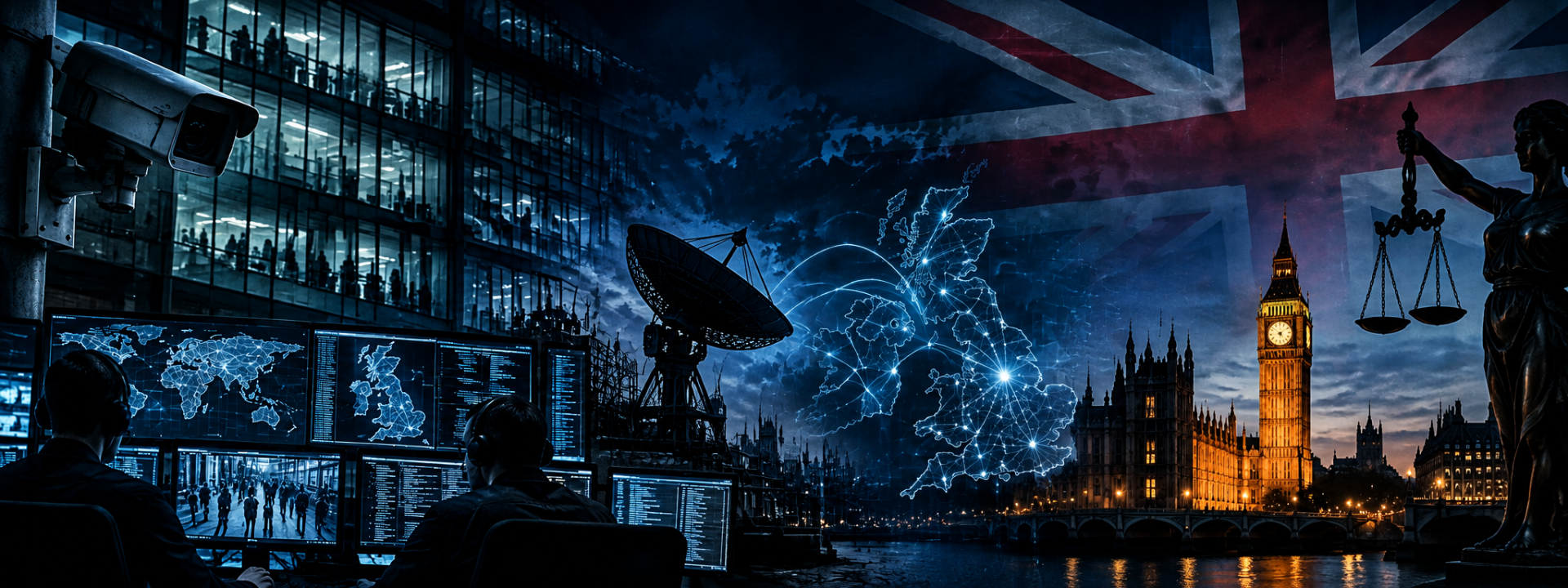
Surveillance & Intelligence Accountability
British Intelligence, Surveillance Powers & Democratic Oversight
Surveillance plays a central role in modern intelligence operations, allowing governments to identify national security threats, investigate hostile activity and gather information about individuals, organisations and communications networks.
In Britain, intelligence surveillance is conducted under statutory frameworks governing the activities of MI5, MI6 and GCHQ, alongside authorised surveillance undertaken by police and other public authorities.
These capabilities range from targeted interception and communications data analysis to equipment interference, intelligence sharing and certain forms of bulk data collection.
However, the existence of sophisticated surveillance technology raises important questions about privacy, proportionality, civil liberties and the accountability of those authorised to use it.
Intelligence Capabilities and Their Legal Boundaries
British intelligence agencies operate under legislation including the Security Service Act 1989, Intelligence Services Act 1994 and Investigatory Powers Act 2016, as subsequently amended.
These laws establish responsibilities, authorisation procedures and safeguards governing intelligence activities.
The legal framework seeks to balance the protection of national security with individual rights, including privacy and freedom of expression.
Nevertheless, the interpretation and effectiveness of these safeguards have been subjects of parliamentary debate, judicial proceedings and independent scrutiny.
The Snowden Revelations and Public Accountability
The 2013 disclosures by former US intelligence contractor Edward Snowden transformed public understanding of modern electronic surveillance.
The documents revealed previously secret aspects of intelligence collection and cooperation involving the US National Security Agency and Britain's GCHQ.
They prompted international debate about bulk interception, communications metadata, intelligence sharing and the extent of democratic oversight.
Subsequent court judgments, parliamentary investigations and legislative reforms have shaped Britain's surveillance framework.
The disclosures remain a significant reference point for examining the relationship between intelligence capabilities, public accountability and individual privacy.
Oversight, Technology and Civil Liberties
Modern intelligence surveillance increasingly involves digital communications, encryption, advanced data analysis and technologies capable of collecting information at considerable scale.
Oversight is therefore essential to ensuring that surveillance powers are exercised lawfully and proportionately.
Britain's accountability framework includes the Intelligence and Security Committee of Parliament, the Investigatory Powers Commissioner and the Investigatory Powers Tribunal.
These institutions perform different functions, including parliamentary scrutiny, independent oversight of investigatory powers and the examination of certain legal complaints.
Their effectiveness, independence and access to information remain important subjects of public interest.
Scope of This Research
This section examines British intelligence surveillance, its historical development, technological capabilities and legal regulation.
It also considers the Snowden disclosures, intelligence-sharing arrangements, judicial findings and the implications of emerging surveillance technologies.
Particular attention is given to distinguishing documented intelligence capabilities from allegations, technical possibilities and unverified claims.
The objective is to assess how Britain can maintain effective national security capabilities while protecting democratic accountability, privacy and fundamental freedoms.
Research Investigations
British Intelligence Surveillance — MI5, MI6 & GCHQ
An examination of Britain's three principal intelligence agencies, their distinct responsibilities, surveillance capabilities and intelligence-gathering methods. This investigation explores communications interception, national security operations, international intelligence cooperation and the legislation governing intelligence activities.
The Snowden Revelations & Mass Surveillance
Investigating Edward Snowden's 2013 disclosures concerning the NSA, GCHQ and the Five Eyes intelligence partnership. This research examines bulk communications collection, the TEMPORA programme, intelligence sharing, public revelations and the subsequent legal challenges and reforms.
Intelligence Oversight, Investigatory Powers & Civil Liberties
(in development)
An examination of Britain's intelligence accountability framework, including the Investigatory Powers Act 2016, subsequent legislative amendments, judicial authorisation and independent oversight. This investigation considers the balance between national security, privacy, freedom of expression and democratic scrutiny.
Surveillance Technology, Encryption & Digital Privacy
(in development)
Exploring the technologies behind modern electronic surveillance, including communications interception, metadata analysis, encryption, equipment interference, commercial spyware and artificial intelligence. This research distinguishes established technical capabilities from theoretical possibilities and unverified surveillance claims.