

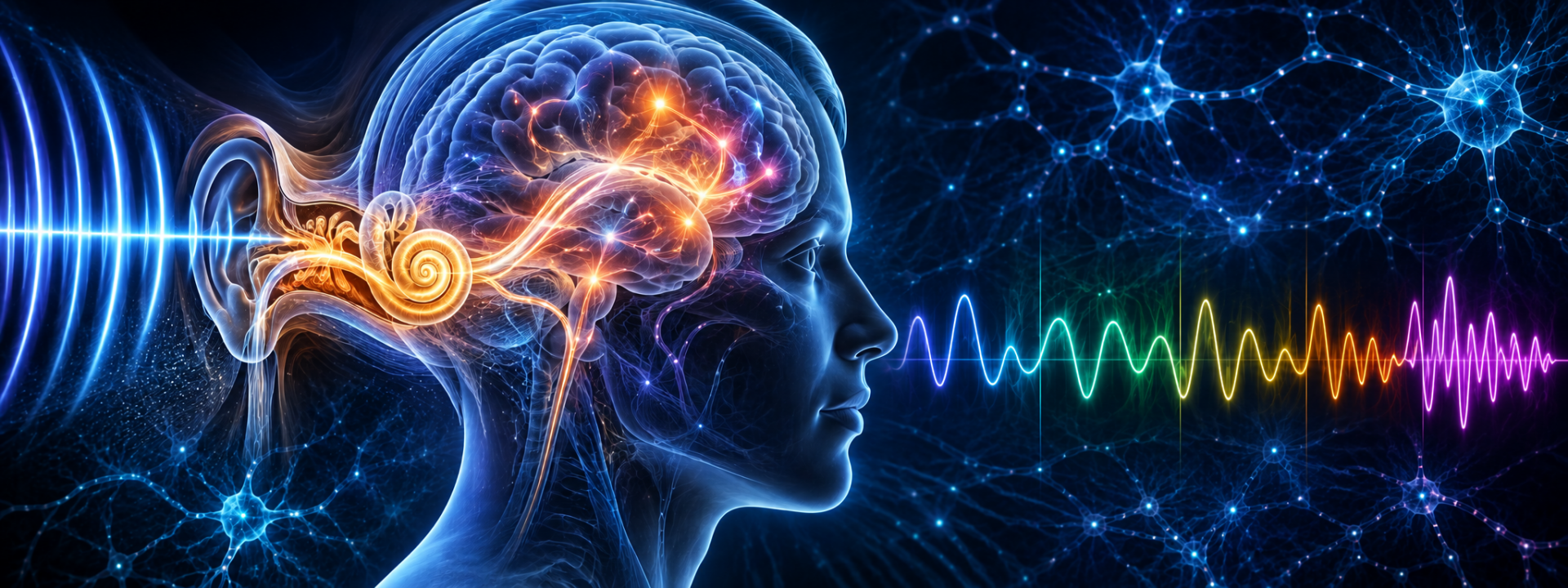
The Science of Perception
How the Brain Interprets the World
Human perception is the process through which the brain transforms incoming sensory information into conscious experiences. Whether recognising a familiar voice, interpreting spoken language or identifying a sound, the brain does not simply receive information passively. It continuously processes, organises and interprets signals arriving from the body's sensory systems.
This process involves electrical and chemical communication between billions of neurons, coordinated activity across specialised brain regions and rhythmic patterns of neural activity commonly known as brainwaves.
Understanding these mechanisms is particularly relevant to the microwave auditory effect, where externally generated electromagnetic energy produces mechanical pressure waves that stimulate the inner ear. Once converted into neural signals, the resulting information follows established auditory pathways and is processed by the brain.
The science of perception therefore provides an important connection between the physical generation of a sensory signal and the conscious experience of hearing it.
The Human Auditory System
The human auditory system is responsible for detecting sound, converting mechanical vibrations into electrical signals and allowing the brain to interpret those signals as meaningful auditory experiences.
During conventional hearing, airborne sound waves enter the external ear and cause the eardrum to vibrate. These vibrations are transferred through three small bones in the middle ear—the malleus, incus and stapes—before reaching the fluid-filled cochlea within the inner ear.
Inside the cochlea, specialised sensory hair cells respond to mechanical movement through the opening of mechanically sensitive ion channels. This produces changes in the electrical activity of the hair cells, which influence signalling in the auditory nerve. Outer hair cells also contribute to the amplification and frequency selectivity of hearing through a process known as electromotility.
The electrical foundations of hearing were being investigated decades before the discovery of the microwave auditory effect. In 1934, L. J. Saul examined electrical responses within the cochlea, while investigations by John Guttman and S. E. Barrera in 1937 explored electrical potentials associated with the cochlea and auditory nerve. Research during the same period also documented electrical responses within the brainstem following auditory stimulation, helping establish the relationship between sensory stimulation and neural electrical activity.
Modern investigations have further explained the remarkable speed and precision of these mechanisms. Studies of hair cell biology, outer hair cell electromotility and mechanotransduction, published in 2010, 2019 and 2021, have expanded scientific understanding of how the inner ear responds to rapid mechanical changes and initiates the electrical signalling required for hearing.
The resulting signals travel through the brainstem, thalamus and auditory cortex, where different aspects of the sound are analysed.
The brain processes information relating to pitch, intensity, timing, rhythm and the relationships between acoustic patterns. These processes allow individuals to distinguish speech from background noise, recognise familiar voices and understand spoken language.
Importantly, the auditory system can also respond to mechanical vibrations that reach the cochlea through pathways other than airborne sound entering the ear canal.
Bone-conducted hearing provides one example, while the microwave auditory effect demonstrates how internally generated acoustic pressure waves can stimulate the same sensory structures.
From Sensory Signals to Conscious Perception
Hearing and understanding are not identical processes.
The cochlea converts mechanical stimulation into neural activity, but the conscious experience of sound depends on further processing throughout the central nervous system.
Auditory information passes through several interconnected structures, including the cochlear nuclei, superior olivary complex, inferior colliculus, medial geniculate nucleus of the thalamus and auditory cortex.
These structures contribute to analysing sound location, timing, frequency and other acoustic characteristics.
Within the auditory cortex, neural networks process increasingly complex patterns, while connections with language, memory and attention systems help determine what the sounds mean.
For example, the same sequence of acoustic signals may be interpreted differently depending on the listener's previous experiences, expectations and familiarity with the information.
The brain therefore constructs a meaningful auditory experience from incoming neural signals rather than simply reproducing the physical stimulus.
Brainwaves and Neural Oscillations
Brainwaves are rhythmic patterns of electrical activity produced by coordinated populations of neurons.
These patterns, more accurately described as neural oscillations, occur across a range of frequencies and are associated with different aspects of brain activity.
They can be measured using technologies such as electroencephalography (EEG), which records electrical activity at the scalp, and magnetoencephalography (MEG), which detects the extremely weak magnetic fields generated by neural currents.
Neural oscillations reflect coordinated activity within neural networks and contribute to the timing and organisation of information processing.
Researchers commonly classify these oscillations into several frequency bands.
Delta Waves: Slow Rhythms and Speech Structure
Delta oscillations generally occur at frequencies of approximately 1–4 hertz (Hz).
Although strongly associated with deep sleep, delta-frequency activity also contributes to aspects of waking sensory processing.
In speech perception, slower neural rhythms can track broad temporal structures such as phrases, pauses, stress patterns and changes in speech intensity.
These slower patterns help the brain organise continuous speech into larger meaningful units.
The relationship between delta activity and speech processing illustrates how neural timing can contribute to understanding information extending over several seconds.
Theta Waves: Syllables and Speech Recognition
Theta oscillations generally occur at frequencies of approximately 4–8 Hz and are particularly important in research into auditory perception, language and memory.
Human conversational speech frequently contains rhythmic fluctuations at rates associated with syllabic structure.
Neural activity within auditory regions can synchronise with aspects of these fluctuations, helping the brain organise incoming speech into smaller units.
This process is often described as neural entrainment or neural tracking.
Theta-band activity is also associated with memory-related processes, particularly through interactions involving the hippocampus and other neural networks.
In speech perception, theta oscillations are thought to contribute to the segmentation and organisation of auditory information, supporting the recognition of syllables and the interpretation of spoken language.
However, the relationship is not a simple one-to-one correspondence between individual syllables and theta cycles. Speech processing involves multiple interacting timescales and neural mechanisms.
Alpha Waves: Attention and Sensory Filtering
Alpha oscillations generally occur between approximately 8 and 12 Hz.
They are often associated with relaxed wakefulness, but they also play important roles in attention and the regulation of sensory processing.
Alpha activity can change as the brain selectively attends to particular information while reducing the influence of competing stimuli.
For example, when listening to someone speaking in a noisy environment, attention-related neural processes help prioritise the relevant voice over surrounding sounds.
Changes in alpha activity are among the mechanisms associated with this selective processing.
Rather than acting as a simple on-or-off switch, alpha oscillations participate in wider neural networks that regulate the processing of sensory information.
Beta Waves: Prediction and Cognitive Processing
Beta oscillations generally occur between approximately 13 and 30 Hz.
They are associated with several functions, including motor control, attention, working memory and predictive processing.
During speech perception, the brain continuously uses context and previous knowledge to anticipate what may come next.
These predictions can influence how incoming sounds are interpreted, particularly when speech is unclear or partially obscured.
Beta-band activity has been implicated in aspects of maintaining and updating predictions, although its precise role varies across tasks and brain regions.
This illustrates an important feature of perception: the brain combines incoming sensory information with expectations generated from previous experience.
Gamma Waves: Rapid Information Processing
Gamma oscillations generally refer to neural activity above approximately 30 Hz, commonly studied across ranges extending towards 100 Hz or higher.
Gamma-band activity has been associated with sensory processing, attention and the coordination of neural populations involved in analysing rapidly changing information.
In auditory neuroscience, gamma activity is investigated in relation to the processing of fine temporal features and the integration of information across neural networks.
Some theories propose that interactions between slower and faster neural oscillations help organise information at multiple timescales.
For example, theta–gamma interactions have been proposed as one mechanism through which slower speech rhythms and faster acoustic details may be coordinated.
These relationships remain active areas of scientific research and should not be interpreted as evidence that particular brainwave frequencies independently generate words, thoughts or conscious experiences.
How the Brain Recognises Spoken Language
Speech recognition requires the brain to interpret a continuously changing acoustic signal.
Unlike written language, spoken words are not separated by clearly defined spaces. Individual speech sounds overlap, vary between speakers and are influenced by pronunciation, speaking speed and surrounding sounds.
The auditory system must therefore analyse multiple features simultaneously.
These include the timing of acoustic events, changes in frequency, syllabic rhythm, phonetic information and the broader context of a conversation.
Different neural networks contribute to these processes.
Auditory cortical regions analyse acoustic patterns, while wider temporal and frontal language networks support speech recognition, linguistic interpretation and the production of appropriate responses.
Memory and attention also contribute to understanding, particularly when information is incomplete or difficult to distinguish.
The brain's ability to combine incoming signals with previously learned patterns explains why familiar words can sometimes be recognised even when the original acoustic information is degraded.
How Encoded RF Communication Is Interpreted by the Brain
The relationship between neural processing and the microwave auditory effect becomes particularly relevant when information is deliberately encoded into radiofrequency pulses.
In the encoded-communication experiments described by Don R. Justesen in Microwaves and Behavior (1975), researchers reported that Morse-code patterns and prerecorded spoken digits could be transmitted through appropriately structured microwave pulses and recognised by human listeners.
The physical mechanism begins with the absorption of pulsed electromagnetic energy, producing rapid thermoelastic expansion and microscopic acoustic pressure waves within the head.
These pressure waves stimulate the cochlea, where mechanical activity is converted into neural signals.
From this point, the brain processes the information through its normal auditory pathways.
For Morse code, recognition depends on the listener identifying the timing and spacing of perceived signals and associating those patterns with previously learned symbols.
For encoded speech, the auditory system must recover sufficient temporal and acoustic information from the pulse-generated stimulus for familiar spoken sounds to be recognised.
Neural oscillations associated with auditory processing, including delta, theta and gamma activity, are relevant to understanding how the brain analyses speech rhythms and rapidly changing acoustic information.
However, the historical microwave speech experiments did not directly establish which oscillatory mechanisms were responsible for the reported recognition of spoken digits.
The demonstrated principle is that deliberately encoded electromagnetic pulses can generate auditory information that the brain subsequently interprets through established sensory and cognitive processes.
The brain is not directly decoding the microwave carrier frequency. It is interpreting neural activity generated by the cochlea in response to the mechanically produced auditory stimulus.
The Role of Memory, Learning and Expectation
Perception depends not only on incoming sensory information but also on what the brain has previously learned.
When hearing familiar speech, the brain draws upon stored knowledge of language, pronunciation, vocabulary and context.
These processes allow listeners to recognise words even when parts of the acoustic signal are missing or distorted.
For example, a familiar word may remain recognisable despite background noise, poor recording quality or an unusual synthetic voice.
The same general principles help explain how listeners can interpret deliberately encoded auditory patterns.
Morse code requires learned associations between sequences of short and long signals and their corresponding characters.
Recognition of degraded speech similarly depends on the interaction between incoming auditory information and stored representations of familiar sounds.
This does not mean that the brain can recover unlimited information from an incomplete signal. Successful recognition still depends on the quality of the stimulus, the listener's experience and the amount of information available.
Neural Synchronisation and the Timing of Perception
One important area of modern neuroscience concerns the relationship between the timing of external sensory information and the rhythmic activity of neural networks.
When listening to speech or other rhythmic sounds, neural activity can become aligned with aspects of the incoming signal.
This alignment helps the auditory system organise information over different timescales.
Slower activity may track broad speech structure, while faster neural processes contribute to analysing more rapidly changing acoustic features.
These interacting mechanisms help explain how the brain can transform a continuous stream of sensory input into recognisable patterns.
The Science Behind Conscious Auditory Experience
Conscious perception emerges from interactions between sensory pathways, cortical networks, attention, memory and other neurological processes.
The brain receives electrical signals generated by sensory receptors, but the subjective experience of hearing is produced through the coordinated processing of that information.
This explains why a physical stimulus does not need to originate as an ordinary airborne sound wave to produce an auditory sensation.
If a stimulus generates the appropriate mechanical activity within the cochlea, the resulting neural signals can enter the auditory system and contribute to conscious hearing.
The microwave auditory effect provides a particularly interesting example of this principle.
Electromagnetic energy is converted into mechanical pressure waves, which are subsequently transformed into neural activity and interpreted as sound.
The final conscious experience depends on the biological processing of that information rather than the original physical form of the energy.
Scientific Significance
The science of perception demonstrates how human experience emerges from interactions between physics, biology and neuroscience.
The microwave auditory effect provides an example of how electromagnetic energy can generate a sensory experience through a physical mechanism involving tissue expansion, acoustic pressure waves and the auditory system.
The historical Morse-code and encoded-speech experiments further demonstrate that structured information can be represented in microwave pulse sequences and recognised by listeners under experimental conditions.
Modern neuroscience helps explain the wider processes involved in recognising auditory information, including neural oscillations, sensory integration, attention, memory and speech processing.
Understanding the distinction between sensory stimulation, neural processing and conscious interpretation is essential to accurately describing both the capabilities and limitations of the underlying science.
Scientific References
Hallowell Davis, A. J. Derbyshire, M. H. Lurie and L. J. Saul (1934)
The Electric Response of the Cochlea.
American Journal of Physiology, 107(2), 311–332.
https://doi.org/10.1152/ajplegacy.1934.107.2.311
John Guttman and S. E. Barrera (1937)
The Electrical Potentials of the Cochlea and Auditory Nerve in Relation to Hearing.
American Journal of Physiology, 120(4), 666–670.
https://doi.org/10.1152/ajplegacy.1937.120.4.666
E. H. Robinson (1937)
Electric Responses of the Brain Stem to Unilateral Auditory Stimulation.
American Journal of Physiology.
https://journals.physiology.org/doi/abs/10.1152/ajplegacy.1937.120.2.304
Allan H. Frey (1962)
Human Auditory System Response to Modulated Electromagnetic Energy.
Journal of Applied Physiology, 17(4), 689–692.
https://doi.org/10.1152/jappl.1962.17.4.689
Kenneth R. Foster and Edward D. Finch (1974)
Microwave Hearing: Evidence for Thermoacoustic Auditory Stimulation by Pulsed Microwaves.
Science, 185(4147), 256–258.
https://doi.org/10.1126/science.185.4147.256
Don R. Justesen (1975)
Microwaves and Behavior.
American Psychologist, 30(3), 391–401.
https://doi.org/10.1037/h0076867
https://zoryglaser.com/wp-content/uploads/2020/05/MICROWAVES-AND-BEHAVIOR.pdf
György Buzsáki (2006)
Rhythms of the Brain.
Oxford University Press.
https://academic.oup.com/book/11166
Martin Schwander, Bechara Kachar and Ulrich Müller (2010)
The Cell Biology of Hearing.
Journal of Cell Biology, 190(1), 9–20.
https://doi.org/10.1083/jcb.201001138
Anne-Lise Giraud and David Poeppel (2012)
Cortical Oscillations and Speech Processing: Emerging Computational Principles and Operations.
Nature Neuroscience, 15, 511–517.
https://doi.org/10.1038/nn.3063
Joseph Santos-Sacchi, Kuni H. Iwasa and Winston Tan (2019)
Outer Hair Cell Electromotility Is Low-Pass Filtered Relative to the Molecular Conformational Changes That Produce Nonlinear Capacitance.
Journal of General Physiology, 151(12), 1369–1385.
https://doi.org/10.1085/jgp.201812280
David Poeppel and Michael F. Assaneo (2020)
Speech Rhythms and Their Neural Foundations.
Nature Reviews Neuroscience, 21, 322–334.
https://doi.org/10.1038/s41583-020-0304-4
Maryline Beurg, Jong-Hoon Nam and Robert Fettiplace (2021)
The Speed of the Hair Cell Mechanotransducer Channel Revealed by Fluctuation Analysis.
Journal of General Physiology, 153(10).