


European Space
Last updated: 15th October 2026
Tracking Europe's evolving space sector — from launch vehicles and spaceports to satellites, exploration missions and emerging technologies. Coverage focuses on verified developments, technical progress and what they mean for Europe's growing space capabilities.
European Space Technology
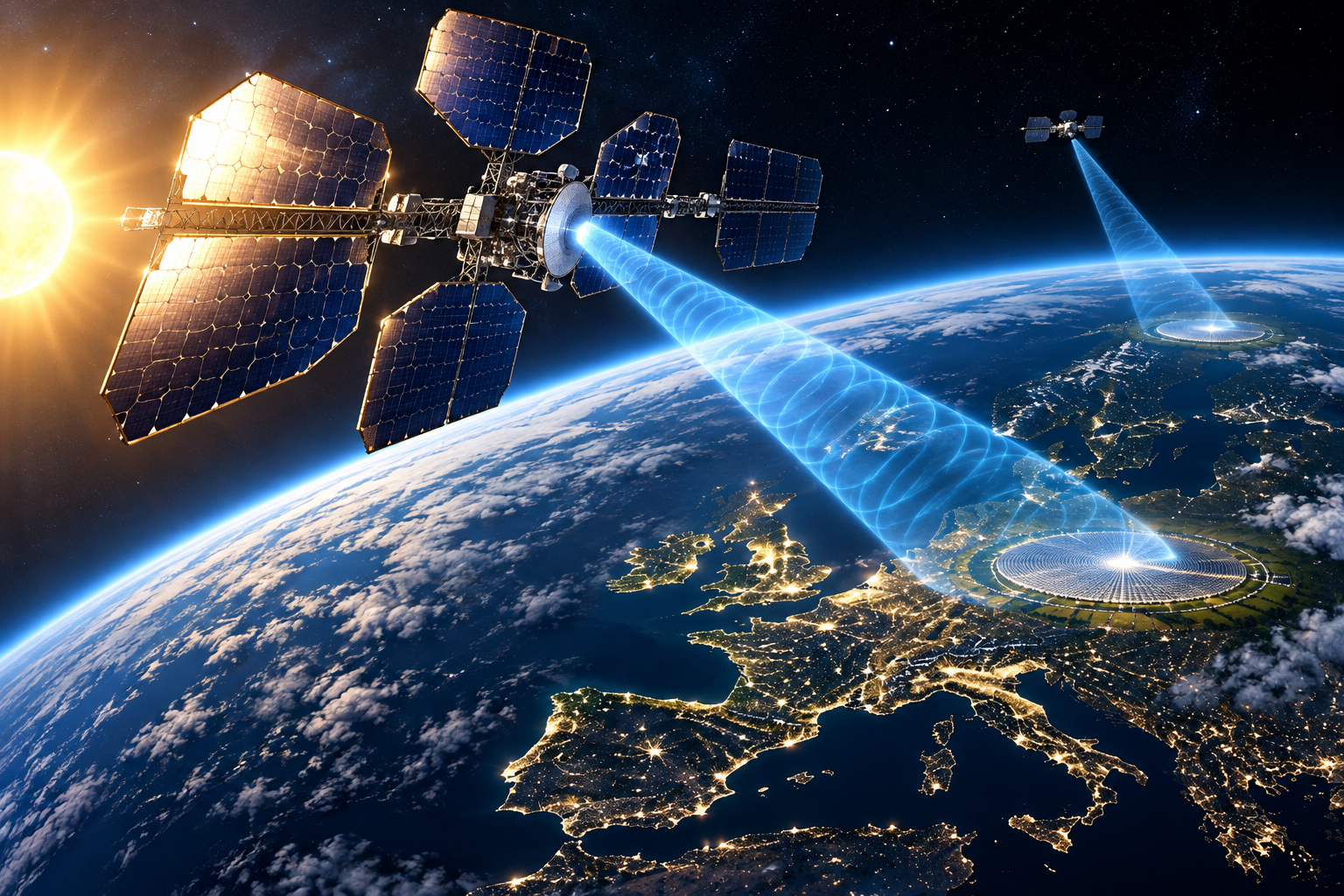
Space-Based Solar Power
Explore European research into collecting solar energy in orbit and transmitting it wirelessly to Earth. This section examines ESA's SOLARIS initiative, the technologies involved, engineering challenges and the potential role of space-based solar power in Europe's future energy systems.
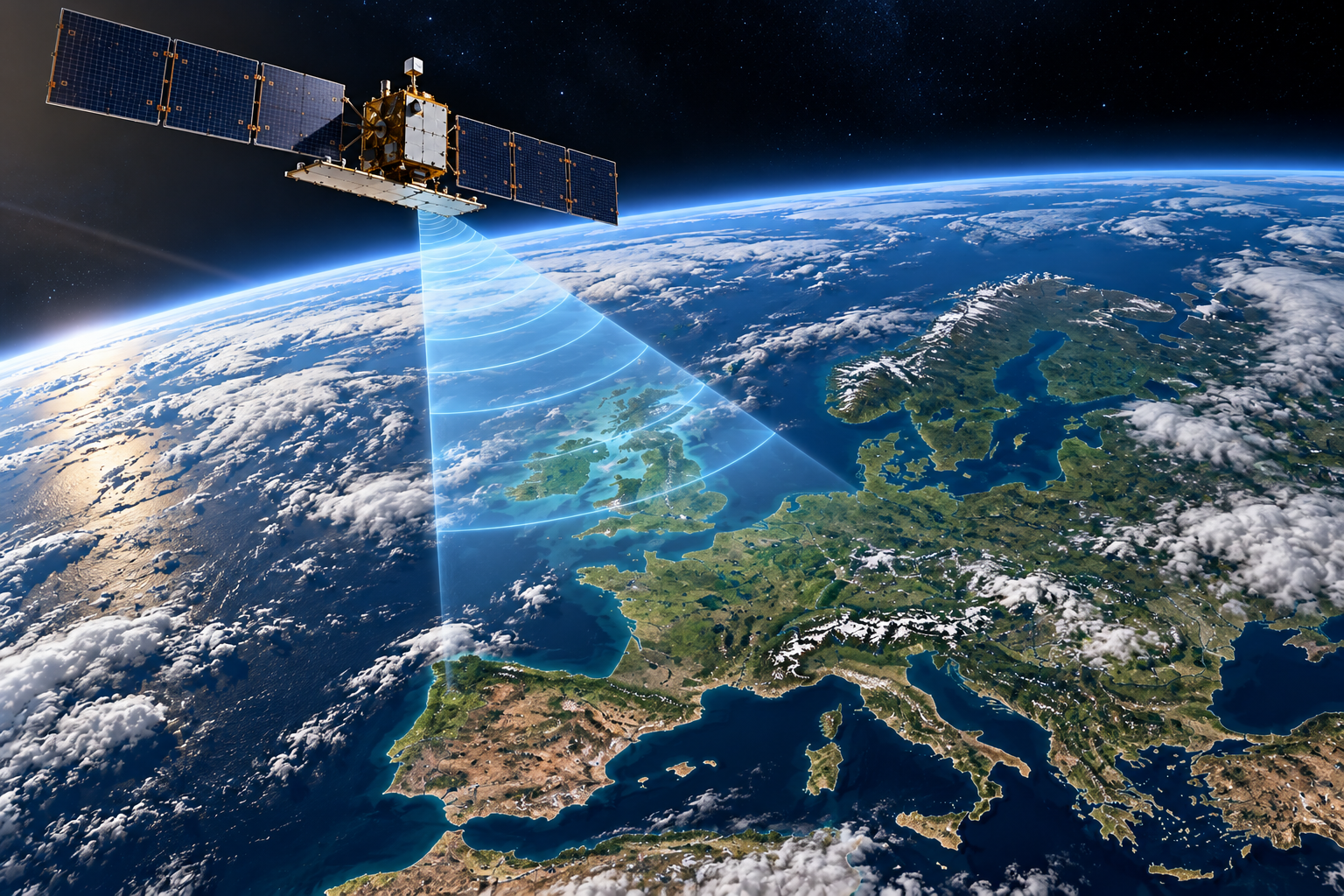
Satellite Radar, SAR & Earth Observation
Explore Europe's satellite radar and Earth observation technologies, including Synthetic Aperture Radar (SAR), the Copernicus programme and the Sentinel satellites. Discover how these systems monitor environmental changes, track infrastructure, support disaster response and provide detailed observations of Earth's surface, including at night and through cloud cover.
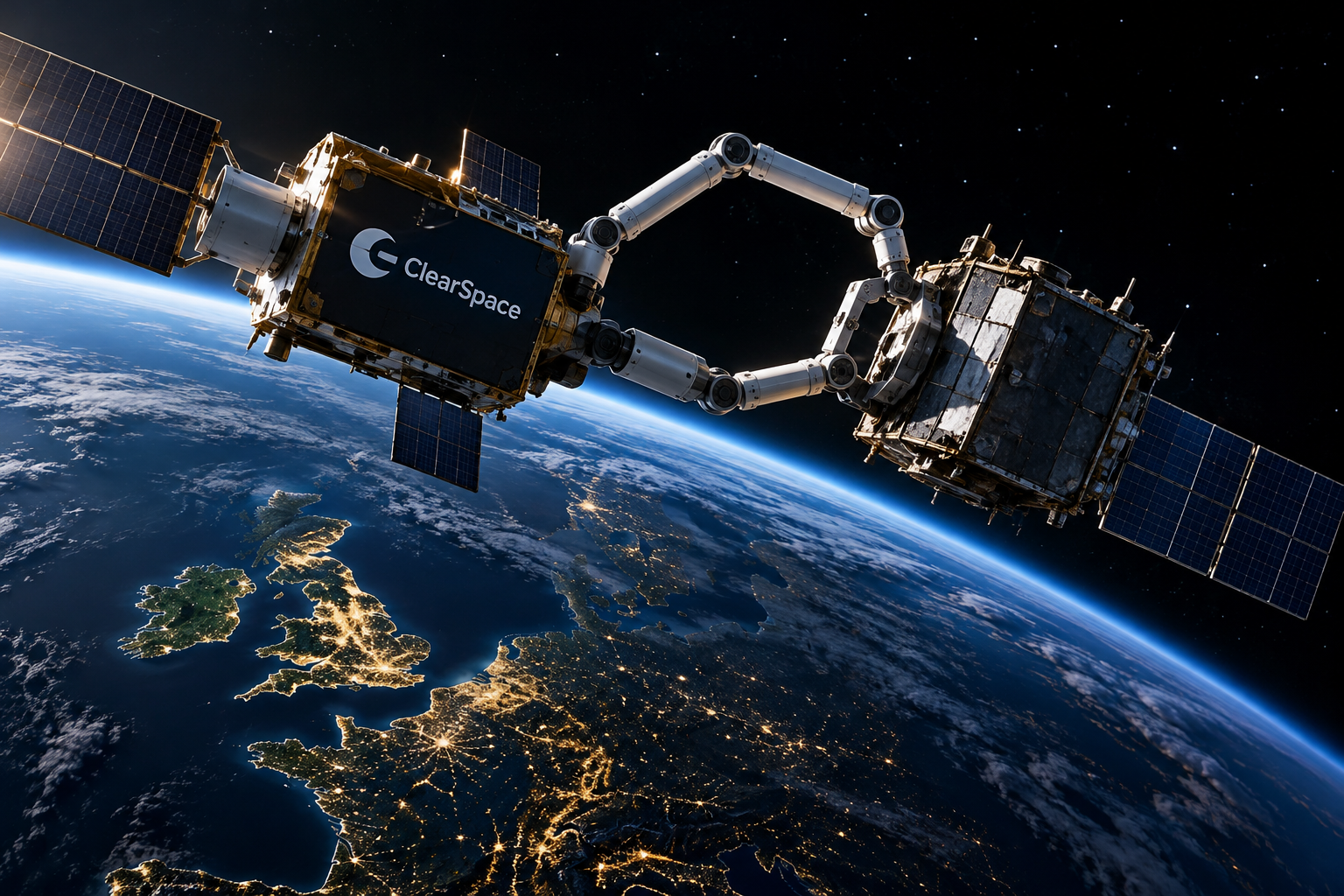
UK Active Debris Removal Mission
The UK Space Agency has selected European space technology company ClearSpace to lead the UK's first nationally commissioned orbital debris removal mission. Scheduled to begin operations in 2029, the mission aims to capture and remove two defunct UK-registered satellites from low Earth orbit, advancing British and European technologies for safer, more sustainable space operations.
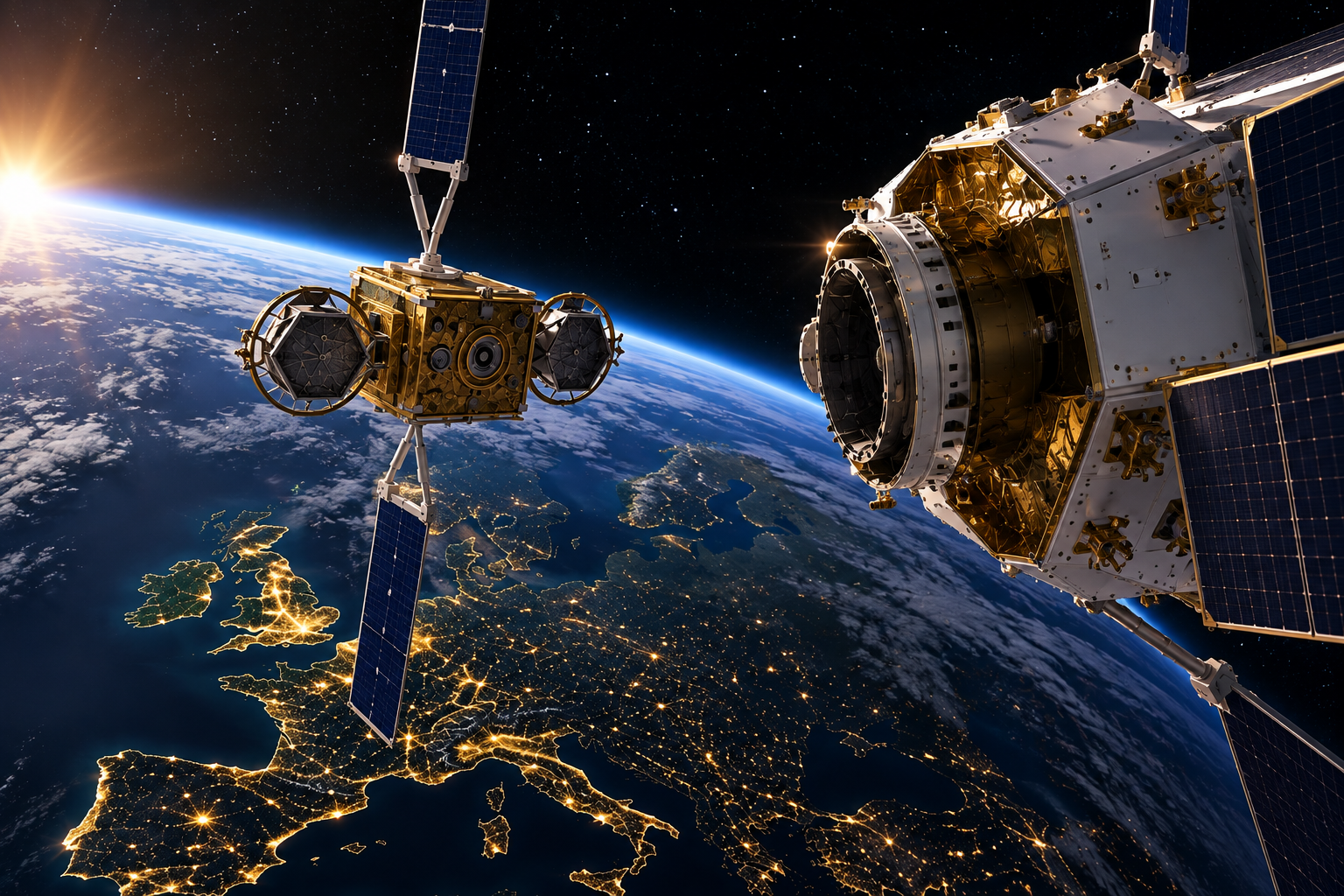
European Phoenix Satellite Servicing Mission
The European Space Agency has selected ClearSpace Luxembourg to develop Phoenix, a new European spacecraft servicing programme. Announced in September 2026, the project aims to develop technologies for servicing satellites in geostationary orbit, extending their operational capabilities and supporting Europe's growing orbital services industry.
Copernicus & Earth Observation
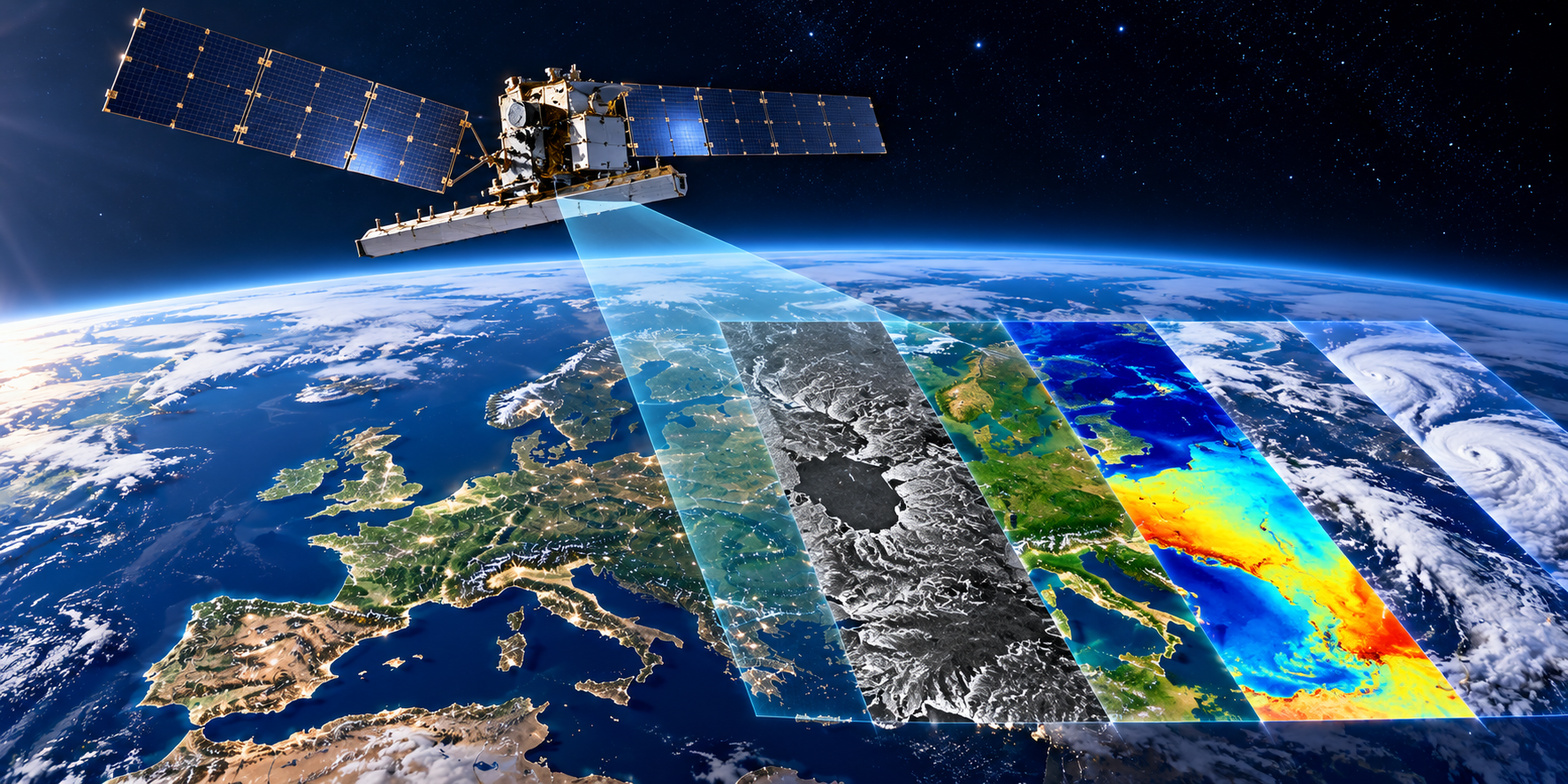
Europe's Copernicus programme uses a fleet of Sentinel satellites to monitor Earth's atmosphere, oceans, land and changing climate. In October 2026, ESA released the first observations from Sentinel-3C, including measurements of Greenland's ice sheet and sea-surface height. These early results represent an important commissioning milestone, although the satellite has not yet entered full operational service. Once operational, Sentinel-3C will strengthen Europe's ability to monitor environmental changes and support long-term climate research.

Digital EO — Europe's Earth Observation Infrastructure
ESA is developing Digital EO, a sovereign European digital infrastructure designed to bring together the rapidly growing volumes of data produced by Earth-observation missions with cloud computing, processing services and AI. ESA expects its Earth-observation data holdings to exceed 500 petabytes by 2035.
Under a 30-month contract, European cloud provider OVHcloud will supply the underlying cloud infrastructure while CGI will act as architect and systems integrator.
European Launches & Spaceports
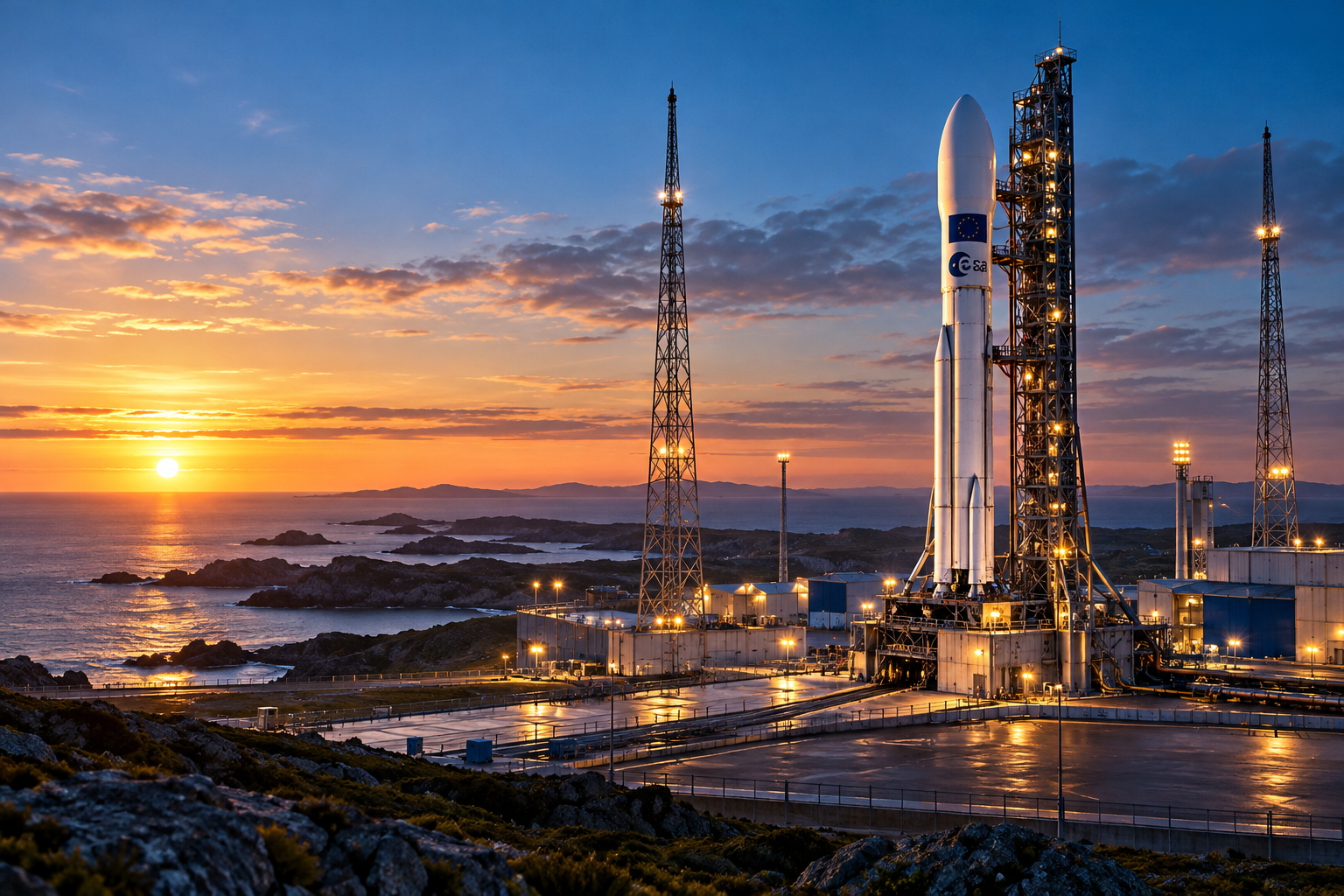
Europe is entering a new phase of independent spaceflight, with several commercial launch companies developing vehicles alongside a growing network of European spaceports. This section follows significant launch preparations, test programmes and confirmed missions, distinguishing scheduled flights from provisional targets and longer-term plans.
Coverage includes Skyrora, RFA One and SaxaVord Spaceport in Scotland, Isar Aerospace’s Spectrum, HyImpulse’s SR75 and SL1, the emerging PrimeNEO programme, and other important developments across the European launch sector.
Themis & Prometheus — Europe’s Reusable Rocket Demonstrator
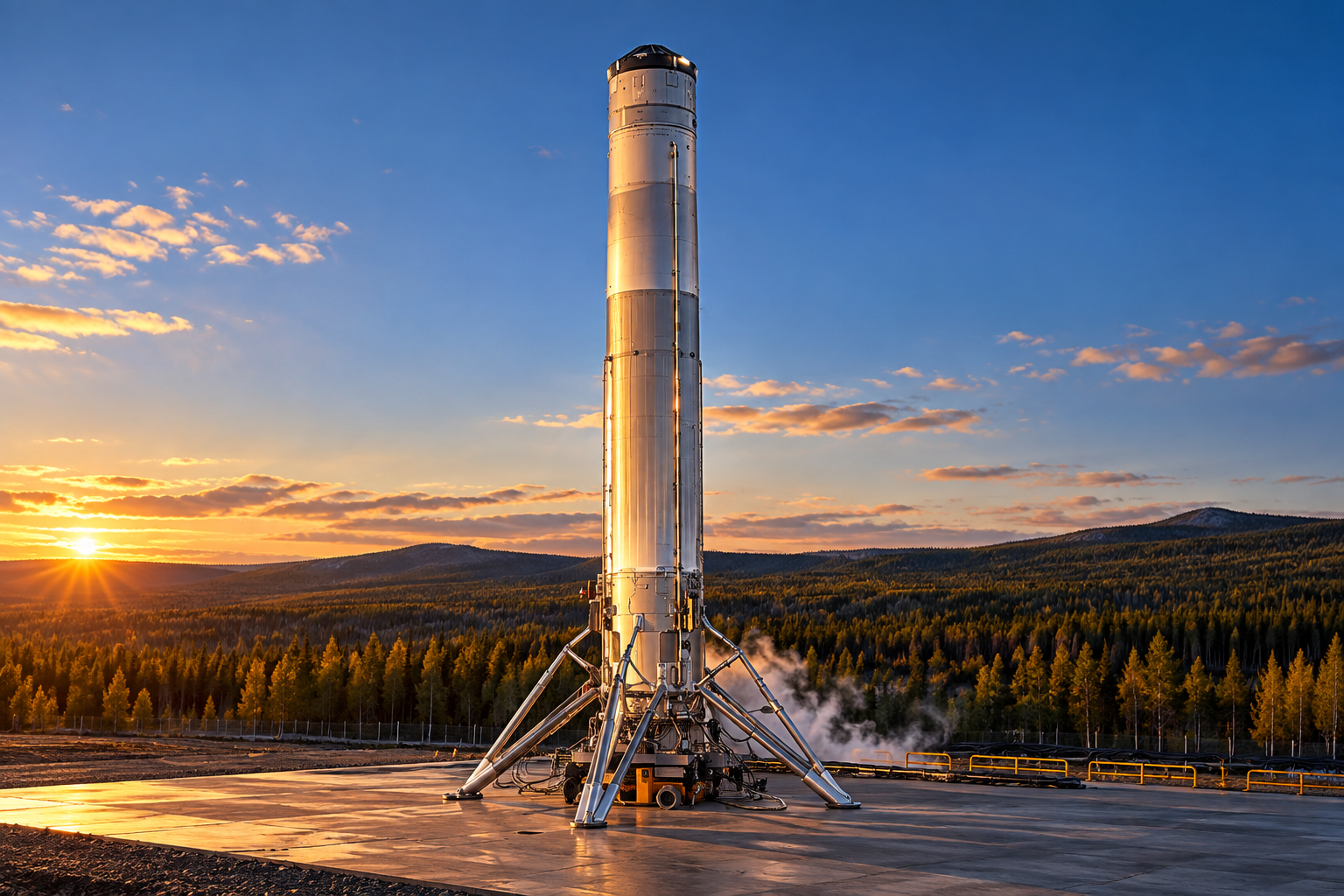
Themis is a European Space Agency demonstrator designed to test technologies for rocket-stage recovery and reuse. Developed with ArianeGroup as prime contractor, it uses the Prometheus engine, powered by liquid oxygen and methane. The aim is to demonstrate vertical take-off and landing and help develop lower-cost reusable European launch systems.
Latest milestone: September 2026
On 29 September 2026, Themis completed its second wet dress rehearsal at Esrange Space Center in northern Sweden, as part of the EU-funded SALTO test campaign.
A wet dress rehearsal involves loading propellants and practising the launch sequence while the vehicle remains on the ground. It allows engineers to check how the rocket, ground equipment and operating procedures work together before proceeding to further tests.
Why it matters:
Themis provides a platform for testing the propulsion, control and landing technologies needed for reusable rocket stages. These demonstrations will help engineers assess their performance and practical requirements before applying them to future launch vehicles. The rehearsal is a preparation milestone; it does not itself demonstrate successful flight or recovery.
Ariane 6 — Europe’s Heavy-Lift Launcher
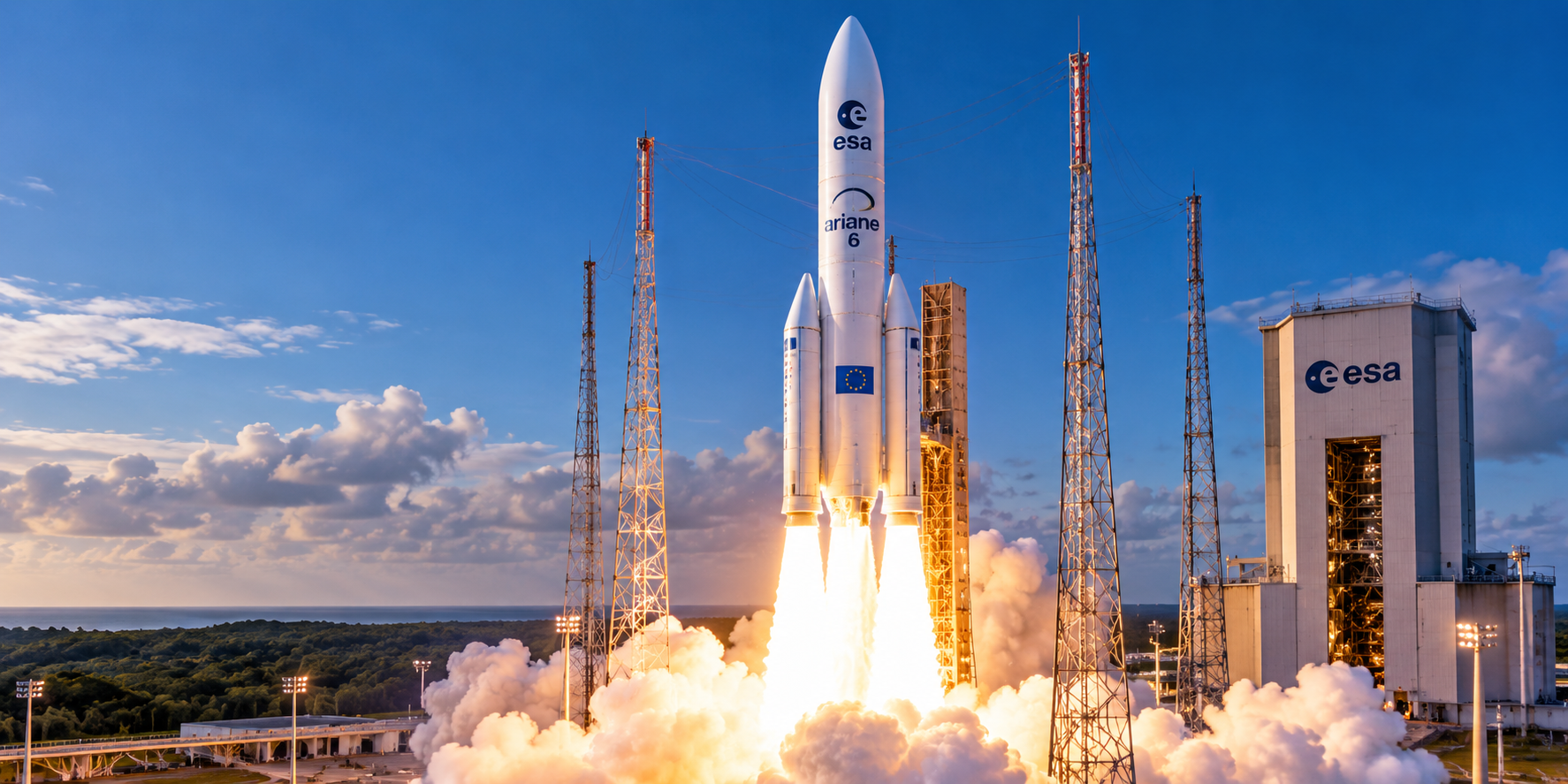
Ariane 6 is now in regular operational service, restoring Europe’s independent heavy-lift launch capability. In 2026 it has flown missions for Amazon Leo and Europe’s Meteosat weather programme. In June, the four-booster Ariane 64 flew with upgraded P160C boosters and placed 36 Amazon Leo satellites into orbit, setting a new payload-weight record for a European launcher. Its latest flight, on 27 August 2026, successfully launched the MTG-I2 weather satellite.
Commercial activity is also expanding: in September, Arianespace announced seven new agreements and MoUs covering approximately ten future Ariane 64 launches.
Orbex / PrimeNEO
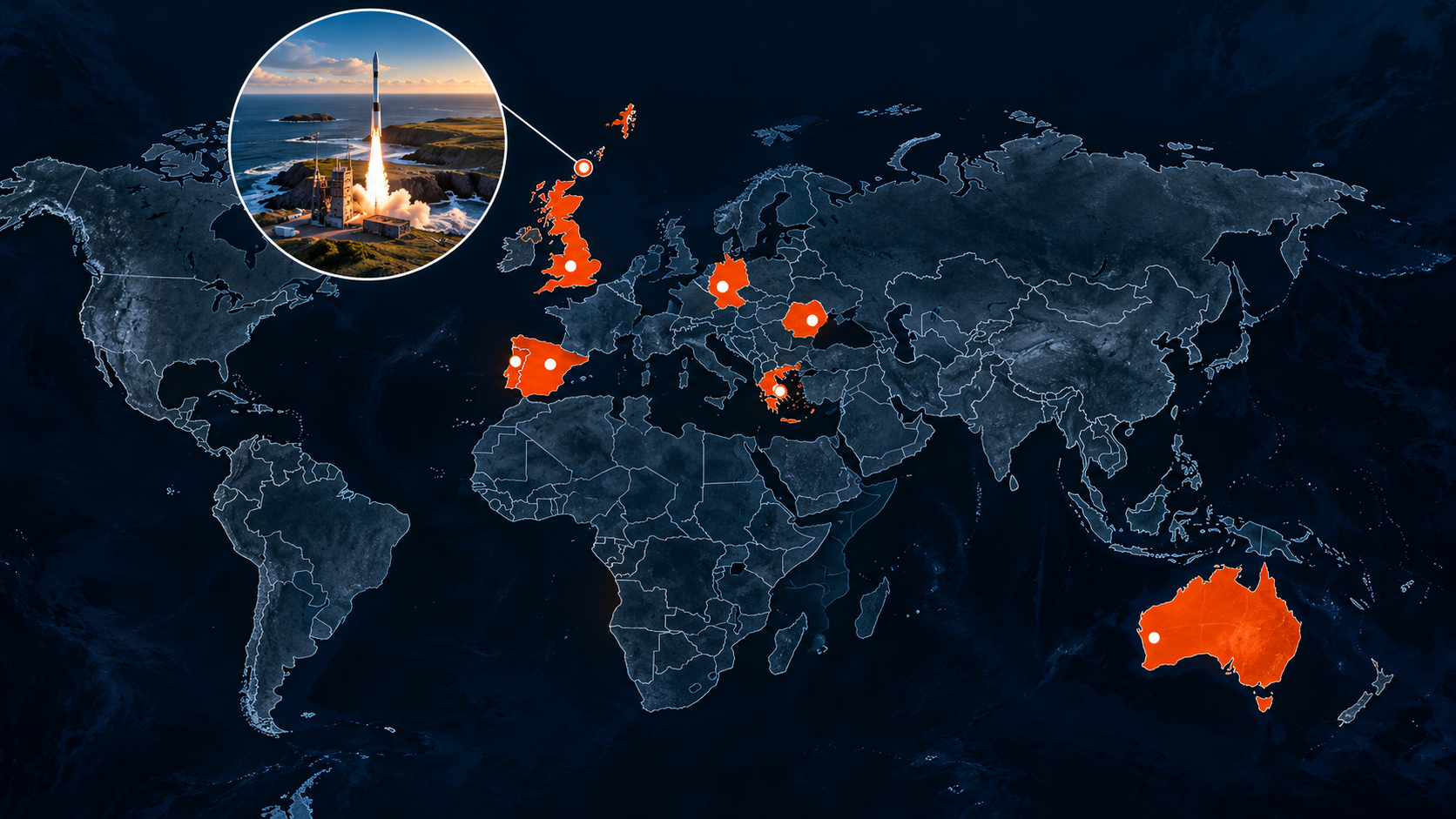
Following the closure of UK launch company Orbex, Portuguese aerospace group Omnidea acquired its technology, intellectual property and manufacturing assets in Scotland in September 2026. Omnidea plans to develop a redesigned successor to the Orbex Prime rocket called PrimeNEO, while retaining engineering and manufacturing activity in Forres, Scotland. The programme could preserve part of the UK's developing launch capability, but PrimeNEO remains at an early stage and no maiden-flight date or launch site has yet been confirmed.
Skyrora — Skylark L & Skyrora XL
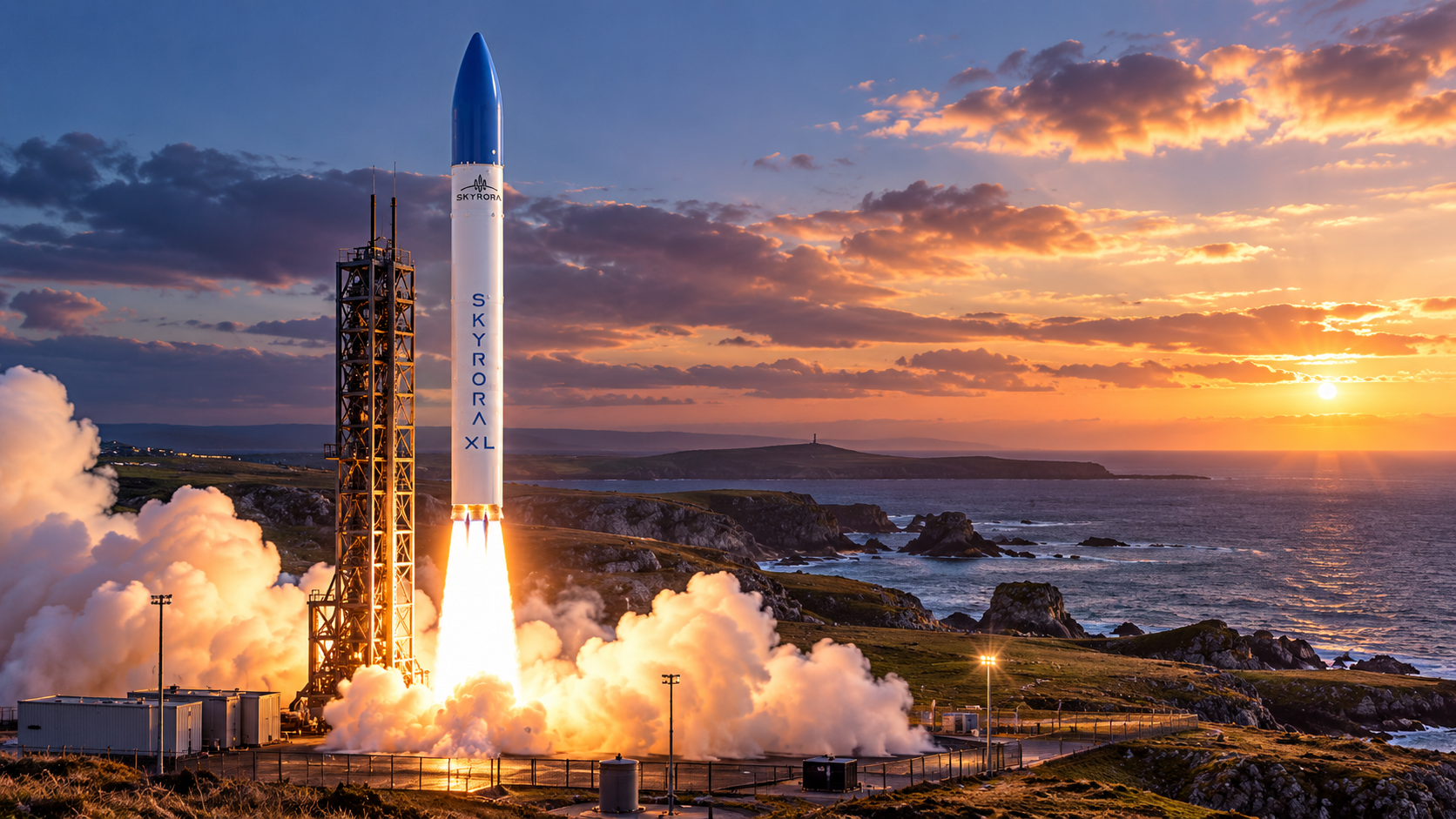
Skyrora is a UK launch company developing suborbital and orbital rockets in Scotland. Its Skylark L is designed for suborbital missions, while the three-stage Skyrora XL is being developed to carry small satellites into orbit. In September 2026, Skyrora completed a 45-second static hot-fire test of a scaled-down version of the Skyrora XL system in Scotland, providing data for development of its full-size 70 kN engine. A further Skylark L flight is provisionally targeted for 2027, while Skyrora currently describes 2030 as its tentative target for its first orbital launch.
RFA One & SaxaVord
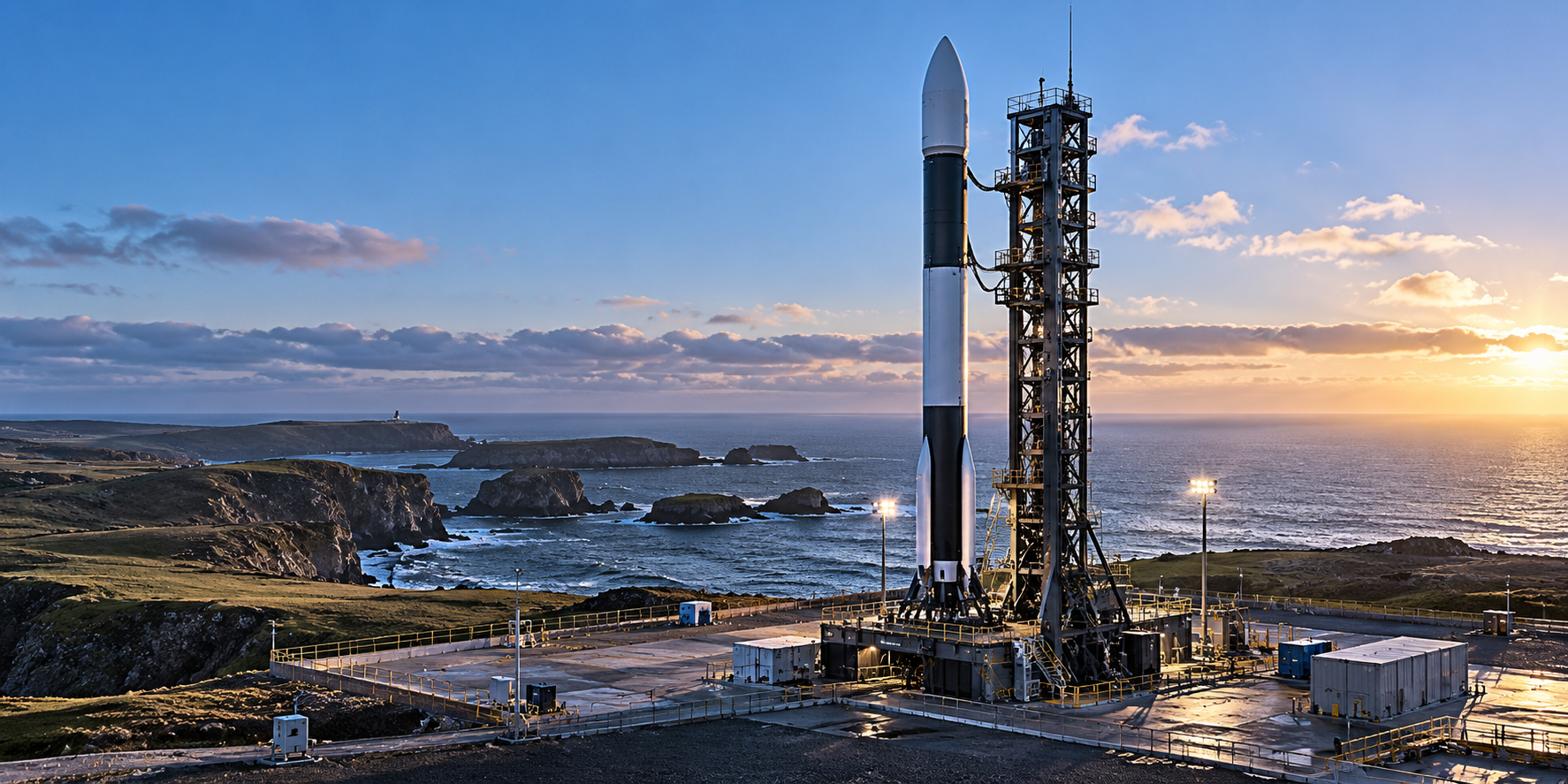
Rocket Factory Augsburg is preparing RFA One for its first test flight from SaxaVord Spaceport in Shetland. The previously targeted summer 2026 launch did not take place, but preparations continue, supported by further UK Space Agency and ESA funding for launch infrastructure and testing. The mission represents an important step towards regular commercial orbital launches from the UK.

Isar Aerospace — Spectrum
German launch company Isar Aerospace achieved a major milestone in September 2026 when its Spectrum rocket successfully reached orbit from Andøya Spaceport in Norway on only its second flight. The mission deployed multiple small satellites and demonstrated a new commercial European orbital-launch capability. Isar is now expanding production, with further Spectrum vehicles already being manufactured as it works towards more frequent launches.
HyImpulse — SL1
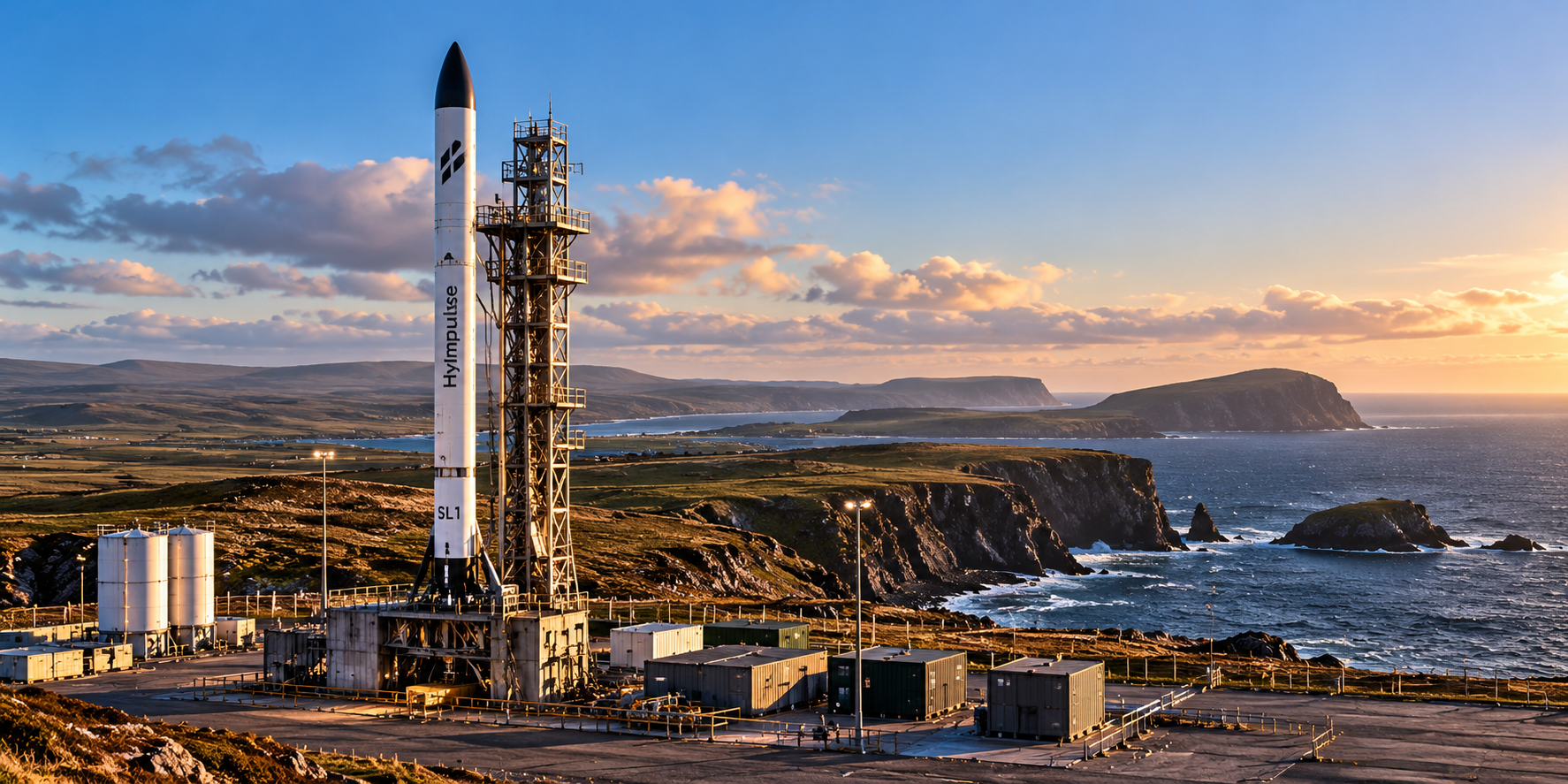
German launch company HyImpulse is developing SL1, a three-stage hybrid rocket designed to carry up to 600 kg into low-Earth orbit. In October 2026, HyImpulse secured a UK Launch Operator Licence, clearing an important regulatory milestone for operations from SaxaVord. Its SR75 suborbital rocket is targeted to fly from Shetland in spring 2027, while development of the larger orbital SL1 continues.
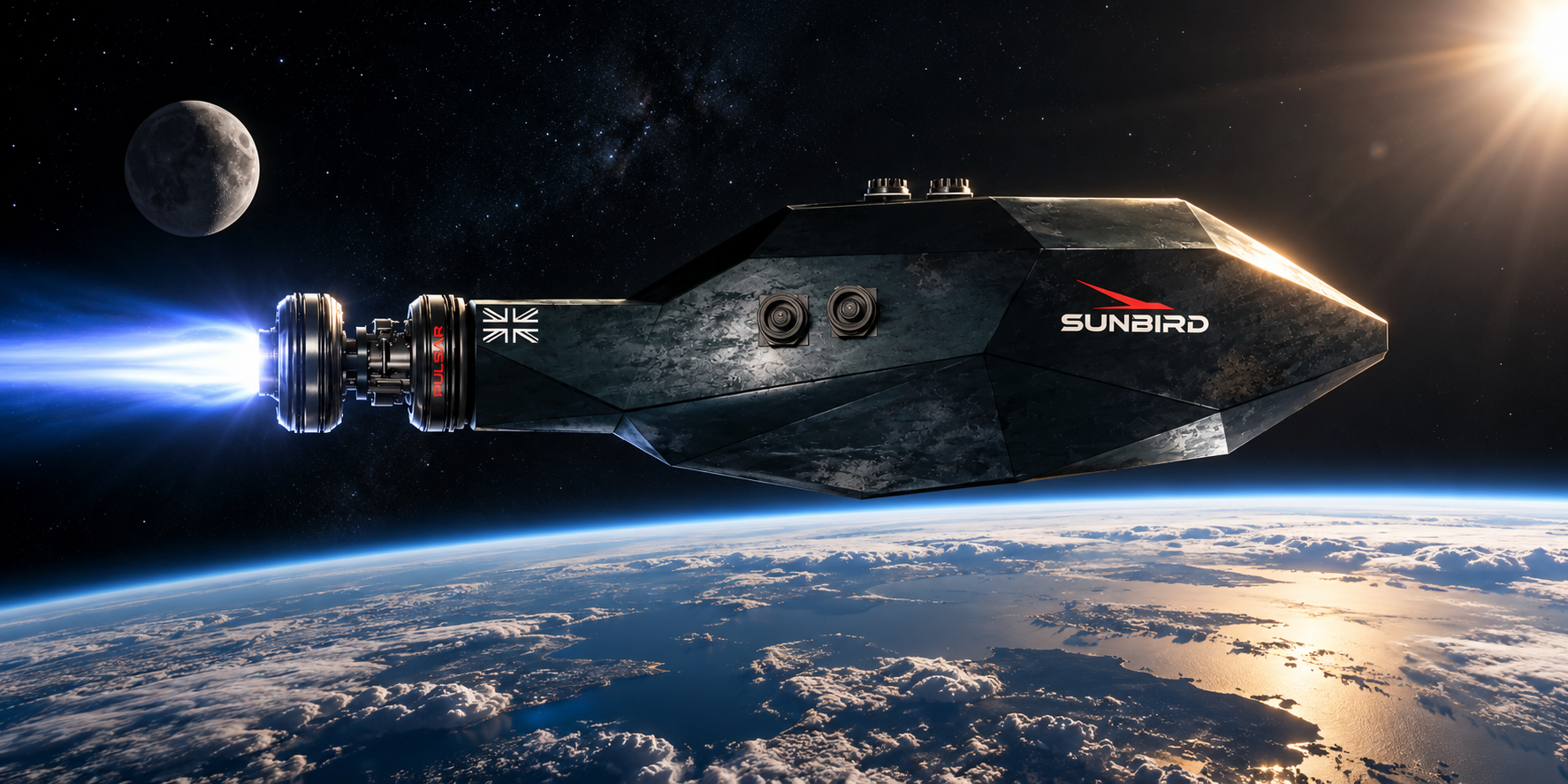
Pulsar Fusion — Sunbird
UK-based Pulsar Fusion is developing Sunbird, an advanced spacecraft concept intended to use direct fusion propulsion for high-speed travel beyond Earth orbit. In April 2026, the programme achieved first plasma in its experimental exhaust system, demonstrating plasma generation and confinement but not yet nuclear fusion. Further ground testing is planned as Pulsar develops its proposed Dual Direct Fusion Drive, with an in-orbit demonstration of core technology targeted for 2027.
European Science & Exploration Missions
Europe’s scientific spacecraft are exploring targets from the Sun to Jupiter. ESA’s JUICE spacecraft completed another major Earth gravity assist on 28 September 2026, passing 8,640 km above Earth and gaining about 3.5 km/s as it continues its journey towards Jupiter and its ocean-bearing moons. Arrival at Jupiter is planned for July 2031.
Hera is approaching the Didymos–Dimorphos binary asteroid system, with rendezvous scheduled for November 2026. It will investigate the aftermath of NASA’s DART impact and help refine our understanding of asteroid-deflection techniques for planetary defence.
Meanwhile, Euclid continues mapping the dark Universe and in 2026 reported exceptionally ancient quasars. Solar Orbiter continues its close study of the Sun. In October 2026, scientists used measurements of particles within a magnetic disturbance known as a switchback to trace its origin back towards the Sun. The findings provide strong evidence that magnetic reconnection helps generate these structures, while waves and turbulence influence their subsequent evolution. This research improves understanding of the solar wind and space weather, which can affect satellites, communications and electrical infrastructure. A December 2026 Venus flyby is expected to increase Solar Orbiter’s orbital inclination to around 24°, providing increasingly direct views of the Sun’s polar regions.
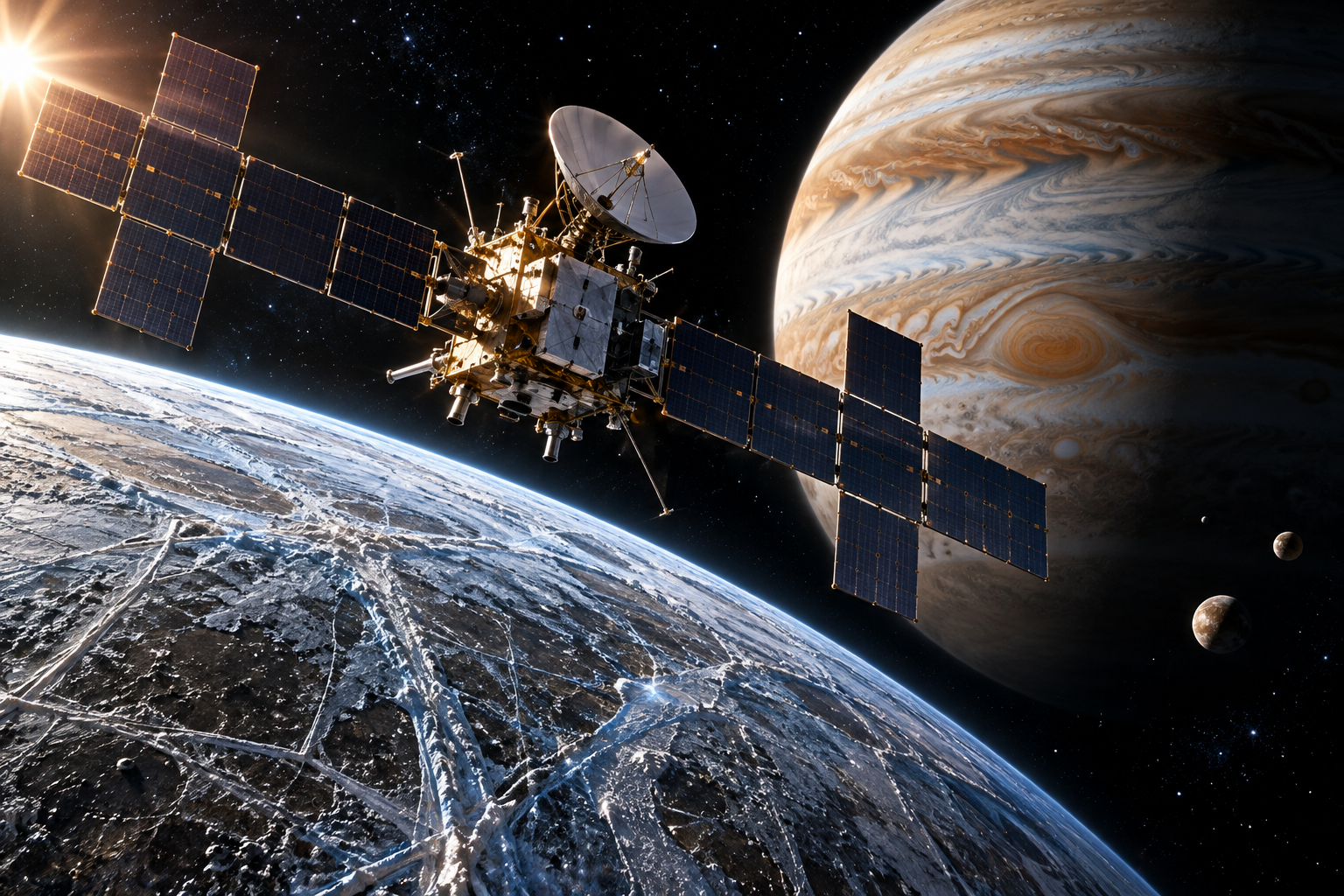
JUICE
JUICE (Jupiter Icy Moons Explorer) is one of the European Space Agency's most ambitious planetary exploration missions. Launched aboard an Ariane 5 rocket in April 2023, the spacecraft is undertaking an eight-year journey to Jupiter, where it will investigate the gas giant and three of its largest moons: Ganymede, Europa and Callisto. Scientists believe these icy worlds contain vast oceans beneath their frozen surfaces, making them important targets in the search for environments potentially capable of supporting life.
Following a successful Earth gravity-assist flyby in September 2026, JUICE remains on course to reach Jupiter in July 2031. Equipped with ten scientific instruments, including ice-penetrating radar, the spacecraft will investigate subsurface oceans, magnetic fields, atmospheric conditions and planetary geology. In 2034, JUICE is scheduled to enter orbit around Ganymede, becoming the first spacecraft to orbit a moon in the outer Solar System and advancing Europe's understanding of potentially habitable worlds.
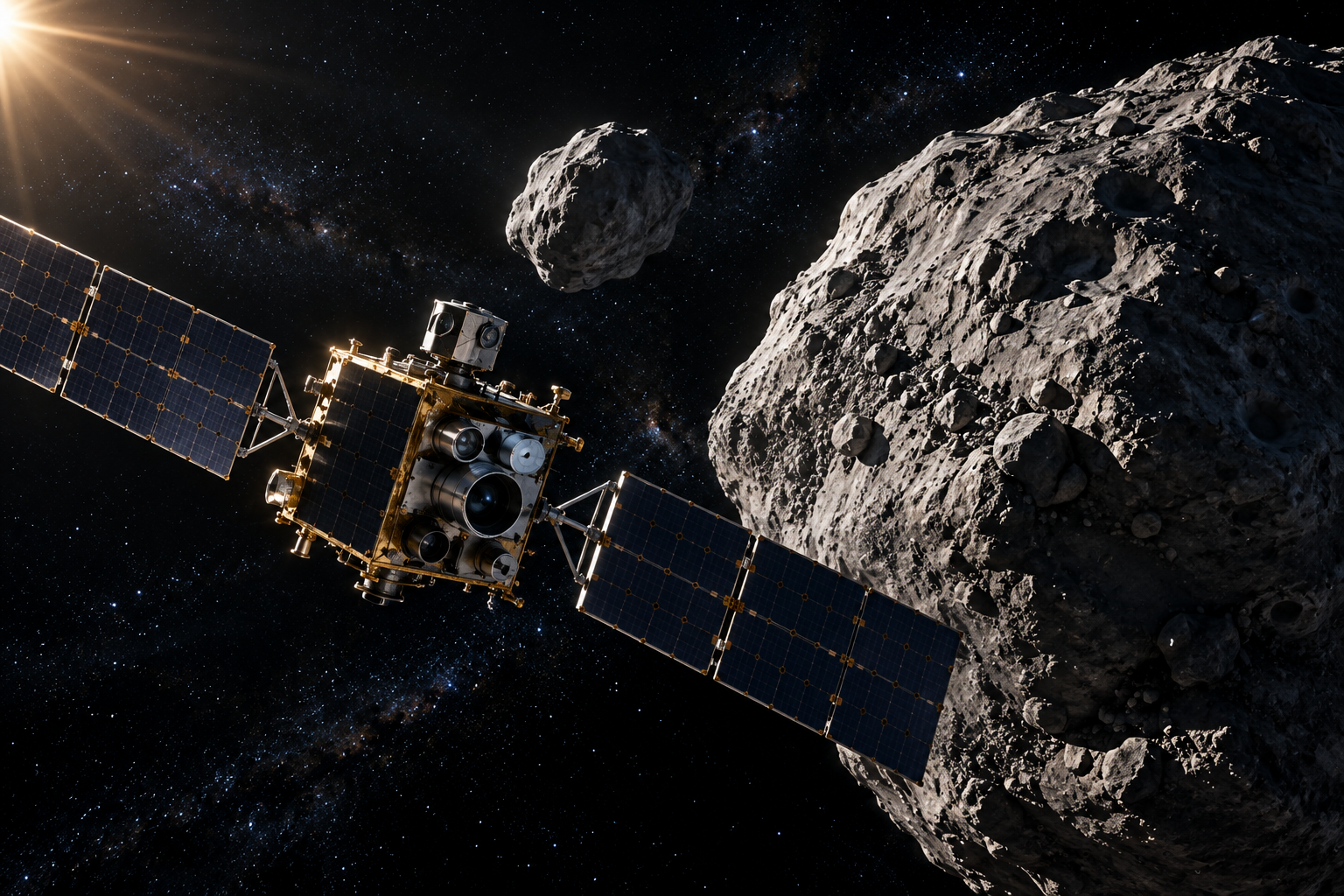
Hera
The European Space Agency's Hera spacecraft, launched in October 2024, is approaching the Didymos binary asteroid system, where it is scheduled to arrive in November 2026. The mission will investigate Dimorphos, the smaller asteroid deliberately struck by NASA's DART spacecraft in September 2022, successfully altering its orbit. Hera will examine the consequences of that collision, helping scientists determine how effectively spacecraft impacts could redirect potentially dangerous asteroids away from Earth.
Equipped with advanced cameras, laser instruments and autonomous navigation technology, Hera will conduct detailed measurements of the asteroids' surfaces, masses and internal structures. Two accompanying European CubeSats, Milani and Juventas, will investigate their composition and subsurface properties, including using radar to examine Dimorphos internally. The mission represents an important advancement in European planetary defence, transforming an experimental asteroid deflection into a better-understood technique for protecting Earth from future impact threats.
Euclid
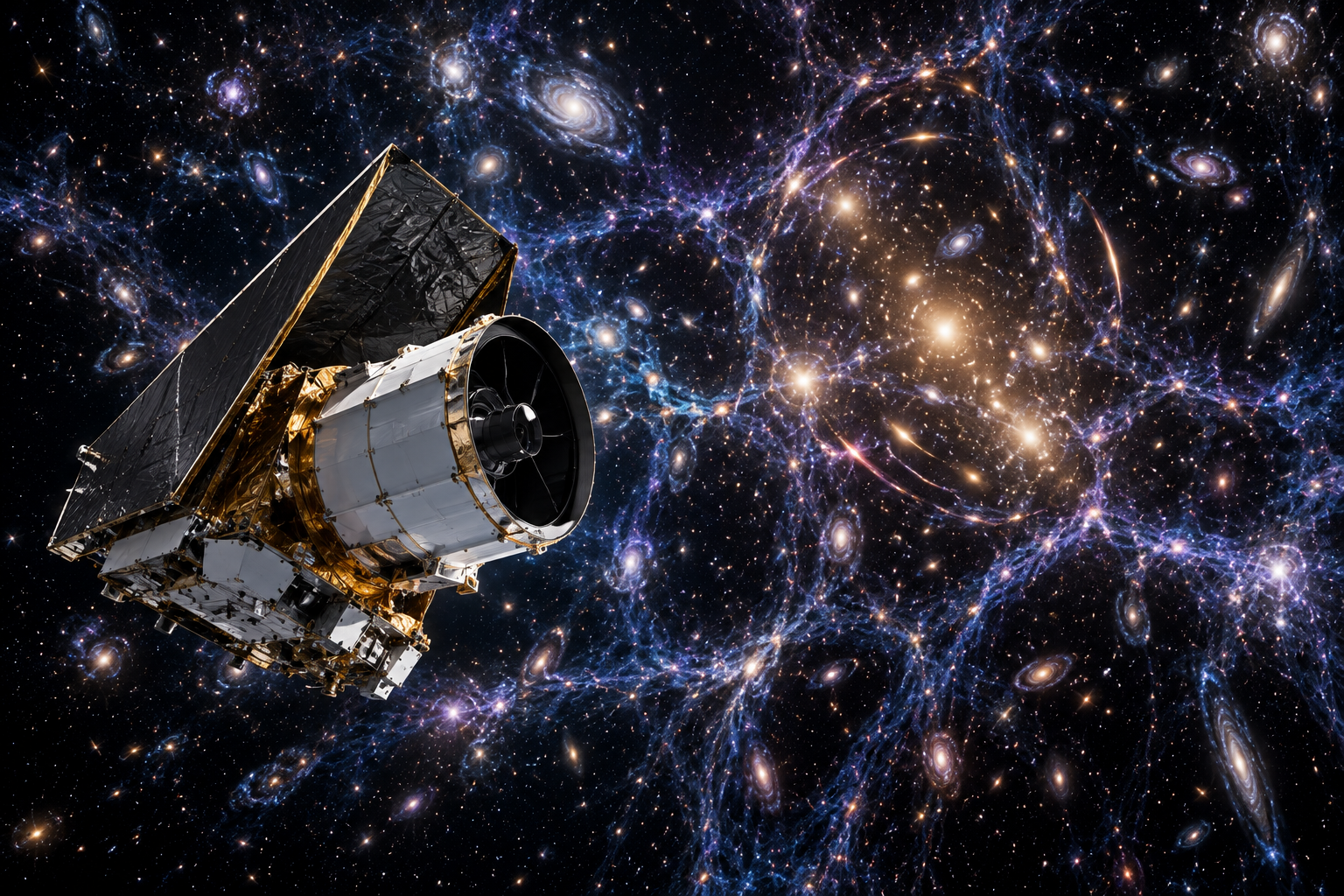
The European Space Agency's Euclid space telescope, launched in July 2023, is undertaking one of the most ambitious surveys of the Universe ever attempted. Operating approximately 1.5 million kilometres from Earth at the Sun–Earth L2 point, Euclid is mapping billions of galaxies across more than one-third of the sky. Its mission is to investigate two of cosmology's greatest mysteries: dark matter, the invisible substance influencing the gravitational structure of galaxies, and dark energy, the unexplained phenomenon associated with the accelerating expansion of the Universe.
Using advanced visible-light and near-infrared instruments, Euclid measures galaxy shapes, distances and the subtle gravitational distortion of light to reconstruct the Universe's large-scale structure. By examining how galaxies have formed and evolved over billions of years, European scientists hope to understand how dark matter and dark energy have shaped cosmic history. The mission represents a major European contribution to modern cosmology and our understanding of the Universe.
Solar Orbiter
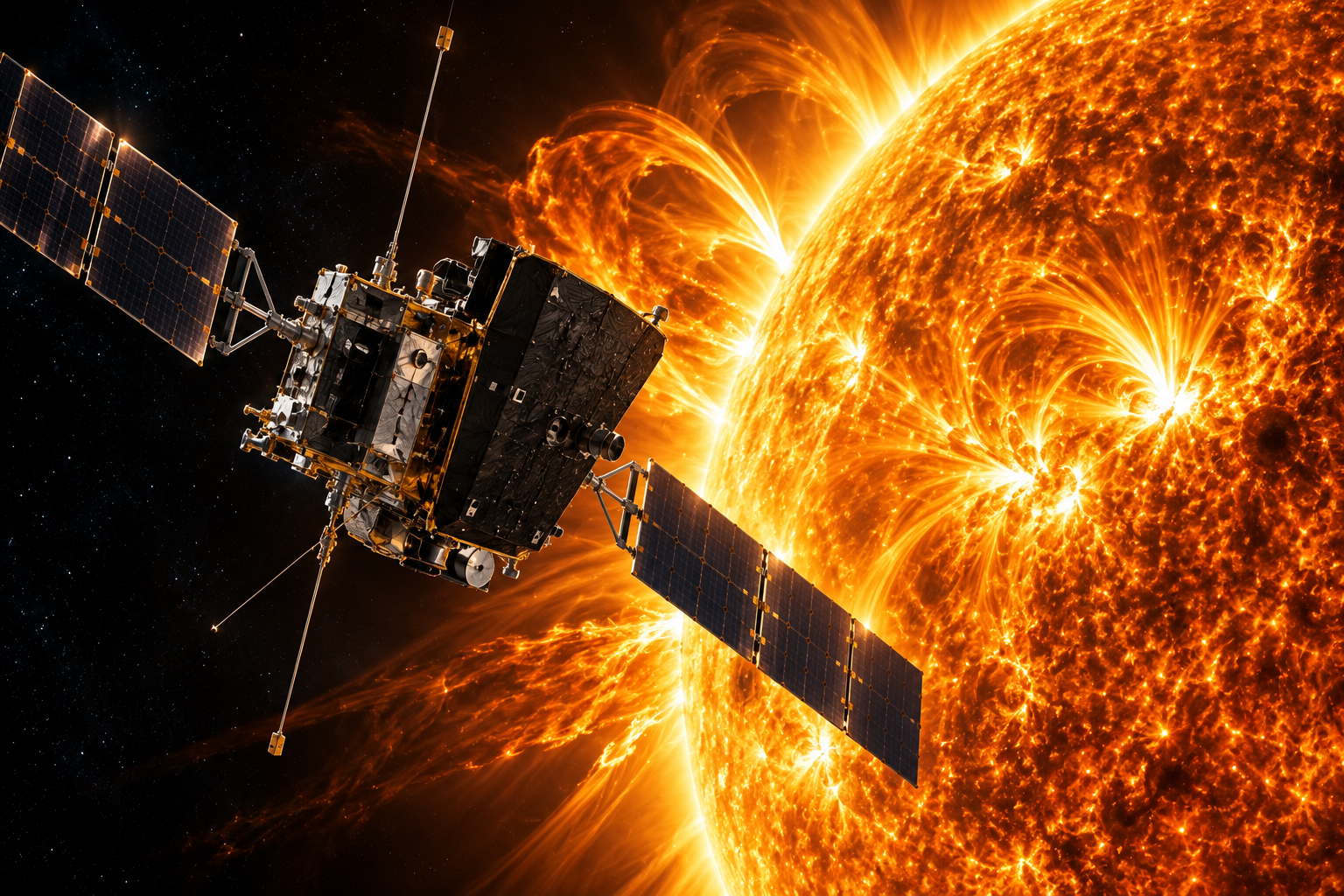
The European Space Agency's Solar Orbiter, launched in February 2020 in cooperation with NASA, is undertaking one of the most detailed investigations of the Sun ever attempted. Travelling deep into the inner Solar System, the spacecraft combines close-range observations with measurements of the solar wind, magnetic fields and energetic particles. Its increasingly inclined orbit provides unprecedented views of the Sun's polar regions, helping scientists investigate how solar activity develops and influences the wider Solar System.
Equipped with ten scientific instruments, Solar Orbiter is examining the mechanisms responsible for solar flares, coronal mass ejections and the formation of the solar wind. Understanding these processes is essential for improving space-weather forecasting and protecting satellites, communications networks, navigation systems and electrical infrastructure on Earth. The mission represents a major achievement in European solar science, advancing our understanding of the Sun's magnetic activity and its effects on modern technology.
ESA Exploring Mars
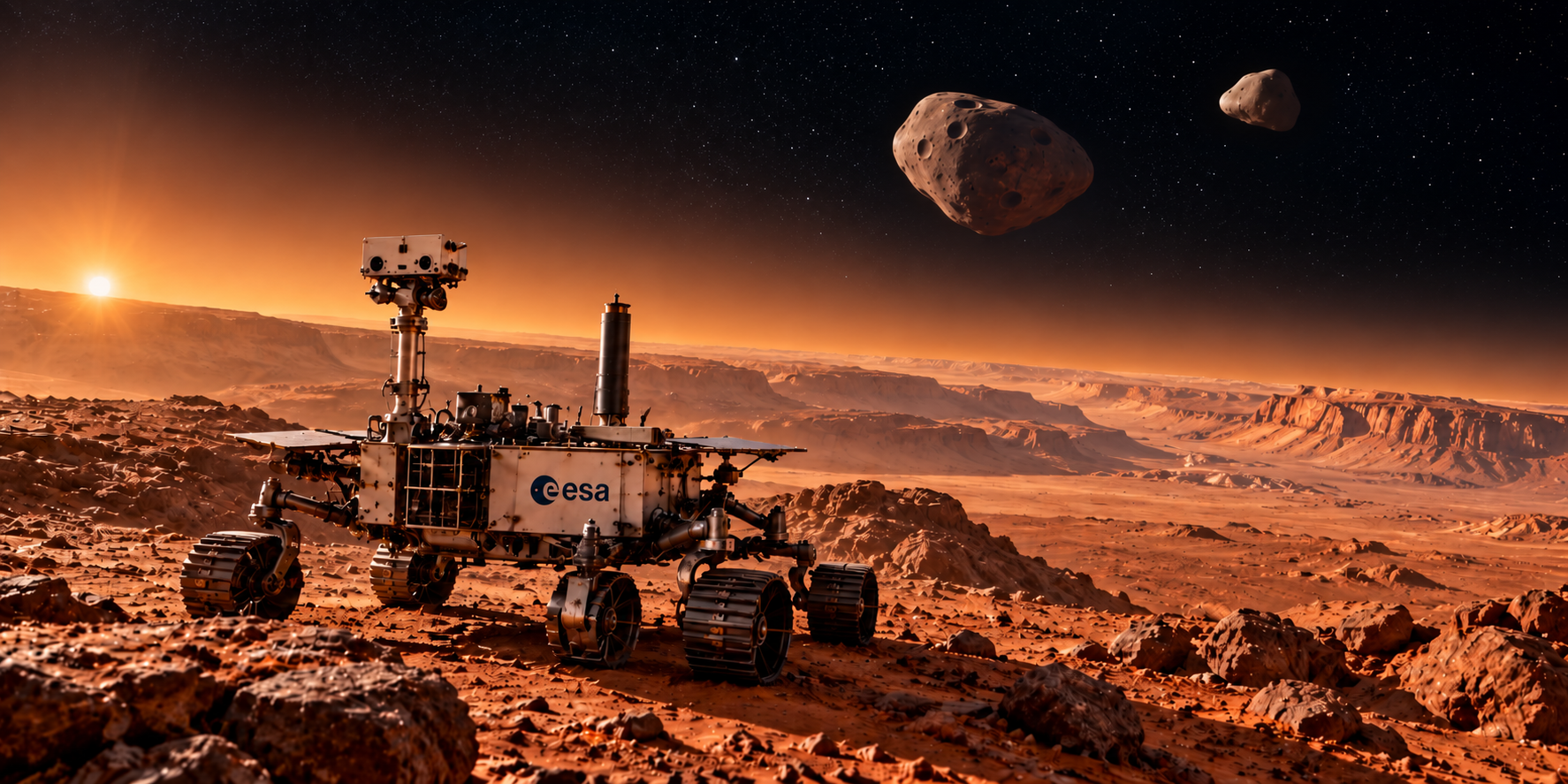
Mars remains one of the central targets of European planetary exploration. ESA's Mars Express has been studying the Red Planet since 2003, producing detailed colour and three-dimensional views while investigating its surface, subsurface, atmosphere and history of water. New imagery released in 2026 continues to reveal remarkable Martian landscapes, including ancient terrain, vast dune fields and colourful formations near the south pole. In October 2026, researchers using Mars Express observations and atmospheric modelling proposed a new explanation for the enormous Arsia Mons Elongated Cloud, which can stretch up to 1,800 kilometres across the Martian sky. Their findings suggest that water vapour may form ice particles without requiring atmospheric dust, through a process known as homogeneous nucleation. Although supported by modelling, this mechanism has not yet been directly confirmed. The research could improve our understanding of atmospheric processes on Mars and other planets.
Europe is also preparing the ExoMars Rosalind Franklin rover for launch in 2028 and landing at Oxia Planum in 2030. Unlike previous Mars rovers, Rosalind Franklin will be able to drill as deep as two metres beneath the surface, where potential biological signatures are better protected from radiation and surface chemistry. Its onboard laboratory will analyse samples as scientists investigate whether ancient, water-rich Mars ever provided conditions suitable for life. In October 2026, ESA reported the successful completion of an operational rehearsal in Spain's Tabernas Desert, where a prototype rover named Charlie travelled 220 metres while scientists and engineers tested remote navigation, scientific instruments and exploration procedures under Mars-like conditions. The exercise provided valuable preparation for the planned mission.
ESA's ExoMars Trace Gas Orbiter is already operating around Mars, studying the planet's atmosphere and trace gases while mapping water-rich material beneath the surface. Together, these missions combine orbital imaging, atmospheric science and future surface exploration in Europe's continuing search to understand Mars and its potential for past life.
BepiColombo — Exploring Mercury
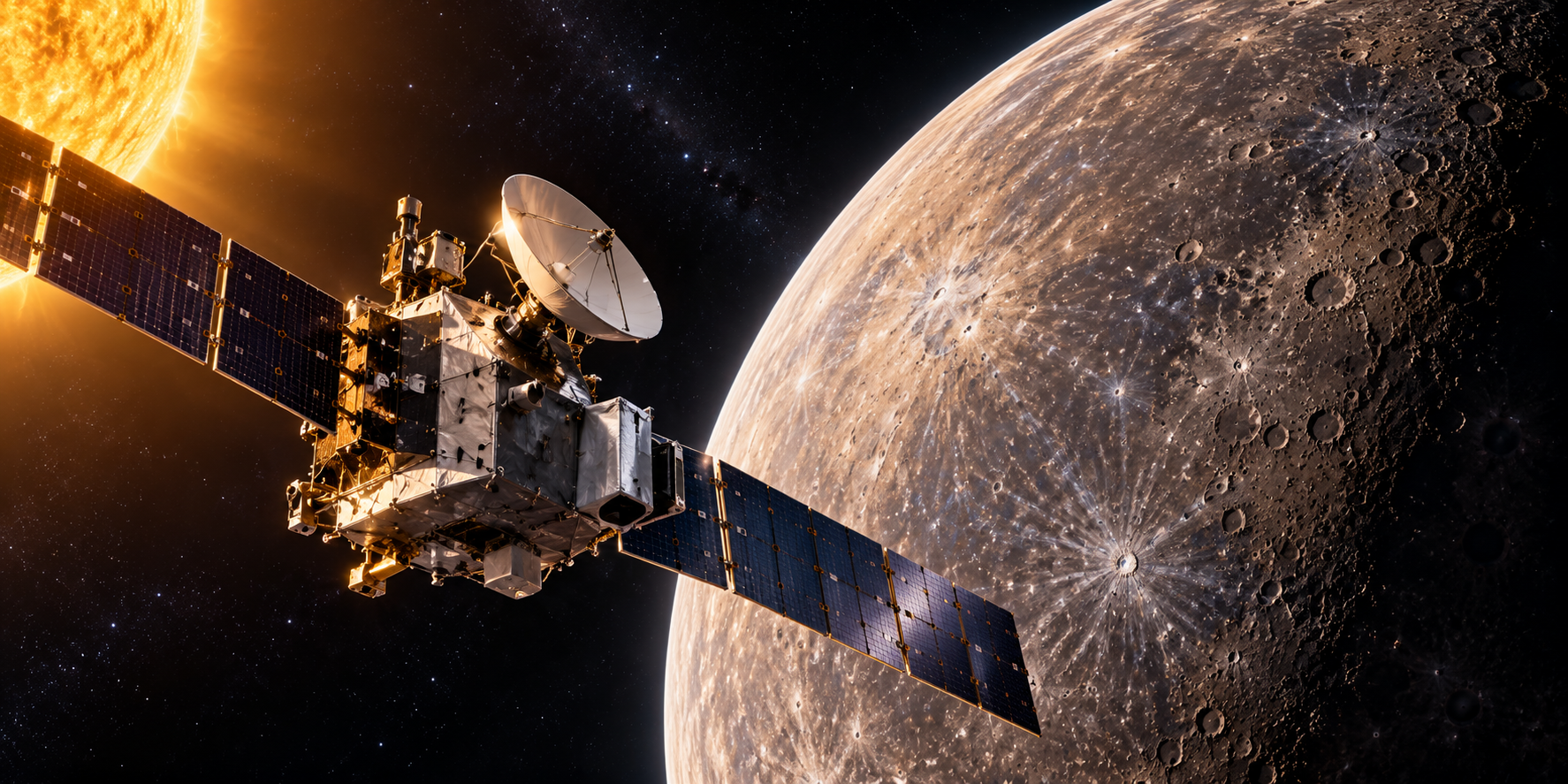
BepiColombo, a joint ESA–JAXA mission, is completing an eight-year journey to Mercury and entering one of the most technically demanding phases of European planetary exploration. After nine planetary flybys, its Mercury Transfer Module separated successfully in September 2026, leaving ESA's Mercury Planetary Orbiter and JAXA's Mio spacecraft to complete the final approach. The two spacecraft are scheduled to enter orbit around Mercury on 21 November 2026 before separating in December.
Beginning in April 2027, the two orbiters will investigate Mercury simultaneously from complementary orbits. Their instruments will examine the planet's surface and composition, enormous iron-rich interior, magnetic field, exosphere and interaction with the solar wind. The mission should provide an unprecedented view of the least-explored terrestrial planet and help scientists understand how Mercury — and the inner Solar System — formed and evolved.
What’s Next for European Space?
Europe is entering an important new phase in spaceflight. New commercial launch systems are moving towards regular operations, established programmes such as Ariane 6 and Copernicus are expanding, and ambitious technologies including fusion propulsion are being developed alongside major ESA science missions. This page will be updated as RFA One, Isar Aerospace, HyImpulse, Sunbird and European institutional missions reach significant new milestones.