

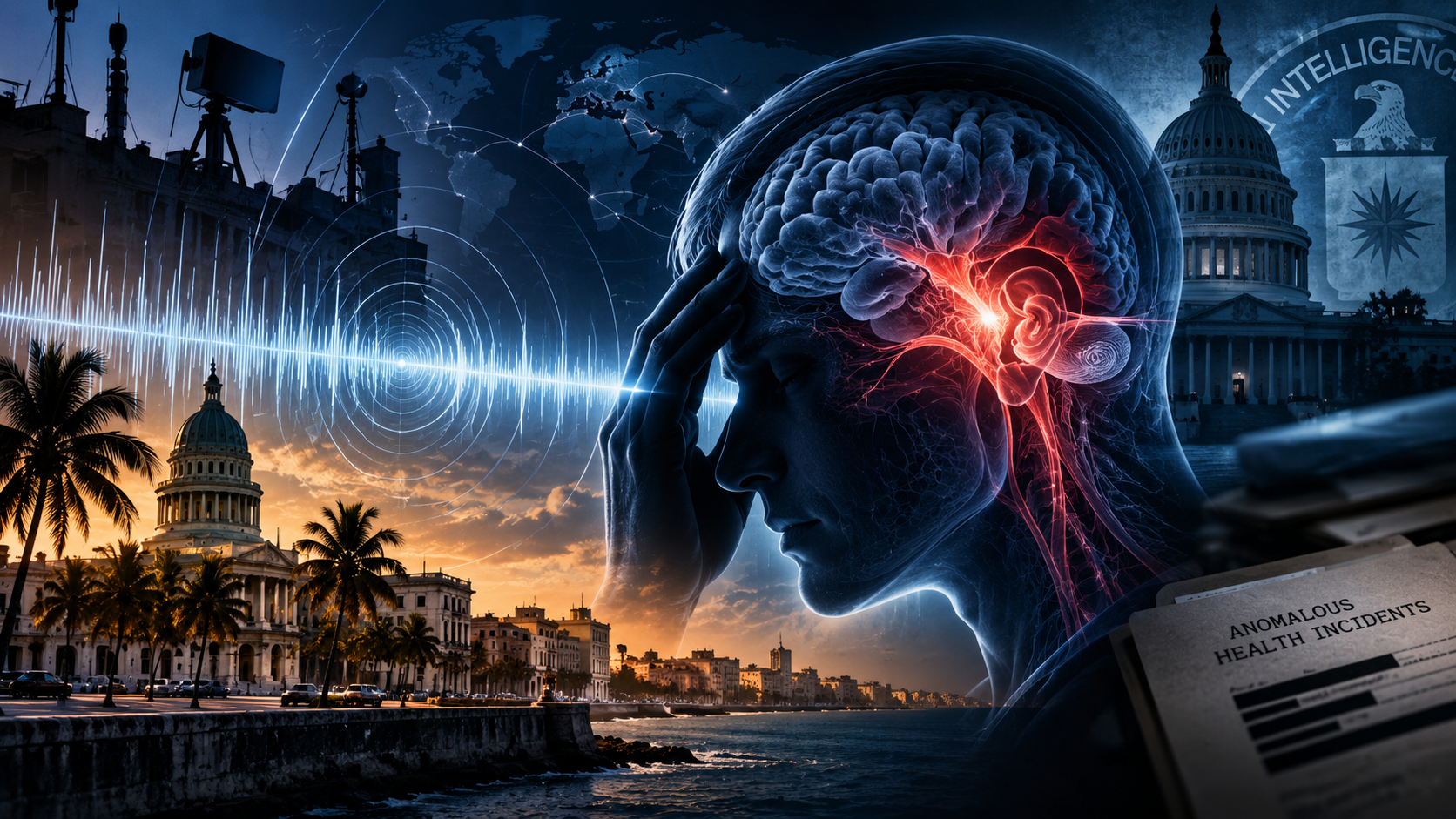
Havana Syndrome
Havana Syndrome refers to a series of unusual health events first reported by U.S. government personnel in Havana, Cuba, beginning in 2016, with later reports associated with personnel in other locations around the world. These cases became officially described as Anomalous Health Incidents (AHIs). In July 2026, the U.S. Department of War renamed its AHI Cross-Functional Team the Directed Energy Bio-Effects (DEBE) Cross-Functional Team, reflecting a new departmental focus on investigating directed-energy biological effects and other non-kinetic threats.
Reported experiences have included sudden perceptions of sound or pressure, ear pain, dizziness, imbalance, headaches and cognitive or neurological symptoms. The circumstances and medical findings have varied between individuals, and no single cause has been established for all reported cases.
Video: The Voices of Havana Syndrome
For additional context, this documentary explores Havana Syndrome through the experiences of people who reported anomalous health incidents and examines the continuing questions surrounding their cause.
The Significance of Established Microwave Capabilities
The diplomat's account warrants consideration alongside decades of established microwave-auditory research. Frey's experiments demonstrated auditory perception at considerable distances from an RF transmitter, while subsequent American experiments demonstrated the transmission of encoded speech information. Modern radar, signal processing and RF communication technologies separately demonstrate sophisticated capabilities for detecting, tracking and transmitting electromagnetic signals. Considered together, these developments provide a scientific basis for investigating whether directed pulsed RF could account for the distinctive auditory and directional experiences reported in some Havana Syndrome cases. However, the integration of these capabilities into a system capable of producing the complete reported symptom profile remains unverified. The central investigative question is therefore not whether microwave-induced hearing is possible because this is already established science, but whether such technology was employed during the incidents.
My argument extends beyond claiming that pulsed RF could explain one isolated symptom of Havana Syndrome. Instead, I contend that a combination of historically demonstrated capabilities makes pulsed RF a compelling explanation when all reported experiences are considered together. Given the lack of viable alternative explanations—and because this involves multiple converging factors rather than a single similarity—the case arguably meets the standard of "beyond reasonable doubt."
Source: NBC News — Fighting An Invisible Enemy: The Voices of Havana Syndrome
Her account featured in the NBC News documentary, and is particularly notable in the context of microwave-auditory research. A diplomat describes perceiving intelligible words during an incident, including the phrase “get off the X.” The perception of intelligible speech is broadly consistent with the type of auditory experience demonstrated in earlier microwave-auditory research, in which speech information was encoded into pulsed RF energy and reportedly perceived by a human subject. This similarity provides a relevant historical comparison with an experimentally reported capability. In the NBC News documentary, the diplomat also states that a doctor who evaluated her told her that her symptoms were “not psychosomatic.” This is relevant to her account.

Havana Syndrome: What Does the Medical Evidence Actually Show?
An evidence-based examination of the neurological, neuroimaging, vestibular and biomarker findings reported in people affected by Havana Syndrome, including what the studies establish—and what remains uncertain.

A Technology-Focused Hypothesis for a Possible Havana Syndrome Mechanism
Explore an original hypothesis examining whether experimentally established microwave-auditory phenomena could, in principle, be integrated with modern RF engineering, sensor fusion, automated tracking, digital-twin modelling and software-defined systems.

Hearing Microwaves: The Strange Science of the Frey Effect
An evidence-based examination of the microwave auditory effect, from early experimental research to proposed biological mechanisms and its potential relevance to anomalous health incidents.

Microwave Transmission, Radar & Waveguides
Learn the differences between pulsed microwave transmission, radar systems and waveguides, from American research and Soviet laboratory experiments to modern RF technologies. Understand their relationship to the microwave auditory effect, including the generation and perception of sound through pulsed electromagnetic energy.

Intelligence Assessments & Government Inquiries
An evidence-based comparison of declassified U.S. intelligence assessments, congressional investigations and scientific reviews examining possible causes of Havana Syndrome, areas of agreement and disagreement, and what remains unresolved.

Sensor Evidence & Hardware Feasibility
Examining reported RF measurements, sensor evidence, directional transmission, propagation constraints, power requirements and the practical feasibility of proposed directed-energy mechanisms.

The US-Soviet/Russian Connection
The microwave auditory effect has a predominantly American experimental history, but during the Cold War a smaller and scientifically significant connection developed between American researchers and Soviet scientists.
The Soviet contribution appears to have been comparatively limited in duration and experimental focus.

The History Of The Microwave Auditory Effect
American research into microwave-induced auditory effects dates back to investigations at Airborne Instruments Laboratory (AIL) in 1947, followed by Allan H. Frey's experiments in the 1960s and later demonstrations involving encoded speech. This decades-long technological history remains relevant to modern investigations into Havana Syndrome, first reported in 2016. Although microwave-induced auditory perception is scientifically established, its involvement in these incidents remains unproven. Our dedicated investigation examines the historical experiments, scientific evidence and unresolved questions through to the present day.