

Geopolitics | 21 October 2026
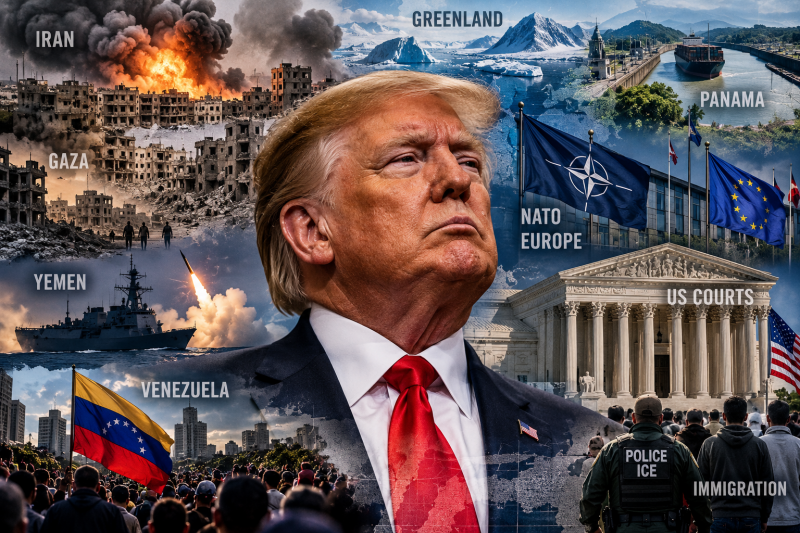
Donald Trump's second presidency has seen American military operations, disputes over territorial sovereignty, growing tensions with NATO allies and significant challenges to presidential authority in the courts.
From Iran and Gaza to Greenland, Panama and Europe, the administration's actions have raised questions about international law and the limits of American power.
Iran and Allegations of War Crimes
In September 2026, a United Nations fact-finding mission reported reasonable grounds to believe that attacks on civilian facilities in Iran constituted war crimes.
The investigation documented 157 deaths at a primary school in Minab, including 123 children, and reported 22 deaths at a sports centre in Lamerd.
These were UN investigative findings, not criminal convictions. The mission also documented serious violations attributed to Iranian authorities.
Gaza, Yemen and Venezuela
Trump's policies towards Gaza have attracted international criticism, particularly over proposals involving the displacement of Palestinians.
UN experts warned that forced displacement would violate international law. The United Nations subsequently welcomed progress towards a further phase of the Gaza peace process, while continuing to emphasise civilian protection and Palestinian rights.
American military operations involving Yemen and Venezuela have also prompted questions concerning sovereignty, the use of force and international accountability.
Greenland, Panama and NATO
Trump's renewed interest in American control of Greenland has caused tensions with Denmark and other European governments.
His statements concerning the Panama Canal, Canada and the Falkland Islands have similarly raised diplomatic concerns.
Relations with NATO allies have also been strained by disagreements involving Spain and Italy, including disputes over military cooperation and proposed trade restrictions.
Political threats, however, are not the same as implemented policies.
Tariffs and Presidential Authority
The controversy extends into American domestic law.
In February 2026, the US Supreme Court ruled that the International Emergency Economic Powers Act did not authorise Trump's use of tariffs under that legislation.
The administration has also faced legal challenges involving immigration enforcement, federal research funding and education programmes.
Trump's January 2025 pardons relating to the Capitol attack of 6 January 2021, alongside decisions concerning the Paris Agreement and World Health Organisation, have further divided political opinion.
Who Holds American Power Accountable?
The United States has long played a central role in developing international institutions, security alliances and the post-war legal order.
Yet military operations, territorial disputes and disagreements with longstanding allies have renewed debate about how those rules apply to Washington itself.
The main question is whether international institutions, allied governments and domestic courts can effectively constrain presidential decisions when they conflict with established legal obligations.