

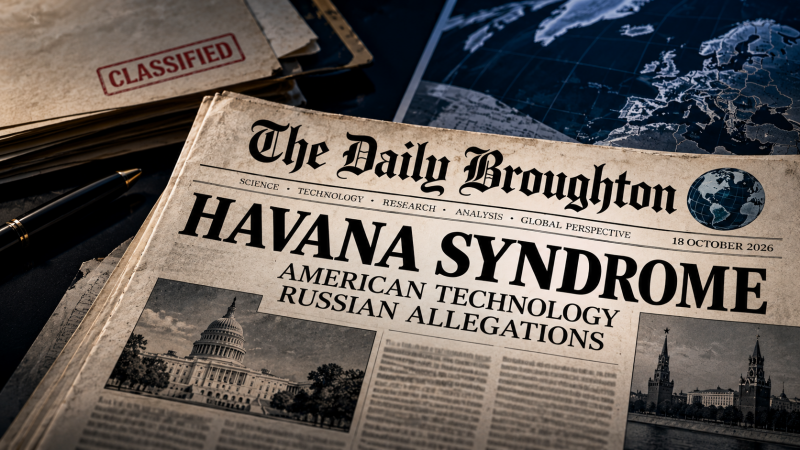
The Daily Broughton | 18 October 2026
A new book alleging Russian involvement in Havana Syndrome has revived questions about the origins of the technology suspected of causing unexplained health incidents.
Yet the documented history of microwave-induced hearing is predominantly American.
America's Microwave Research
Beginning with observations at Airborne Instruments Laboratory in 1947, American researchers developed increasingly sophisticated experiments.
In 1962, Allan Frey documented microwave-induced auditory effects at distances extending to thousands of feet from a transmitter. His experiments also described head-buffeting and pins-and-needles sensations produced by changing transmitter parameters. Subsequent American research explored Morse code, encoded speech and auditory effects produced by pulsed microwave transmitters.
Head buffeting is an intense sensation of pressure or pounding inside or around the head, resembling repeated blows or forceful buffeting, produced during exposure to modulated electromagnetic energy.
The United States also possessed extensive radar infrastructure and the specialised equipment required for such experiments.
What About Soviet Research?
American scientist James C. Lin encountered initially sceptical Soviet researchers and helped interpret their microwave auditory findings.
Their published experiments involved waveguides and laboratory arrangements, unlike American demonstrations involving pulsed transmitters and encoded communication.
These were different levels of demonstrated capability.
Why Suspect Russia?
The book's allegations of Russian responsibility remain unverified.
America's documented expertise and equipment provide a closer technical comparison with the proposed pulsed-microwave mechanism and therefore an important starting point for investigation.
Old Technology, New Questions
In July 2026, the Pentagon renamed its investigative unit the Directed Energy Bio-Effects (DEBE) Cross-Functional Team and announced nearly $3 million in HAVANA Act compensation.
The renewed attention reinforces the importance of establishing what technology caused the incidents.
One important question remains: why does the documented technological history point so strongly towards American research while allegations of responsibility concentrate on Russia?
Editorial Note: This article examines the documented differences between American and Soviet microwave research. It questions why Russian involvement is emphasised when American experiments demonstrated more advanced capabilities in the published record. The comparison is based on historical evidence, not national bias or an allegation of responsibility.