

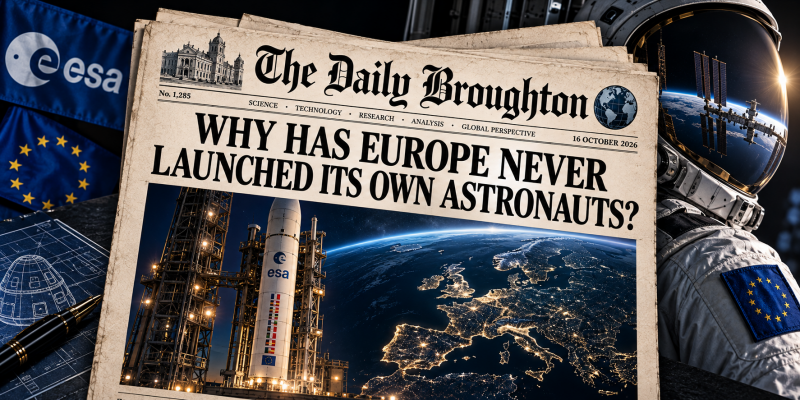
Why Has Europe Never Launched Its Own Astronauts?
Martin Broughton — Research & Analysis | 16 October 2026
Europe has flown astronauts for decades, contributed major components to the International Space Station and developed powerful launch vehicles, yet it has never possessed an independent operational system for transporting its own crews into orbit. At the International Space Summit in Paris on 10 September 2026, French President Emmanuel Macron called for that to change. His proposed milestones included Europe's Nyx cargo capsule docking with the International Space Station within two years, the Argonaut lunar lander reaching the Moon within five, and a European crewed spacecraft launching from Kourou within ten. The announcement raised a longstanding question: why has Europe, with its considerable aerospace expertise, never developed an independent crewed launch capability?
The rocket itself may not be the greatest obstacle. Ariane 6 was not designed or certified to carry astronauts, but ArianeGroup chief executive Martin Sion has publicly stated that adapting it for human spaceflight is technically possible. ESA previously commissioned Arianespace, supported by ArianeGroup, to investigate the requirements for crewed launches, including launcher modifications and spacecraft escape systems. Europe's technological foundations are substantial: Ariane 64 successfully demonstrated its heavy-lift capability in February 2026, while ArianeGroup's SUSIE concept, unveiled in 2022, proposed a reusable spacecraft capable of carrying five astronauts. These developments demonstrate credible engineering possibilities, although none constitutes an approved, human-rated crew transportation system.
The greater challenge is developing and funding the complete infrastructure. ESA Director General Josef Aschbacher has estimated that independent European crew transportation could require approximately €1 billion annually over a decade. He has also argued that continuing to purchase astronaut flights from foreign providers could cost around €5 billion over the same period, money that might otherwise support European industry. However, crewed spaceflight requires considerably more than a suitable rocket: spacecraft development, life-support systems, emergency escape capability, mission control, recovery operations and extensive safety certification are all essential. Europe's December 2026 ministerial meeting in Rome is expected to consider the political commitment, with funding decisions to follow through ESA's established processes.
Europe has considered independent human spaceflight before. Its Hermes spaceplane, intended to launch aboard a human-rated Ariane 5, was cancelled in 1992 following rising costs, technical difficulties and changing priorities. Today, Europe possesses far more advanced launch infrastructure, experience in human-spaceflight systems and an expanding commercial space industry. Ariane 64 is also planned to launch ESA's Argonaut lunar lander, while private initiatives such as Nyx are advancing European spacecraft development. Nevertheless, Macron's ten-year ambition remains a political objective rather than an approved, fully funded crewed spaceflight programme.
Europe's absence from independent crewed orbital launches therefore cannot be explained simply by an inability to build rockets. The continent possesses substantial technical expertise, but converting that foundation into a complete, certified human-spaceflight capability requires sustained investment, engineering development and agreement among participating governments. The question is no longer merely whether Europe could develop such a system, but whether its governments are prepared to make the long-term commitment necessary to achieve it.