

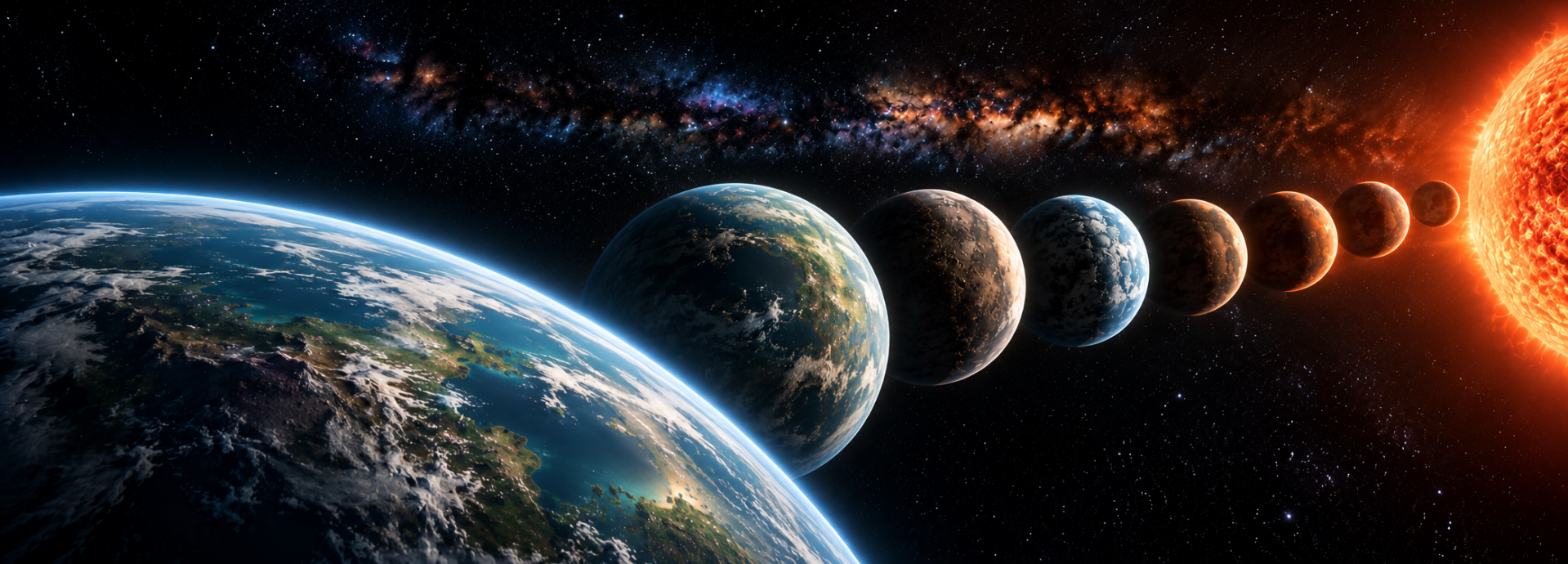
Potentially Habitable Exoplanets
Searching for Worlds Beyond Earth
The discovery of planets orbiting distant stars has transformed our understanding of the universe and raised one of science's most fascinating questions: could life exist beyond Earth?
Among the thousands of known exoplanets, particular scientific attention is directed towards worlds orbiting within their host stars' circumstellar habitable zones, sometimes called the Goldilocks zones. These are regions where temperatures could permit liquid water on a planet's surface, provided suitable atmospheric and environmental conditions exist.
Some of these planets are rocky worlds comparable in size to Earth, while others are larger super-Earths or planets whose physical composition remains uncertain. Their potential habitability depends on considerably more than distance from their stars.
Atmospheric composition, stellar radiation, planetary geology, water availability and long-term environmental stability all influence whether conditions suitable for life might develop or persist.
Observatories including the James Webb Space Telescope, alongside European ground-based facilities and future missions, are helping astronomers investigate these distant worlds. By studying planetary atmospheres and the light received from their host stars, researchers can begin distinguishing potentially habitable environments from those unlikely to support life.
Importantly, no exoplanet has yet been confirmed to support life, and occupying a habitable zone does not establish that a planet possesses liquid water or habitable surface conditions.
This research section examines confirmed habitable-zone planets and credible candidates, their known characteristics, atmospheric investigations and the latest scientific discoveries, distinguishing established observations from theoretical possibilities.
TRAPPIST-1e — An Earth-Sized World
Located approximately 40 light-years from Earth, TRAPPIST-1e is a rocky, Earth-sized exoplanet orbiting an ultracool red dwarf star in the constellation Aquarius. It is one of seven confirmed planets in the TRAPPIST-1 system and lies within its star's habitable zone, where liquid water could theoretically exist under suitable atmospheric conditions.
Its size, density and orbital location make it an important target in the search for potentially habitable worlds. Observations from the James Webb Space Telescope are helping scientists investigate whether the planet possesses an atmosphere, although its atmospheric composition, surface conditions and potential habitability remain unresolved.
TRAPPIST-1e is explored in greater detail in our dedicated research page, examining its discovery, physical characteristics, atmospheric investigations and prospects for supporting liquid water.