

Martin Broughton — Research & Analysis | 15th October 2026
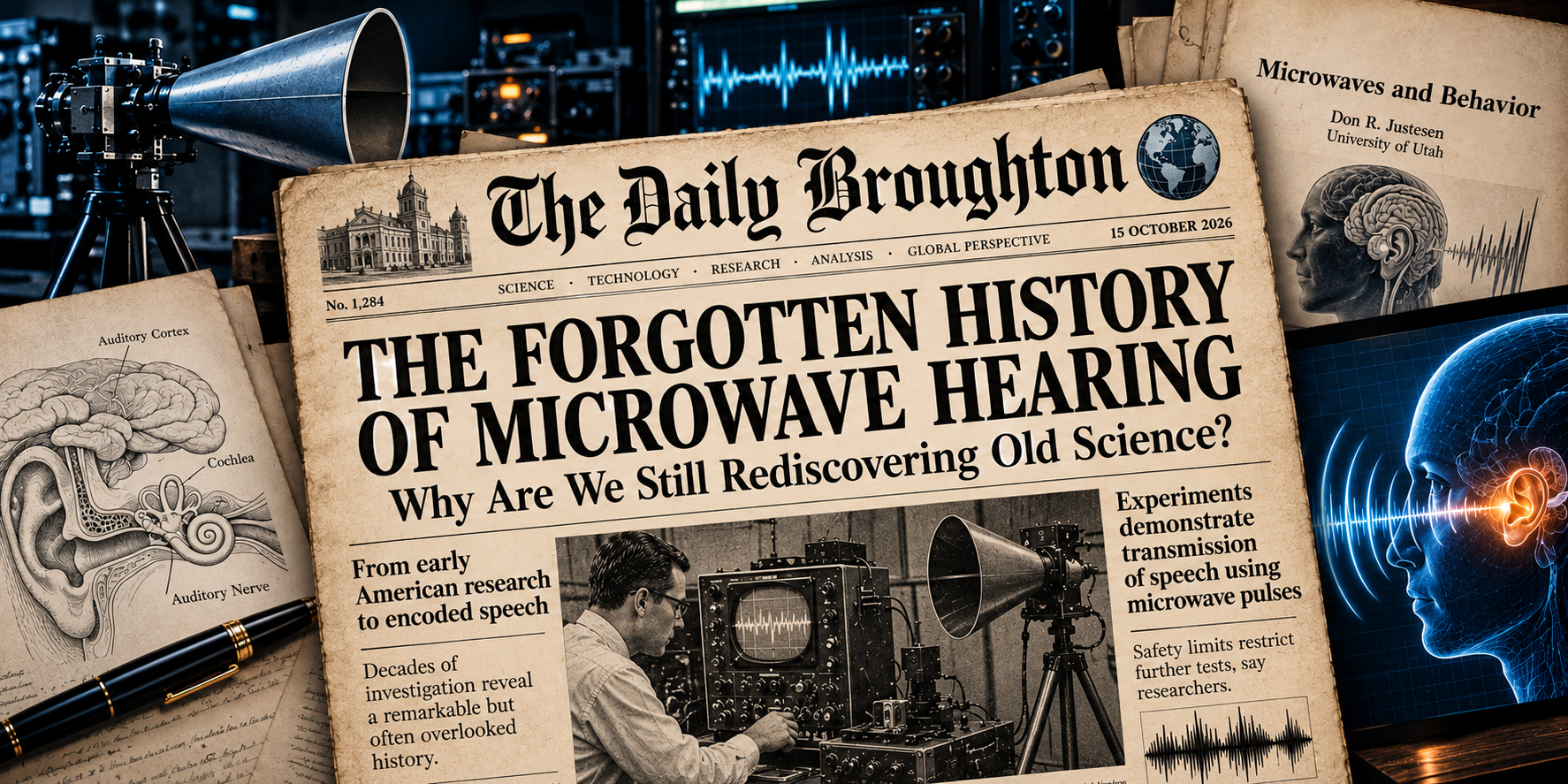
The microwave auditory effect is sometimes presented in modern discussions about directed-energy technology and Havana Syndrome as an unfamiliar or speculative phenomenon. Yet its scientific history extends back to observations reported at America's Airborne Instruments Laboratory in 1947. During the 1960s, Allan H. Frey demonstrated that pulsed microwave energy could produce audible sensations, while Foster and Finch subsequently provided experimental evidence supporting the thermoacoustic mechanism, in which absorbed electromagnetic energy generates acoustic pressure waves that stimulate the auditory system.
By the 1970s, American experiments had progressed beyond clicks and buzzing. In his 1975 paper Microwaves and Behavior, Don R. Justesen described Arthur W. Guy's experiments involving Morse code and the work of Joseph C. Sharp and H. Mark Grove, who reportedly transmitted nine recognisable spoken digit words using microwave pulses derived from recorded speech. Crucially, Justesen explained that more complex words and sentences were not attempted because the required average energy densities would approach the American radiation exposure safety limit of 10 mW/cm². This was a safety-related restriction, not evidence that the technology had reached its technical limits. Although the speech demonstration was reported through personal communication rather than a separate peer-reviewed publication, its historical significance should not be overlooked.
These developments occurred during a period of considerable disagreement over microwave radiation safety. American and Soviet exposure standards differed substantially, while researchers debated whether existing limits adequately accounted for biological effects. The circumstances surrounding the speech experiments illustrate how safety requirements could constrain further investigation without establishing that more advanced communication was technically impossible.
The emergence of Havana Syndrome has renewed interest in this research. Microwave hearing is an established phenomenon, and the historical literature documents experiments involving encoded auditory information.
The forgotten history of microwave hearing demonstrates why revisiting original scientific research matters. Technologies sometimes portrayed as modern possibilities may have roots stretching back decades, while restrictions imposed for safety reasons can be mistaken for limitations of the technology itself. Understanding what researchers actually demonstrated — and why certain experiments were not extended — provides a more accurate foundation for evaluating today's claims.