

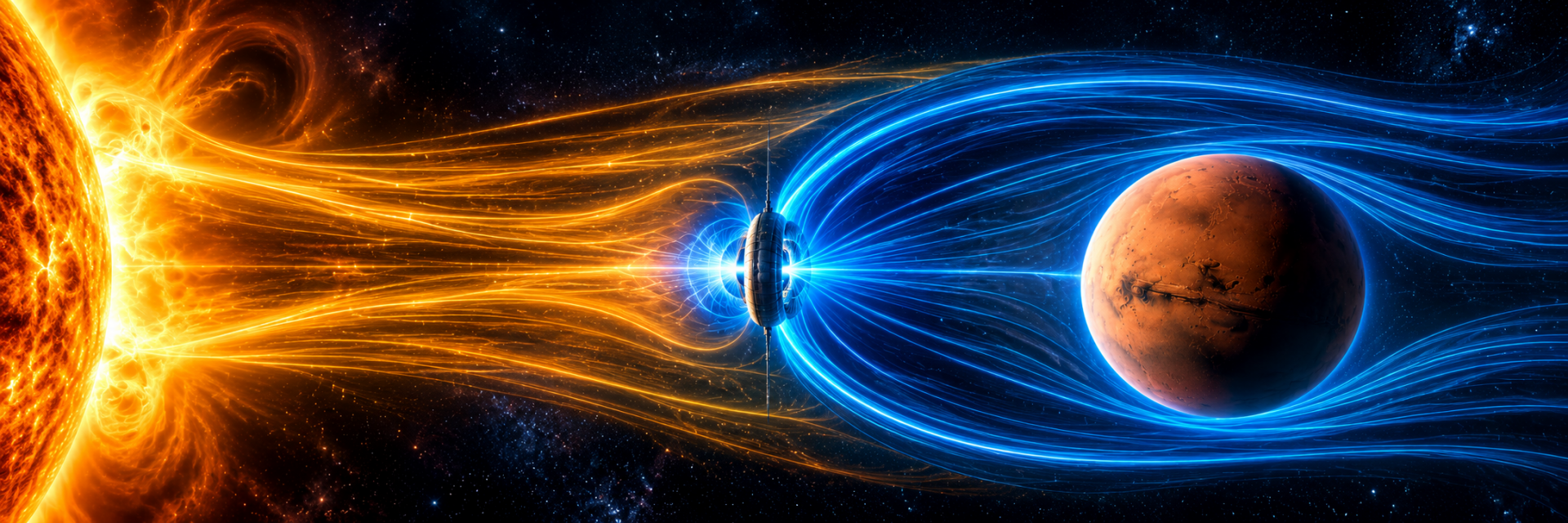
Planetary Magnetic Shielding
Protecting Planetary Atmospheres and Supporting Future Human Exploration
Planetary magnetic fields play an important role in how planets interact with the solar wind, the continuous stream of charged particles released by the Sun. Earth's magnetic field creates a magnetosphere that deflects much of this incoming particle flow.
Mars once possessed a global magnetic field, but today retains only localised magnetic fields within parts of its crust. Its atmosphere is also considerably thinner than Earth's, having undergone substantial losses over billions of years.
Scientists have investigated whether artificial magnetic shielding could reduce atmospheric erosion, protect future spacecraft and human settlements, and contribute to efforts to improve conditions on Mars.
Among the most significant proposals are those developed by former NASA planetary science director Dr James (Jim) Green and his collaborators.
Mars and the Loss of Its Global Magnetic Field
Evidence from spacecraft observations indicates that Mars possessed a global magnetic field early in its history.
As its internal magnetic dynamo ceased operating, Mars became more directly exposed to the solar wind. Atmospheric escape subsequently contributed to the loss of gases and water over geological timescales.
However, solar wind erosion is not the only mechanism responsible for atmospheric loss. Other processes, including photochemical escape and the loss of lighter gases, must also be considered.
Restoring magnetic protection could therefore address an important part of the problem, but would not automatically restore Mars's former atmosphere.
🔍 Click image to enlarge
🔍 Click image to enlarge
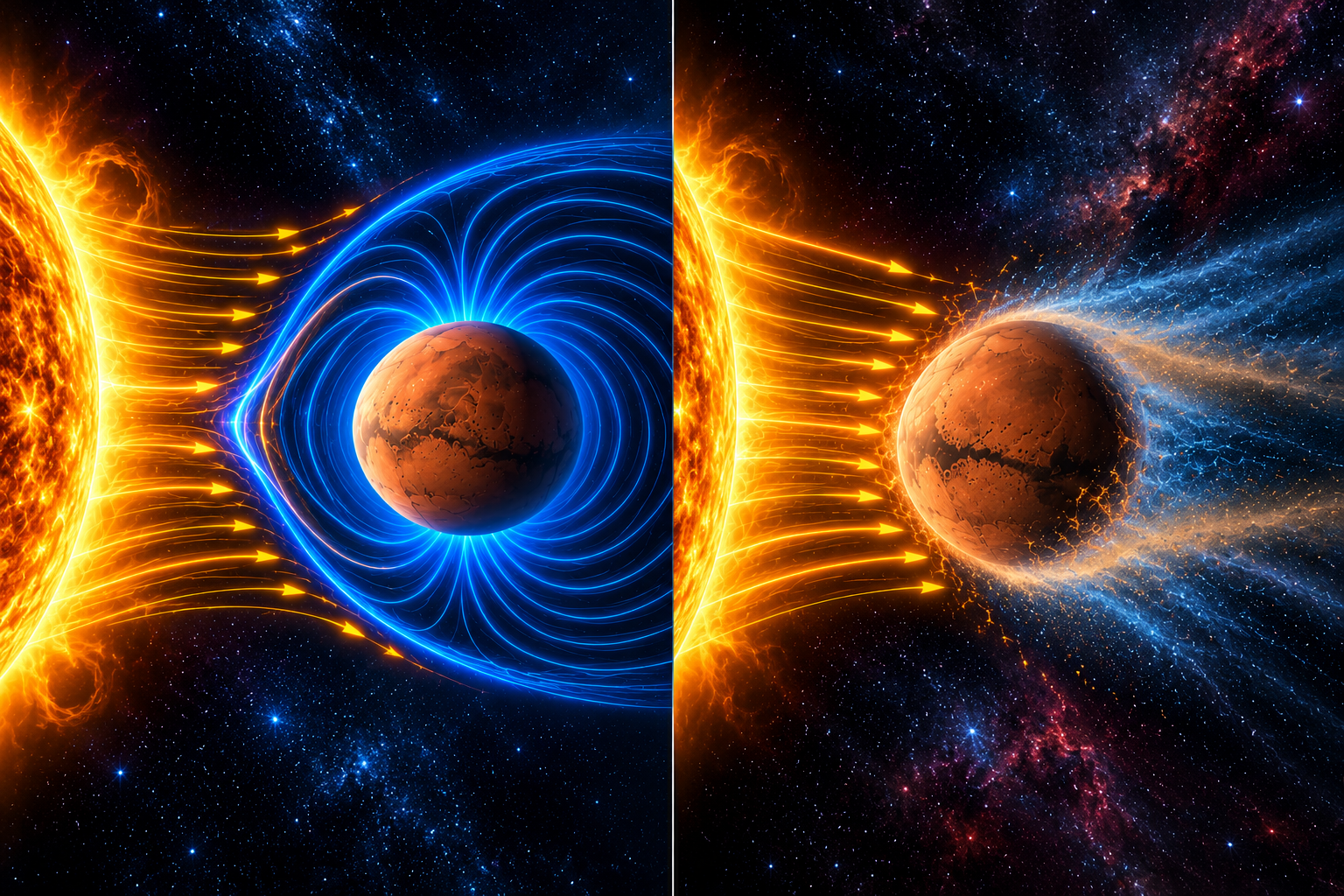
Mars's Magnetic Field: Past and Present
Artist's impression comparing early Mars (left), when a global magnetic field helped shield its atmosphere from the solar wind, with present-day Mars (right), which lacks a global magnetic field and is more exposed to solar-wind-driven atmospheric erosion.
Dr Jim Green's 2017 Mars–Sun L1 Proposal
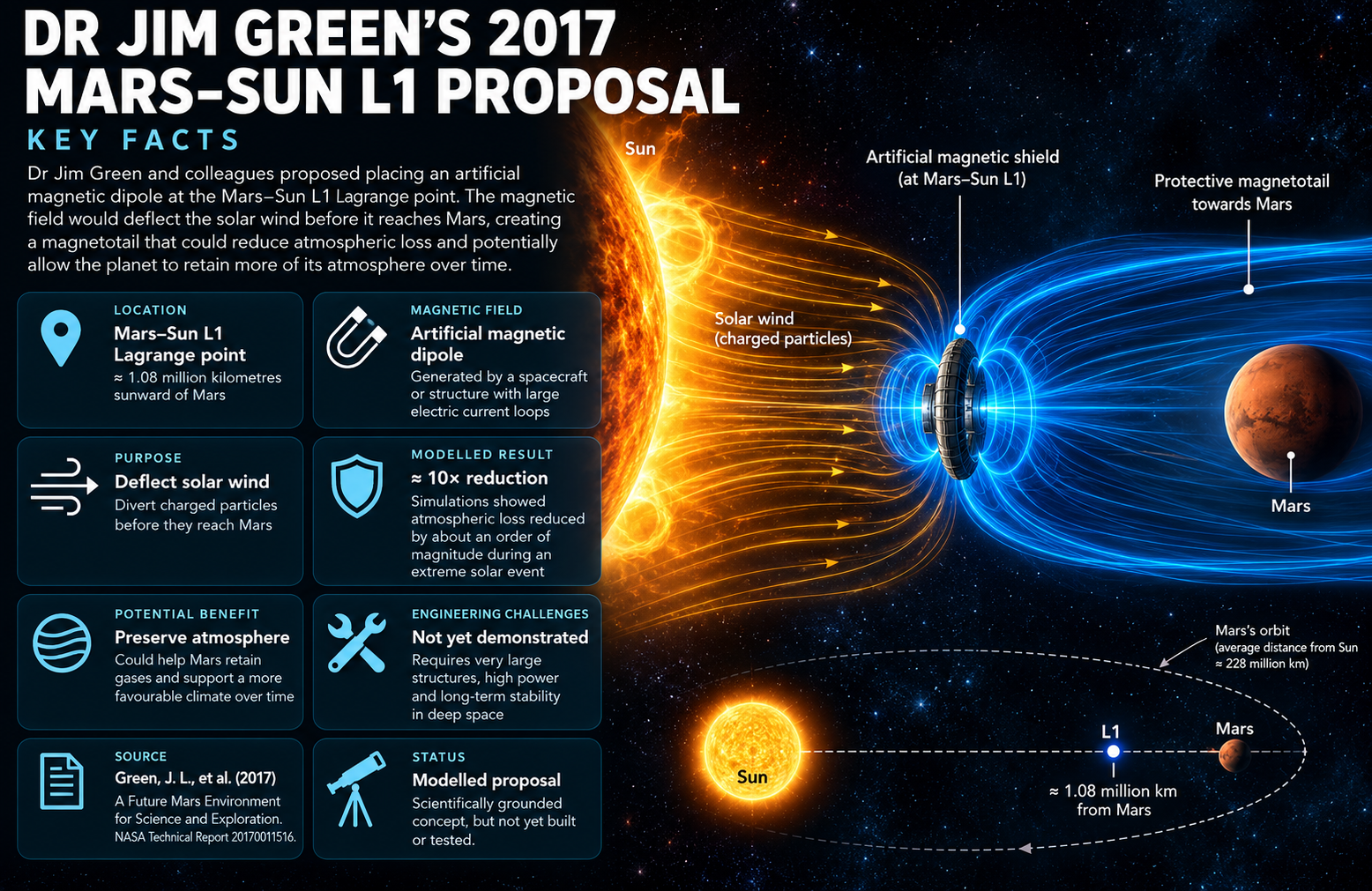
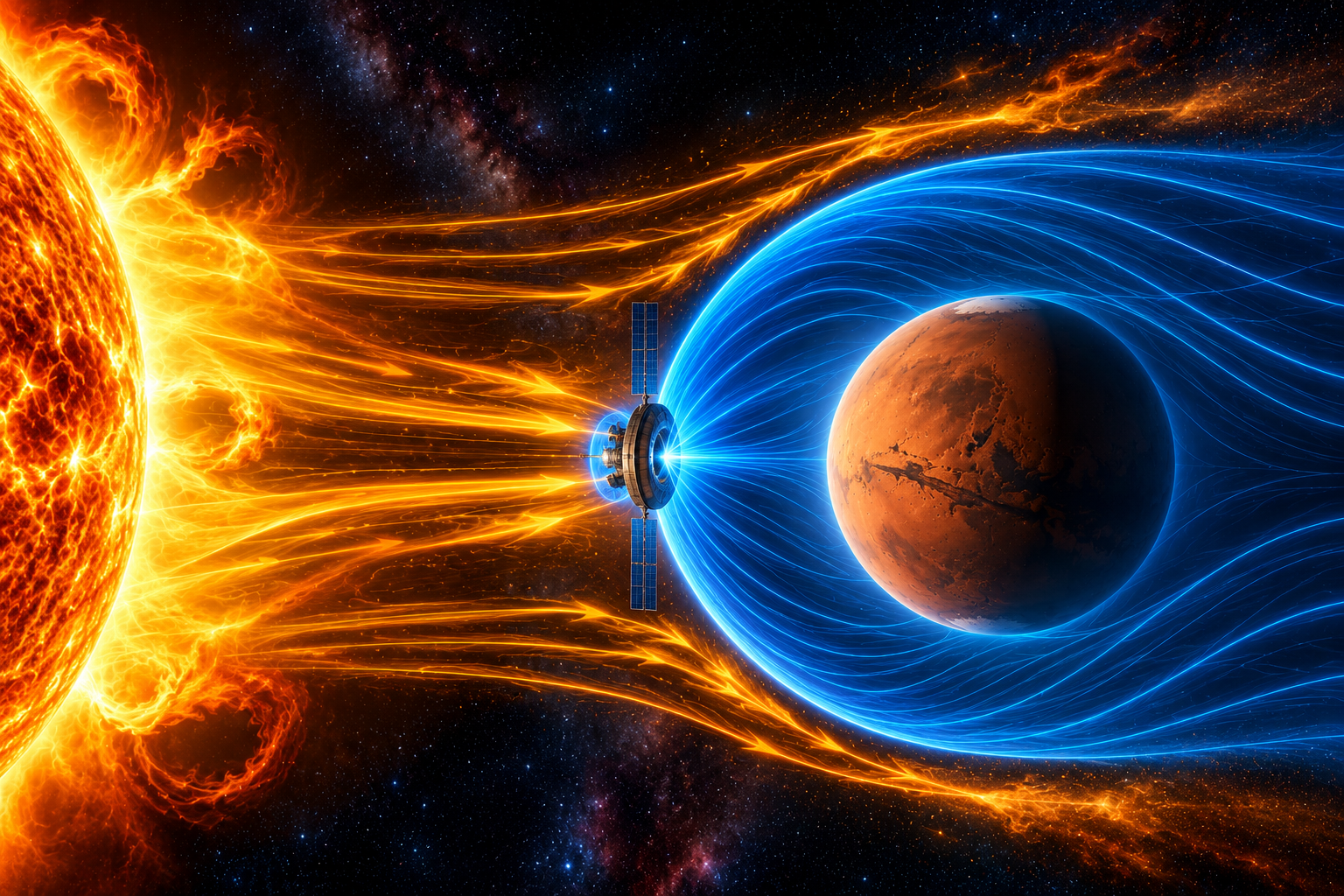
In 2017, Dr Jim Green and colleagues presented research examining the possibility of placing an artificial magnetic dipole at the Mars–Sun L1 Lagrange point.
Located approximately 1.08 million kilometres sunward of Mars, this region could provide a position from which an artificial magnetic field might divert incoming solar wind before it reaches the planet.
Computer simulations examined how the resulting magnetotail could shelter Mars from charged particles.
In one simulated extreme solar event, atmospheric losses were reduced by approximately an order of magnitude compared with an unshielded scenario.
The researchers also considered whether reduced atmospheric erosion might allow naturally released gases to accumulate over time, potentially contributing to higher atmospheric pressure and temperature.
These results demonstrated a promising physical concept in computer modelling. They did not establish that a sufficiently powerful system could be constructed or that Mars's atmosphere would recover to habitable conditions.
🔍 Click image to enlarge
The 2025 Pelton–Green Research
In October 2025, Joseph N. Pelton and James Green published Magnetic Shielding Systems to Support Longer-Term Human Exploration of Mars in Frontiers in Space Technologies.
The paper revisited planetary magnetic shielding and considered three principal approaches.
1. Localised Magnetic Protection
The first approach generates an artificial magnetic field around a future Martian outpost, addressing radiation as a local problem for a specific crew and site rather than as a planetary one. In general terms, a magnetic field deflects a charged particle by an amount that depends on the particle's energy and charge together with the field's strength and spatial extent — which is why effectiveness here would hinge on field strength, geometry, power supply, and the energies of incoming particles acting jointly rather than independently.
Such a system would also act selectively. Magnetic deflection applies to charged particles, so it would leave other components of the radiation environment unaddressed, and no operational habitat shielding system of this type has yet been demonstrated.
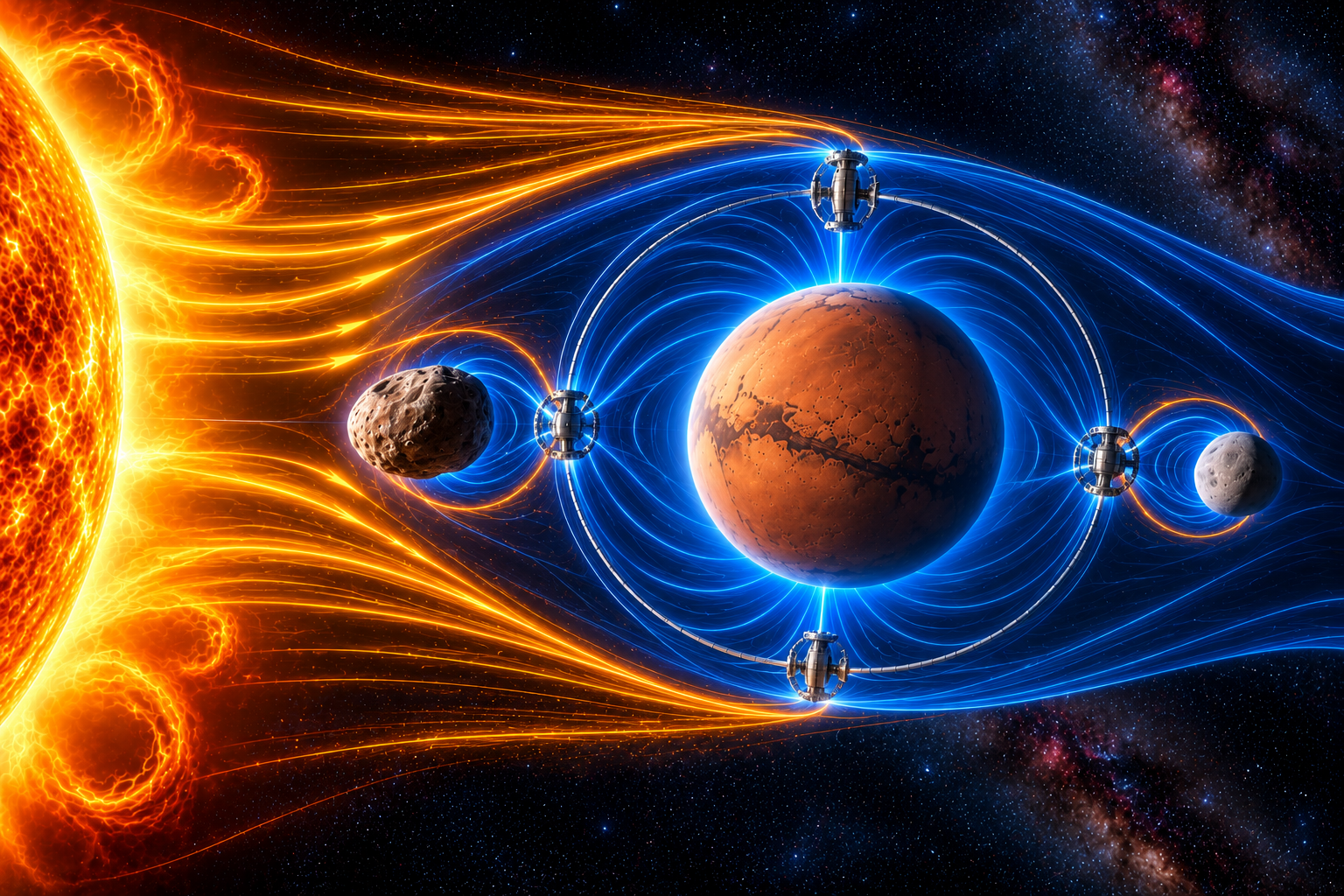
2. Magnetic Shielding Using Phobos and Deimos
The second approach examines whether Mars's two natural moons could serve as locations for electromagnetic systems, supplemented by additional satellites forming a larger protective configuration. The attraction is geometric: both moons orbit far closer to Mars than the Mars–Sun L1 zone, which lies at roughly 320 Mars radii from the planet, so a given field strength would exert its influence nearer to where it is needed. The authors accordingly identify this option as potentially preferable to the L1 configuration, regarding it at the conceptual level as perhaps the most cost-effective and viable route because it draws on two resources already in place.
Two qualifications belong with that assessment. The proposal remains preliminary, and establishing feasibility would require detailed electromagnetic modelling, engineering design, power analysis, and operational demonstration. The paper also notes that Phobos's orbit is modestly unstable and decaying at roughly two metres per year — a design consideration the authors judge minor rather than disqualifying.
3. Magnetic Shielding at Mars–Sun L1
The third approach revisits the concept of positioning field generators near the Mars–Sun L1 region, building on earlier proposals of this kind. A field established there would create a magnetotail extending towards Mars, diverting part of the incoming solar wind before it reaches the planet — functionally analogous to the bow shock that Earth's magnetosphere produces upstream of our own planet. Because the system would intercept the solar wind well ahead of Mars, it could in principle protect the planet as a whole rather than a single site.
The engineering consequences follow from the same distance that gives the approach its reach. The paper observes that L1 is not a true fixed point but a relatively stable zone, since the two-body Lagrange solution assumes circular orbits; a constellation of satellites would therefore be needed to maintain position. Greater distance from Mars also implies larger structures and stronger fields than a moon-hosted system would require. The paper discusses possible satellite configurations and inflatable structures while acknowledging substantial challenges in constructing and maintaining such an arrangement over the long term.
Taken together, the three options map a design space rather than nominate a solution. The paper presents them as candidates for a long-horizon programme, arguing that until a specific effort is approved and funded, proceeding to a full terraforming project would be premature. It extends the argument to Earth as well, judging terrestrial shielding to be the harder problem: Earth sits closer to the Sun and presents a larger target, with no obvious deployment location, since both the Earth–Sun L1 region at roughly 1.6 million kilometres and the Moon at roughly 385,000 kilometres lie too distant for an effective artificial shield.
🔍 Click image to enlarge
Could Magnetic Shielding Help Preserve Mars's Atmosphere?
Mars loses atmosphere today largely because the solar wind interacts directly with its upper atmosphere, with no global magnetic field to divert it. Artificial magnetic shielding — for example, a field generated at the L1 Lagrange point — is one proposed way to reduce some of these escape processes, notably ion pickup, in which the solar wind strips away charged particles.
If such shielding worked as intended, its value would lie mainly in supporting a broader atmospheric engineering effort: retaining gas is a precondition for any strategy that aims to build up atmospheric pressure in the first place.
Two further considerations shape how much a magnetic shield alone could accomplish. The first is that retention and supply are separate problems. Holding on to an atmosphere is not the same as having enough volatiles available to build a thicker one, and how much accessible CO₂ and other gas Mars actually holds remains a subject of ongoing research. The second is that a magnetic field acts on the charged-particle environment specifically. It would not generate breathable oxygen, raise surface temperatures, or screen out ultraviolet light and most galactic cosmic rays — each of which would call for separate measures, such as greenhouse warming, surface radiation shielding, or a photosynthetic biosphere.
Seen this way, magnetic shielding functions as one potential component of planetary environmental engineering: a contribution to habitability rather than a standalone path to a terraformed Mars.
🔍 Click image to enlarge
Potential Applications Beyond Mars
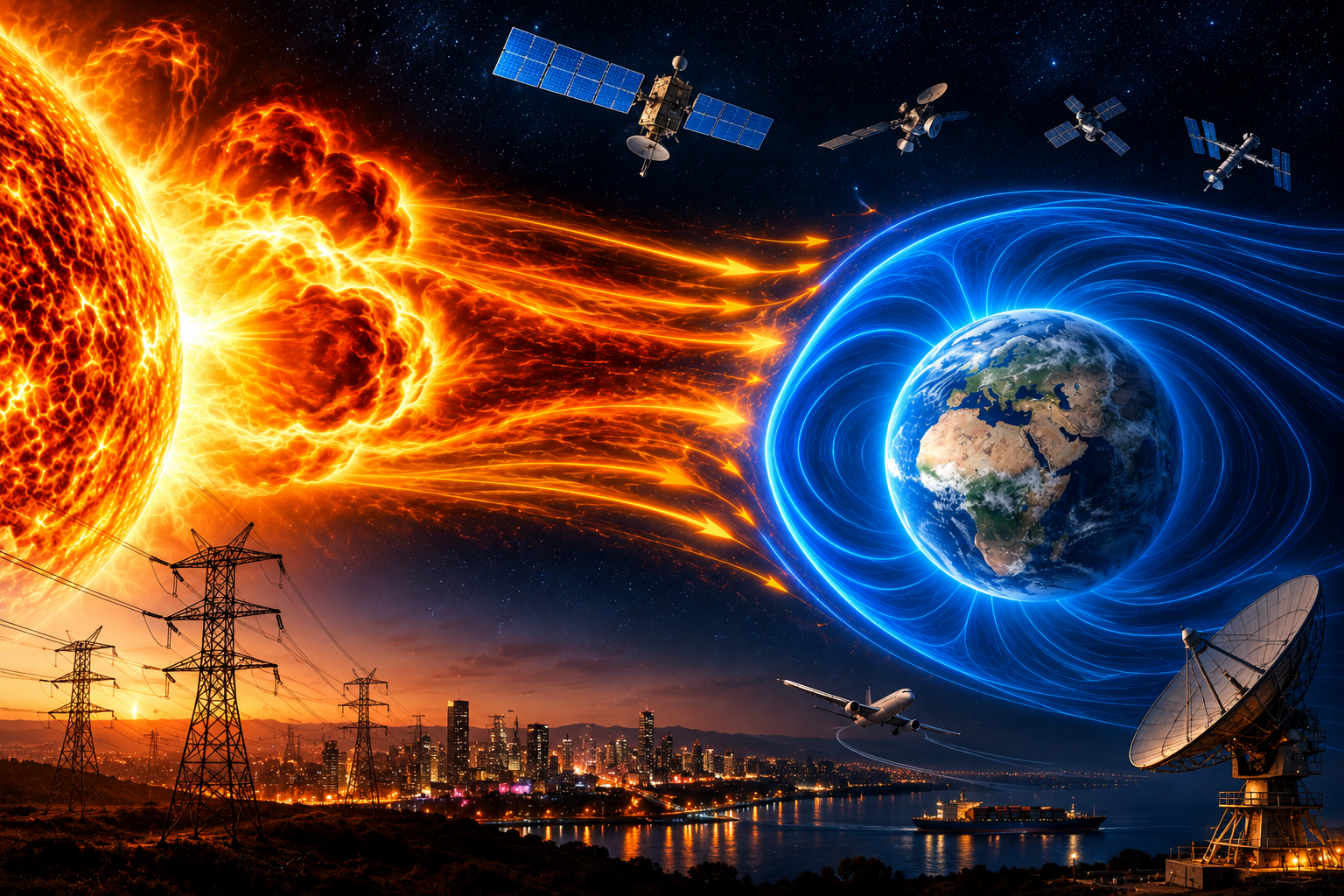
Pelton and Green also explore whether artificial magnetic protection could eventually contribute to safeguarding Earth against severe space-weather events.
Geomagnetic storms can induce currents that stress power grids, disrupt satellite operations, affect navigation systems, and interrupt communications infrastructure. These vulnerabilities are well-documented from past extreme solar events, such as the Carrington Event of 1859, which serves as a historical benchmark for worst-case scenarios.
Research into planetary-scale magnetic shielding offers one theoretical approach to mitigating these effects. No system at this scale has yet been demonstrated, however, and several practical considerations emerge when comparing the two contexts.
Earth differs fundamentally from Mars in that it already possesses a substantial natural magnetosphere, which shields the planet from most routine solar-wind interaction. Protecting technological infrastructure against extreme geomagnetic disturbances therefore involves addressing residual vulnerabilities within that existing shield — challenges such as rapid induction events and ground-level electrical surges — rather than replacing a planetary defense entirely, as might be contemplated for atmospheric retention on Mars.
From this perspective, artificial magnetic shielding for Earth represents a different class of engineering problem, one oriented toward risk mitigation for specific systems rather than wholesale planetary protection. Each application thus opens distinct research questions suited to its context.
🔍 Click image to enlarge
Scientific Assessment
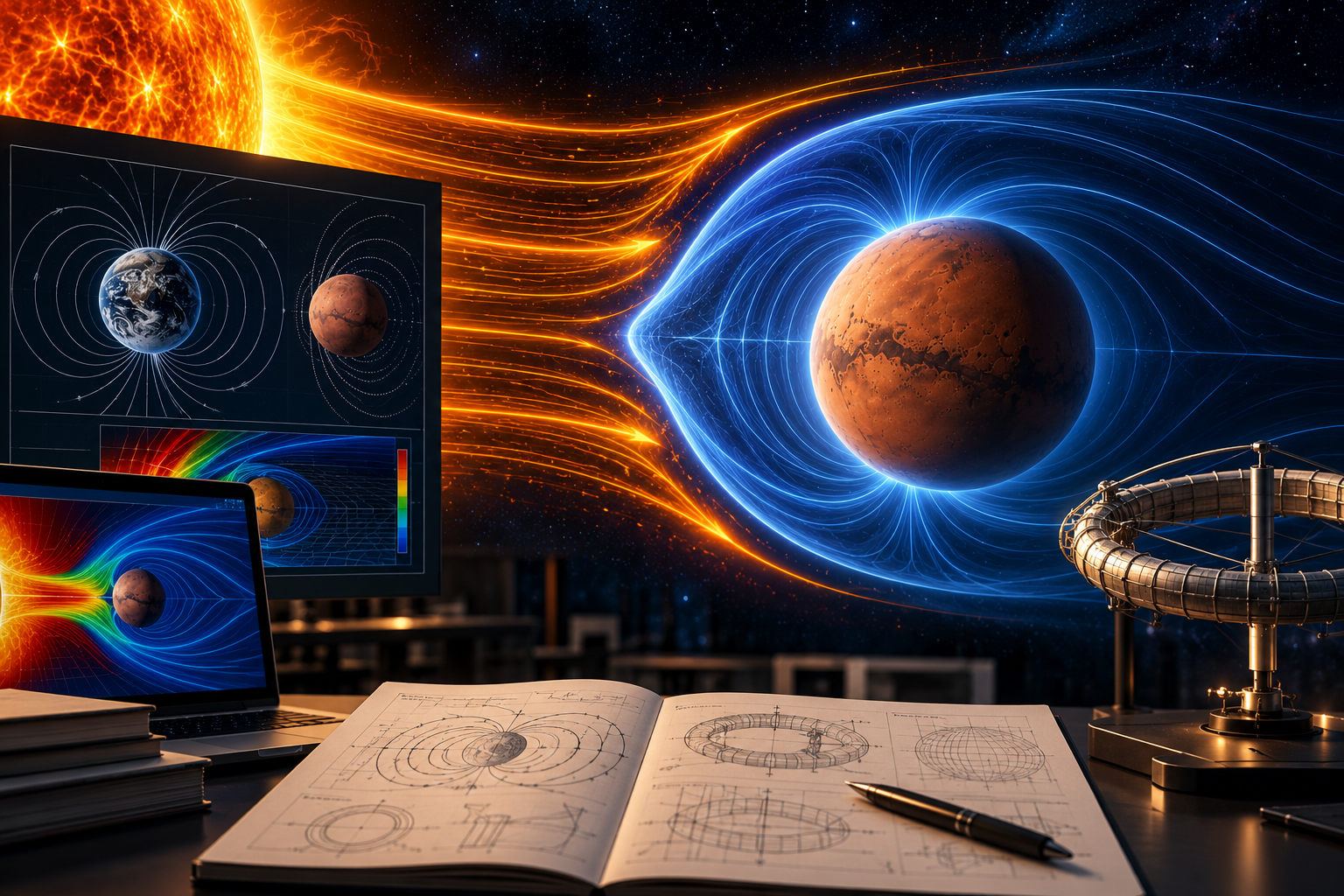
Artificial planetary magnetic shielding rests on established electromagnetic physics. The interaction between magnetic fields and charged particles is well characterised: a moving charge experiences a Lorentz force perpendicular to both its velocity and the field, which is the principle behind deflecting solar-wind ions away from a planet's upper atmosphere.
Numerical modelling has explored how such deflection would play out at planetary scales, and these simulations indicate potentially useful reductions in atmospheric escape. Model results are suggestive rather than conclusive, however, since they rest on assumptions about field geometry, solar-wind conditions, and plasma behaviour that cannot yet be checked against a working system.
That gap between simulation and hardware defines the current state of the field. Proposed planetary-scale systems remain unbuilt and untested, so practical viability turns on a set of coupled engineering questions: how strong a field would be needed, how much power sustaining it would demand, what physical dimensions the generating apparatus would require, how it could be deployed, whether it would remain stable under real solar-wind conditions, and what long-term maintenance it would entail. These questions interact — raising field strength, for instance, tends to raise power and structural demands as well.
Within this framing, the research contributes in two directions. It helps identify candidate methods for protecting planetary environments and supporting future human exploration, and it clarifies the engineering requirements that would need to be resolved before any such method could be assessed as feasible. Establishing those requirements is itself a substantive result, independent of whether a given design is ever built.