

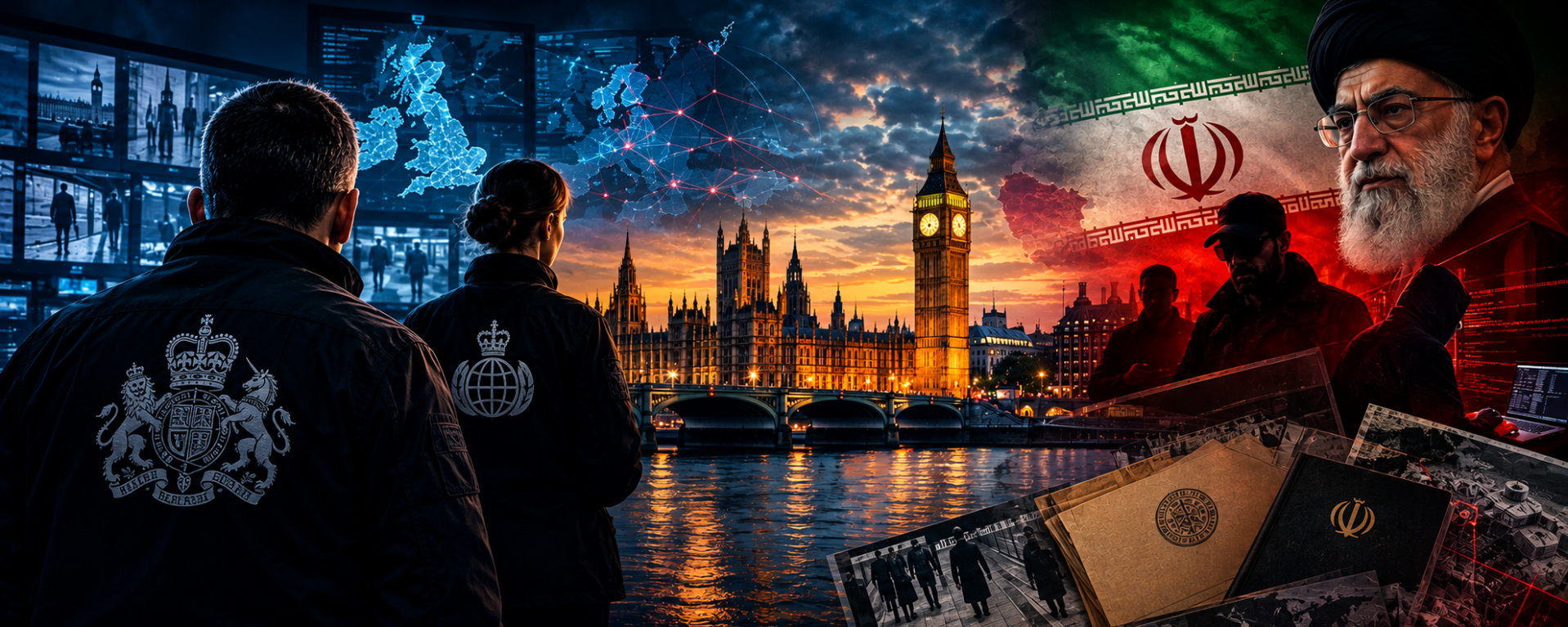
Iranian Intelligence & Covert Operations in Britain
Espionage, Political Repression & National Security
Iranian intelligence operations have become an increasingly serious concern for British national security, involving alleged assassination and kidnapping plots, surveillance, intimidation, cyber espionage and threats against individuals living in the United Kingdom.
Unlike conventional espionage, which primarily involves obtaining confidential information, some activities attributed to Iranian state organisations have involved potential physical violence against journalists, political dissidents and other individuals regarded as opponents of the Iranian government.
British intelligence assessments identify Iran's Ministry of Intelligence and Security (MOIS) and the Islamic Revolutionary Guard Corps (IRGC) as central organisations involved in these threats.
An Escalating Threat to Britain
Iranian intelligence activity affecting Britain has intensified since 2022, particularly following protests in Iran after the death of Mahsa Amini.
British authorities have identified attempts to intimidate or silence Iranian dissidents and independent Persian-language media organisations operating from the United Kingdom.
In October 2025, MI5 reported tracking more than 20 potentially lethal Iran-backed plots during the preceding year.
These figures represent intelligence assessments of plots and potential threats, not confirmed completed attacks or criminal convictions in every case.
Journalists, Dissidents and Transnational Repression
London-based Persian-language broadcasters, including Iran International and BBC Persian, have reported threats against journalists and their families.
British authorities have investigated suspected surveillance and preparations for attacks against individuals associated with these organisations.
Such activities form part of a wider phenomenon known as transnational repression, in which governments attempt to intimidate or silence critics beyond their national borders.
The threat also extends beyond Iranian opposition figures. British intelligence assessments have identified risks affecting Jewish and Israeli individuals and institutions.
Developments During 2025–2026
In March 2025, the British government announced additional measures against Iranian state threats, including placing Iran on the enhanced tier of the Foreign Influence Registration Scheme.
During 2026, British authorities introduced further sanctions and strengthened legislation intended to disrupt hostile foreign intelligence activities.
In July 2026, the government publicly attributed a series of attacks against Jewish and Israeli-linked targets in Britain and Europe to a criminal network it assessed was directed by members of Iran's IRGC Quds Force.
These conclusions were official government intelligence assessments and should be distinguished from individual criminal convictions.
Further investigations and prosecutions during 2026 have demonstrated the continuing importance of counter-intelligence cooperation between MI5, police and international security partners.
Britain's National Security Response
Britain has strengthened its legal and intelligence response through the National Security Act 2023, the Foreign Influence Registration Scheme and the National Security (State Threats) Act 2026.
The government's approach includes intelligence investigations, protective security measures, sanctions, criminal prosecutions and cooperation with European and other international partners.
However, the effectiveness of these measures remains an important question for parliamentary scrutiny and independent oversight.
Scope of This Investigation
This investigation examines Iranian intelligence and covert activities affecting Britain, concentrating on developments between 2020 and 2026 while including relevant historical background.
It considers the findings of British intelligence agencies, parliamentary investigations, criminal proceedings and government assessments.
Particular attention is given to distinguishing documented incidents, official intelligence conclusions, criminal allegations and unresolved questions.
The objective is to understand how Iranian state-linked activities affect Britain's national security, democratic freedoms, sovereignty and the protection of individuals living within the United Kingdom.
The 2025 Iran Report — What British Intelligence Found
On 10 July 2025, Parliament's Intelligence and Security Committee published its investigation into the Iranian state's intelligence activities and threats to British national security.
The inquiry examined evidence from MI5, MI6, GCHQ, government departments and other national security organisations.
Its findings identified Iran as a persistent, unpredictable and wide-ranging security threat, although one operating on a smaller scale and with a less developed strategic approach than Russia or China.
The Committee concluded that Iran's principal objective was the survival and security of its political system. This influenced its intelligence priorities, international operations and treatment of perceived opponents.
Assassination and Kidnapping Threats
One of the report's most significant findings concerned the physical danger posed to individuals living in Britain.
The Committee identified assassination, kidnapping and forced repatriation as methods associated with Iranian intelligence operations overseas.
It reported that British authorities had responded to at least 15 attempted murder or kidnapping plots against British nationals or UK-based individuals since the beginning of 2022, according to the evidence available during the inquiry.
The report described the physical threat to individuals in Britain as the most serious immediate threat posed by Iran.
Its findings also indicated that Iranian intelligence organisations could employ third parties to conduct operations, reducing the direct visibility of state involvement.
These were intelligence findings concerning attempted or suspected operations, not evidence that every identified plot resulted in an attack or criminal conviction.
Iranian Intelligence Organisations
The investigation identified two principal organisations involved in Iranian intelligence activities.
The Ministry of Intelligence and Security (MOIS) is Iran's civilian intelligence organisation, responsible for intelligence collection, counter-intelligence and activities associated with protecting the Iranian state.
The Islamic Revolutionary Guard Corps (IRGC) is a military and security organisation with extensive domestic and international responsibilities. Its intelligence structures and Quds Force have been associated with operations beyond Iran's borders.
The Committee found that both organisations prioritised identifying and monitoring perceived opponents of the Iranian government.
Although their structures and responsibilities differ, both were assessed as contributing to threats affecting British national security.
Journalists, Dissidents and Political Opponents
The report identified Iranian dissidents and critics living in Britain as principal targets of Iranian intelligence activity.
This included individuals involved in opposition politics, journalism and public criticism of the Iranian government.
The Committee assessed that Iranian authorities regarded the monitoring and suppression of overseas opposition as part of protecting the political system.
It also identified an increased threat to Jewish and Israeli interests within Britain.
The findings demonstrate that the threat extended beyond conventional intelligence gathering to activities potentially endangering individuals exercising their rights within the United Kingdom.
Organised Crime and Third-Party Operatives
The Committee examined the use of criminal intermediaries and other third parties to support hostile intelligence activities.
Such arrangements can allow intelligence organisations to distance themselves from operational planning and reduce the likelihood that direct state involvement will be immediately apparent.
They also create difficulties for investigators seeking to establish responsibility, particularly where surveillance, recruitment, financing and operational activity involve different individuals or organisations.
The report warned that the use of intermediaries could complicate Britain's ability to prevent attacks and bring those responsible to justice.
However, the involvement of a criminal intermediary in a particular incident does not independently establish Iranian state direction. Attribution requires supporting intelligence or evidence.
Cyber Espionage and Intelligence Collection
The Committee also identified Iran as a significant cyber espionage threat.
Iranian intelligence activity was assessed as targeting government information, strategically important industries, defence-related knowledge and individuals associated with opposition to the Iranian government.
Cyber operations could support conventional espionage by obtaining confidential information, identifying individuals and collecting material useful for surveillance or future targeting.
The Committee assessed Iran's cyber capabilities as generally less sophisticated than those of Russia and China, while recognising that opportunistic and comparatively simple techniques could still be effective.
This demonstrates that the seriousness of an intelligence threat depends not only on technical sophistication but also on intent, targeting and the potential consequences of an operation.
British Interests in the Middle East
The investigation also examined threats affecting British personnel and interests beyond the United Kingdom.
Iran's regional military capabilities, aligned armed organisations, cyber operations and maritime activities were identified as potential risks to British security and commercial interests.
The Committee considered the possibility of British personnel being affected by attacks primarily directed against American or other allied forces.
These concerns illustrate the connection between Iranian intelligence activity in Britain and wider geopolitical developments involving the Middle East.
Weaknesses in Britain's Response
Although the Committee recognised the work undertaken by British intelligence agencies and police, it identified weaknesses in the government's wider strategic response.
Concerns included insufficient coordination across government, the need for greater specialist expertise and difficulties addressing threats that crossed the boundaries between espionage, organised crime and foreign interference.
The Committee also questioned whether the government had developed a sufficiently comprehensive approach to the Iranian threat.
Its recommendations emphasised stronger coordination, clearer responsibilities and effective use of intelligence and law enforcement capabilities.
The Government's Response
On 4 September 2025, the British government published its formal response to the Committee's findings.
The government acknowledged Iran as a core national security priority and highlighted measures including sanctions, intelligence investigations, protective security arrangements and the Foreign Influence Registration Scheme.
It also stated that British police and intelligence agencies had successfully disrupted potentially lethal Iranian-backed plots.
The government accepted the seriousness of the threat while disputing or qualifying aspects of the Committee's criticism of its response.
Why the Iran Report Matters
The 2025 Iran Report provides an important parliamentary assessment of Iranian intelligence operations affecting Britain.
Its most significant finding was the scale of the physical threat directed against individuals living in the United Kingdom, particularly dissidents and other perceived opponents of the Iranian government.
The report also demonstrated how espionage, cyber operations, criminal intermediaries and transnational repression can overlap.
Its findings establish the historical basis for examining subsequent incidents and government measures during 2024–2026.
As with all intelligence reporting, the Committee's assessments must be distinguished from criminal convictions, independently verified incidents and allegations that remain unresolved.
Iranian Assassination Plots, Surveillance & Threats Against Journalists in Britain (2022–2026)
Iranian state-linked threats against individuals living in Britain have become a major concern for British intelligence and counter-terrorism authorities.
Unlike traditional espionage, which focuses primarily on gathering confidential information, these threats have included suspected preparations for kidnapping, assassination, physical attacks and intimidation.
Journalists, political dissidents and critics of the Iranian government have been particularly vulnerable.
Threats Against Journalists — 2022
In November 2022, the Metropolitan Police warned journalists working for London-based broadcaster Iran International that credible threats had been identified against their lives.
The warnings followed widespread protests in Iran after the death of Mahsa Amini and intensified pressure on independent Persian-language media.
On 11 November 2022, the British Foreign Office summoned Iran's senior diplomatic representative to protest against threats directed at journalists living in the United Kingdom.
The government made clear that intimidation and threats against journalists on British territory were unacceptable.
These developments demonstrated that the security of individuals exercising freedom of expression in Britain had become an international intelligence concern.
Iran International Temporarily Leaves London — 2023
In February 2023, Iran International announced that it was temporarily relocating its broadcasting operations from London to Washington because of serious security concerns.
The decision followed advice from British police concerning threats against its staff and the wider public.
At the time, counter-terrorism police disclosed that British authorities had responded to 15 plots involving threats to kill or kidnap British nationals or individuals based in the United Kingdom since the beginning of 2022.
The broadcaster's relocation illustrated the practical consequences of transnational repression: threats originating overseas could interfere with journalism and freedom of expression within Britain.
The Stabbing of Pouria Zeraati — March 2024
On 29 March 2024, Iran International journalist Pouria Zeraati was stabbed outside his home in Wimbledon, south-west London.
The attack involved several individuals and followed a period of surveillance and preparation.
Zeraati survived but required hospital treatment for his injuries.
British counter-terrorism police investigated the incident because of the victim's occupation and previous threats against journalists associated with Iran International.
Investigators subsequently identified suspects who had travelled internationally in connection with the attack.
Criminal Convictions — June 2026
On 5 June 2026, two men, Nandito Badea and George Stana, were convicted for their involvement in the attack on Zeraati.
The prosecution presented evidence that the assault had been deliberately planned, coordinated and funded, with surveillance undertaken before the stabbing.
Prosecutors described the incident as a proxy operation linked to the Iranian state.
The convictions established the defendants' criminal responsibility for the attack. The prosecution's attribution of the operation to Iranian state interests should be distinguished from a separate criminal conviction of an Iranian official for ordering it.
Iranian representatives denied involvement.
The case nevertheless demonstrated how criminal intermediaries could be used to carry out targeted violence against individuals living in Britain.
Alleged Surveillance of Journalists — 2024–2026
In May 2025, British police charged three Iranian nationals under the National Security Act 2023 following an investigation into suspected intelligence activity.
Mostafa Sepahvand, Farhad Javadi Manesh and Shapoor Qalehali Khani Noori were accused of conducting surveillance and reconnaissance associated with individuals working for Iran International.
Prosecutors alleged that the activities were intended to assist an Iranian foreign intelligence service and prepare for serious violence against at least one target.
The trial began in October 2026.
Evidence presented by prosecutors included alleged surveillance activities, communications and discussions about financial payments.
All three defendants denied the charges.
As of 14 October 2026, the proceedings were ongoing. The allegations must therefore not be presented as proven criminal offences.
Criminal Intermediaries and Plausible Deniability
A recurring concern identified by British intelligence agencies is the suspected use of criminal organisations or intermediaries to conduct operations on behalf of foreign intelligence services.
Such arrangements may involve surveillance, recruitment, financing, intimidation or physical violence.
They can make it more difficult for investigators to establish the relationship between those carrying out an operation and any foreign state directing or supporting it.
The Zeraati prosecution demonstrated the use of a coordinated group in a targeted attack, while wider intelligence assessments have warned about Iranian state-linked reliance on criminal proxies.
However, each case requires its own evidence. Similar methods do not automatically prove that separate incidents share the same organisers or state sponsors.
Continuing Threats During 2026
The threat has continued to evolve beyond journalists and political dissidents.
In October 2026, British authorities reported concerns about suspected Iranian intelligence activities affecting diplomatic, Jewish and Israeli-linked locations, alongside wider national security interests.
On 9 October, two men pleaded not guilty to allegations involving hostile surveillance of the Israeli Embassy and other locations in London.
Separately, British officials attributed a suspected threat involving RAF Fairford to Iran's Islamic Revolutionary Guard Corps, while the criminal investigation remained unresolved.
These developments illustrate the importance of distinguishing official intelligence assessments from evidence tested in court.
Implications for British National Security
The documented threats and criminal proceedings demonstrate that foreign intelligence activity can endanger individuals within Britain without involving conventional military operations.
Targeted surveillance, intimidation and violence can undermine freedom of expression, personal security and the independence of British institutions.
The 2026 convictions arising from the attack on Pouria Zeraati provide direct judicial evidence of a planned assault against a journalist.
Other cases remain subject to criminal proceedings or intelligence assessment.
For Britain, the central challenge is to prevent hostile foreign operations, protect threatened individuals and ensure that those responsible are investigated and prosecuted through established legal processes.
The protection of journalists, dissidents and other residents from foreign-directed intimidation is therefore both a national security responsibility and a fundamental question of democratic rights.
Iranian Cyber Espionage, Covert Networks & Threats to British Infrastructure (2022–2026)
Iranian state-linked cyber operations form an important part of the wider intelligence threat affecting Britain, combining information gathering, online surveillance, credential theft and potential disruption of strategically important systems.
British authorities have identified Iranian cyber actors targeting individuals and organisations connected to government, defence, academia, journalism and international affairs.
Although Iranian capabilities are generally assessed as less sophisticated than those of some other major state actors, relatively simple methods can still compromise sensitive information and create serious security risks.
Iranian Cyber Operations and the IRGC — 2022
In September 2022, Britain's National Cyber Security Centre (NCSC), working with international partners, published an advisory concerning cyber actors affiliated with Iran's Islamic Revolutionary Guard Corps (IRGC).
The advisory identified the exploitation of known software vulnerabilities, including weaknesses in internet-facing systems, to gain unauthorised access to computer networks.
The activity included ransomware operations and targeting across multiple sectors, including organisations responsible for critical infrastructure.
The findings demonstrated that Iranian state-linked cyber activity extended beyond conventional intelligence gathering to operations capable of disrupting commercial and public services.
However, identifying a vulnerability or attempted intrusion does not necessarily establish that a particular organisation was successfully compromised.
Targeted Cyber Espionage Against British Individuals — 2023
In January 2023, the NCSC warned about targeted phishing campaigns conducted by the Iran-based group TA453, also known as APT42 or Charming Kitten.
The campaigns targeted individuals and organisations in Britain and internationally, including politicians, journalists, academics, defence specialists, think tanks and human rights activists.
Attackers used impersonation, fraudulent correspondence and malicious links designed to obtain access to email accounts and other sensitive information.
Some approaches involved apparently legitimate invitations to conferences, professional discussions or online meetings.
The NCSC identified these activities as intelligence-gathering operations rather than indiscriminate attacks against the general public.
The advisory also examined a separate Russian phishing campaign, but did not establish that the Russian and Iranian groups were collaborating.
IRGC-Linked Phishing Operations — September 2024
On 27 September 2024, the NCSC and American security agencies issued a joint warning about cyber actors operating on behalf of Iran's IRGC.
The advisory described attempts to compromise the personal and professional accounts of individuals involved in Iranian and Middle Eastern affairs.
Targets included government officials, journalists, political advisers, researchers and activists.
Attackers frequently impersonated trusted contacts and used deceptive login pages to obtain account credentials.
Compromised accounts could provide access to private correspondence, confidential documents and information about an individual's professional relationships.
Such intelligence could potentially support further surveillance or targeting, although the existence of a cyber intrusion does not by itself establish that a subsequent physical operation occurred.
Industrial Control Systems and Critical Infrastructure
Iranian cyber capabilities have also raised concerns about industrial control systems used in energy, manufacturing, utilities and other infrastructure.
These systems control or monitor physical equipment, meaning that a successful intrusion could have consequences beyond the loss of digital information.
In its 2024 annual review, the NCSC identified Iranian actors as increasingly willing to target industrial control systems and potentially pursue disruptive or destructive objectives.
A May 2025 parliamentary answer confirmed that the British government considered Iranian cyber actors capable of targeting UK infrastructure and citizens.
These assessments establish a credible security concern, but they do not demonstrate that Iran had successfully disabled Britain's electricity, water or transport systems.
The distinction between capability, intent, attempted intrusion and confirmed damage remains essential.
The Middle East Conflict and British Cybersecurity — 2025–2026
During 2025, the NCSC assessed that Iranian cyber operations were increasingly connected to the wider Middle East conflict.
Its annual review warned that threats affecting American critical infrastructure could also extend to British organisations.
In June 2026, the NCSC issued further guidance following developments in the Middle East.
The agency assessed that there was probably no significant immediate increase in the direct Iranian cyber threat to Britain at that time.
However, it warned of heightened indirect risks to organisations operating in the Middle East or dependent upon regional supply chains.
These included possible activity by Iran-linked hacktivists, distributed denial-of-service attacks, phishing campaigns and attempts to exploit industrial systems.
The NCSC advised British organisations to review their security arrangements and prepare for potential changes in the threat environment.
Covert Networks and Digital Intelligence Gathering
Cyber espionage can support wider intelligence operations by identifying individuals, collecting communications and revealing professional or personal relationships.
Access to email accounts, contact lists, cloud storage and online communications may help an intelligence organisation understand a target's movements, associations and activities.
Iranian intelligence organisations have also been accused of using criminal intermediaries and other covert networks for physical surveillance, intimidation and attacks.
Digital information could potentially assist such operations.
Nevertheless, the use of cyber intelligence in a particular physical attack must be established through evidence. The existence of Iranian phishing campaigns and separate suspected assassination plots does not prove that the same systems or operatives were involved.
New Security Concerns — October 2026
In his annual threat assessment on 13 October 2026, MI5 Director General Ken McCallum warned that Iranian state-linked operations were expanding beyond their traditional focus on dissidents and journalists.
The assessment identified growing concerns about military installations and other strategically important targets in Britain.
The suspected threat involving RAF Fairford illustrated the potential for covert surveillance and physical security risks affecting military facilities.
British authorities attributed responsibility to the IRGC with a high degree of confidence, while Iran denied involvement.
The investigation had not established a completed attack on the installation.
These developments concerned physical and covert security threats rather than confirmed Iranian cyberattacks against the base.
Implications for British National Security
The evidence demonstrates that Iranian state-linked cyber actors possess established capabilities for intelligence collection, credential theft, network intrusion and operations that may threaten critical infrastructure.
Official British assessments also identify the potential for more disruptive activity.
However, the available public evidence does not justify claims that Iranian intelligence has achieved unrestricted access to British infrastructure or demonstrated the ability to disable major national systems at will.
Britain's response therefore requires proportionate cybersecurity protections, cooperation between intelligence agencies and infrastructure operators, and careful investigation of suspected incidents.
The central challenge is to recognise documented capabilities and credible threats without presenting hypothetical consequences as established events.
Britain's Response to Iranian Intelligence Threats (2023–2026)
The United Kingdom has progressively strengthened its response to Iranian intelligence operations through national security legislation, financial sanctions, counter-intelligence investigations and measures to protect individuals facing threats.
These developments reflect a growing recognition that hostile state activity can involve espionage, cyber operations, criminal intermediaries and physical violence, requiring cooperation across intelligence agencies, police and government departments.
The National Security Act 2023
The National Security Act 2023 modernised Britain's legal framework for responding to espionage and foreign interference.
It introduced offences addressing activities undertaken for foreign powers, including certain forms of obtaining protected information, assisting foreign intelligence services and foreign interference.
The legislation provides police and prosecutors with powers designed to address contemporary intelligence threats, including activities involving intermediaries and covert networks.
Its importance lies partly in allowing investigators to examine foreign-state involvement rather than treating every incident solely as an ordinary criminal offence.
Nevertheless, charges under the Act remain allegations until established through criminal proceedings.
Foreign Influence Registration Scheme — 2025
On 1 July 2025, Britain introduced the Foreign Influence Registration Scheme (FIRS), established under the National Security Act 2023.
The scheme requires registration of certain activities directed by foreign powers, with more extensive obligations applying to designated foreign states and organisations.
Iran was placed on the scheme's enhanced tier alongside Russia.
The designation covers specified Iranian state bodies, including government ministries, intelligence organisations and the Islamic Revolutionary Guard Corps.
The enhanced tier is intended to increase transparency and help British authorities identify foreign-directed activities that could affect national security.
Failure to register qualifying arrangements can constitute a criminal offence, with penalties of up to five years' imprisonment under the enhanced tier.
However, the scheme does not prohibit all activities involving Iranian organisations. Legitimate activity may continue where applicable legal requirements are satisfied.
Registration should not be interpreted as proof of espionage or wrongdoing.
Sanctions Against Iranian State-Linked Organisations
Britain has also used financial sanctions to restrict individuals and organisations associated with hostile Iranian activities.
Sanctions may include asset freezes, travel restrictions and prohibitions on providing funds or economic resources to designated persons.
On 11 May 2026, the British government announced further sanctions targeting individuals and organisations it identified as enabling Iranian threats to international and British security.
The measures were intended to disrupt hostile activity, including the use of criminal networks to threaten individuals overseas.
Sanctions can impose practical financial and operational restrictions without requiring a prior criminal conviction.
They nevertheless represent government designations subject to the applicable legal framework, rather than judicial findings that every allegation has been proven.
New State Threats Legislation — 2026
The National Security (State Threats) Act 2026 expanded Britain's ability to respond to hostile activities conducted by foreign state organisations and their proxies.
The legislation followed recommendations from Jonathan Hall KC, the Independent Reviewer of State Threats Legislation.
His review identified the need for powers comparable in some respects to the proscription framework used in counter-terrorism law, but specifically designed for state threats.
The new framework was intended to address organisations involved in hostile state activity and strengthen the government's ability to disrupt their operations.
Its introduction reflected the limitations of relying exclusively on criminal prosecutions, financial sanctions and intelligence investigations.
However, the existence of new legal powers does not establish that every suspected organisation or individual has committed an offence.
Protecting Journalists and Political Dissidents
British police and intelligence agencies have increased protective measures for individuals facing credible threats associated with Iranian state activity.
These have included threat assessments, police investigations, security advice and cooperation with organisations whose staff have been targeted.
Persian-language journalists and Iranian political dissidents have been particularly prominent in public reporting concerning these risks.
Protecting threatened individuals involves balancing intelligence confidentiality, effective police action and the rights of those affected.
The objective is not only to prevent violence but also to ensure that foreign-directed intimidation does not undermine freedom of expression within Britain.
Intelligence Cooperation With European Partners
Iranian intelligence threats are not confined to the United Kingdom.
European governments have investigated suspected operations involving surveillance, intimidation, cyber activity and attacks against dissidents or other targeted communities.
Cooperation between British and European authorities can assist in identifying individuals travelling between countries, tracing financial arrangements and investigating networks operating across national borders.
Britain also works with its Five Eyes intelligence partners on cyber threats and other hostile state activities.
Such cooperation is particularly important where suspected operations involve individuals, communications or financial transactions in multiple jurisdictions.
Developments in October 2026
On 13 October 2026, MI5 Director General Ken McCallum warned that Iranian state-linked threats were evolving beyond the targeting of dissidents and journalists.
His assessment highlighted suspected operations involving military facilities and other strategically important targets, including concerns surrounding RAF Fairford.
MI5 also identified the continuing use of criminal intermediaries in activities attributed to Iranian state organisations.
These warnings illustrate why Britain has increasingly treated Iranian intelligence activity as a wider national security concern rather than solely a threat to particular individuals.
However, the allegations surrounding specific suspected operations must remain distinguished from criminal convictions and independently established events.
Effectiveness and Democratic Accountability
The expansion of Britain's national security framework raises important questions about effectiveness, proportionality and independent oversight.
Legislation, sanctions and intelligence investigations can improve the ability to identify and disrupt hostile activities, but their success cannot be measured solely by the number of powers introduced.
Parliamentary scrutiny, independent legal review and transparent reporting remain important safeguards.
Authorities must also distinguish hostile intelligence activity from lawful journalism, political opposition, academic research and legitimate international relationships.
Britain's response must therefore protect national security without unnecessarily restricting democratic freedoms.
Overall Significance
Between 2023 and 2026, Britain introduced a more comprehensive framework for countering Iranian intelligence threats.
The National Security Act, Foreign Influence Registration Scheme, sanctions and additional state-threat powers provide different mechanisms for identifying, investigating and disrupting hostile activity.
The continuing challenge is ensuring that these measures are effective against covert networks and physical threats while remaining proportionate, evidence-based and subject to democratic accountability.
Overall Assessment & Future Developments
What the Evidence Establishes
British parliamentary investigations, intelligence assessments and criminal proceedings demonstrate that Iranian state-linked activities represent a serious national security concern for the United Kingdom.
The evidence includes threats against journalists and political dissidents, suspected assassination and kidnapping plots, cyber espionage, covert surveillance and the use of criminal intermediaries.
The Intelligence and Security Committee's 2025 Iran Report identified the physical threat to individuals living in Britain as particularly significant.
However, the available evidence must be interpreted carefully. Intelligence assessments, government attributions, criminal allegations and court convictions carry different evidential weight.
Not every suspected operation has resulted in a prosecution, and not every allegation of Iranian state involvement has been independently established in court.
An Evolving National Security Threat
Developments between 2022 and 2026 indicate that Iranian intelligence-related threats have extended beyond traditional information gathering.
The targeting of journalists, dissidents and other individuals raises concerns about foreign-directed intimidation and the protection of fundamental freedoms within Britain.
Recent British intelligence warnings have also identified potential risks affecting military facilities, diplomatic interests and strategically important infrastructure.
These developments suggest a broader security challenge involving both physical and digital operations.
Nevertheless, the identification of a credible threat does not establish that an attack has occurred or that a suspected operation has achieved its intended objective.
Britain's Response and Remaining Challenges
Britain has strengthened its counter-intelligence framework through the National Security Act 2023, the Foreign Influence Registration Scheme, sanctions and additional protective security measures.
These mechanisms provide different ways to investigate, disrupt and deter hostile foreign activity.
Their effectiveness will depend on intelligence coordination, police resources, international cooperation and the ability to identify individuals acting through covert or criminal networks.
Parliamentary scrutiny and independent legal oversight remain essential to ensuring that national security measures are proportionate and consistent with democratic rights.
Future Developments to Monitor
Criminal investigations and prosecutions: The outcomes of ongoing espionage and surveillance cases will be important in establishing which allegations can be proven through criminal proceedings.
Threats against journalists and dissidents: Further intelligence warnings and protective measures will help indicate whether foreign-directed intimidation is increasing or being successfully disrupted.
Cybersecurity and critical infrastructure: Iranian cyber capabilities warrant continued attention, particularly where government systems, defence organisations and essential services may be targeted.
Military and diplomatic security: Investigations concerning suspected surveillance of military installations and diplomatic locations will require careful assessment as further evidence emerges.
International intelligence cooperation: British collaboration with European and Five Eyes partners will remain important in identifying networks operating across national borders.
Government accountability: Parliament will need to examine whether legislation, sanctions and intelligence measures are producing demonstrable improvements in national security.
Final Assessment
Iranian state-linked intelligence activities present a documented and continuing challenge to Britain's national security, particularly through threats against individuals, covert surveillance, cyber espionage and suspected operations involving criminal intermediaries.
The available evidence supports serious concern and continued investigation. It does not justify treating every allegation as proven or assuming that Iranian intelligence possesses capabilities beyond those demonstrated by credible evidence.
Britain's long-term response must combine effective counter-intelligence, international cooperation, protection of threatened individuals and independent oversight.
The central objective remains the protection of British sovereignty, national security and democratic freedoms while ensuring that intelligence assessments and criminal allegations are evaluated according to the evidence available.
References & Further Reading
UK Government (2022)
Foreign Secretary Summons Iranian Chargé d'Affaires Over Threats to Journalists in the UK. 11 November 2022.
https://www.gov.uk/government/news/foreign-secretary-summons-iranian-charge-daffaires-over-threats-to-journalists-in-the-uk
National Cyber Security Centre (2023)
NCSC Annual Review 2023 — Threats and Risks. Includes Iranian cyber espionage and targeted phishing.
https://www.ncsc.gov.uk/collection/annual-review-2023/threats-risks
National Security Act (2023)
National Security Act 2023. UK legislation.
https://www.legislation.gov.uk/ukpga/2023/32/contents
National Cyber Security Centre (2024)
UK and US Issue Alert Over Cyber Actors Working on Behalf of Iranian State. 27 September 2024.
https://www.ncsc.gov.uk/news/uk-us-issue-alert-cyber-actors-behalf-iranian-state-carry-targeted-phishing-attacks
Home Office (2025)
Protecting National Security. 4 March 2025.
https://www.gov.uk/government/speeches/protecting-national-security
Home Office (2025)
UK Launches Foreign Influence Registration Scheme. 1 July 2025.
https://www.gov.uk/government/news/uk-launches-foreign-influence-registration-scheme
Intelligence and Security Committee of Parliament (2025)
Iran. Published 10 July 2025.
https://isc.independent.gov.uk/wp-content/uploads/2025/07/Intelligence-and-Security-Committee-of-Parliament-Iran.pdf
Cabinet Office (2025)
Government Response to the Intelligence and Security Committee of Parliament Report: Iran. 4 September 2025.
https://www.gov.uk/government/publications/government-response-to-the-intelligence-and-security-committee-of-parliament-report-iran
MI5 — The Security Service (2026)
MI5 Director General Delivers Annual Threat Update. 13 October 2026.
https://www.mi5.gov.uk/mi5-director-general-delivers-annual-threat-update
The Guardian (2026)
Two Men Convicted of Wounding Journalist in London 'on Orders of Iran'. 5 June 2026.
https://www.theguardian.com/uk-news/2026/jun/05/two-men-convicted-of-wounding-journalist-on-orders-of-iran
House of Commons Library (2026)
Iranian State Threat Activities in the UK. Parliamentary research briefing.
https://commonslibrary.parliament.uk/research-briefings/cbp-10413/